≡ Menu

Three wild snow leopards caught on a camera trap in northern Pakistan. The cameras are set up in places where snow leopards are likely to be passing and activated by the cats. Getting three snow leopards in one photo is extremely unusual. Photo Panthera, SLT and Pakistan Snow Leopard Foundation.

A group of three wild snow leopards have been photographed in a single photo in Khunjerab National Park in northern Pakistan. Supported by Panthera and the Snow Leopard Trust, the Pakistan Snow Leopard Foundation collaborated with the National Park and the Wildlife department in a camera trapping session from late November to end December 2010. Over 600 photographs were taken.

The three cats are judged to be 2 young adults (also called subadults) and their mother and we see them sitting majestically together. It’s truly a wonderful photograph.

Khunjerab is one of the highest altitude parks in the world. As well as being snow leopard habitat it is also home to other endangered species like Marco Polo sheep and Himalayan Ibex (both are important snow leopard prey).

Villagers in northern Pakistan setting up camera traps for snow leopard photos. Photo by T.Grobet / Rolex Awards.

The camera trapping project records data about snow leopards, other carnivores that share snow leopard habitat and snow leopard prey species in a way that’s difficult to do without this technology. The study also tested the affect of different kinds of baits on camera trapping success and hopefully we’ll hear about what sort of bait was used to get this fabulous photo some time soon.

At the same time over 1400 km² area was scanned and 150 fecal (snow leopard droppings or scat) samples were collected for genetic analysis. The study presented a learning opportunity for Wildlife Department staff and and students from national and international universities. When the data’s been analysed, Park staff and the Wildlife department will be able to better manage conservation of snow leopards and the impact of the villagers that share this snow leopard habitat. Conservationists are working on many community-based programs as well as awareness raising in the hope of increasing numbers of the beautiful but endangered snow leopard.

Snow leopards testing camera traps at Bronx Zoo. Photo Julie Maher.

Snow leopards in Himachal Pradesh, in northern India, face yet another threat in their fragile habitat. A camera trap set up in the mountains has captured an image of a pack of dogs attacking and injuring a snow leopard. Camera traps, which are set up in  remote areas, are activated by movement when an animal passes.

Indo-Asian News Service (IANS) reports. “With just about 750 snow leopards left in India, the Himachal Pradesh government is using cameras to monitor their movement in Spiti Valley, the state’s northernmost part, running parallel to the Tibetan border.

The state’s wildlife department, in coordination with Mysore-based non-governmental organisation Nature Conservation Foundation, has installed 20 camera traps (automatic cameras) in Spiti Valley.

One of the cameras captured shots of a pack of dogs attacking a snow leopard. According to chief wildlife warden A.K. Gulati, the pastoral communities that migrate from alpine pastures in summer along with their livestock abandoned the dogs.

“From this video clip, we came to know that abandoned dogs are also a potential threat to the wild cat. However, in this case, the snow leopard managed to escape with minor injuries on its hind legs,” Gulati said.

According to wildlife experts, the rise in the population of abandoned dogs might pose a threat to the snow leopards’ food as they both hunt similar animals.

“The dogs usually attack in a pack and it’s easy for them to hunt even big mammals like the Himalayan blue sheep. This might reduce the prey base of the wild cat,” an expert said.

Snow leopard image by SLT and Panthera

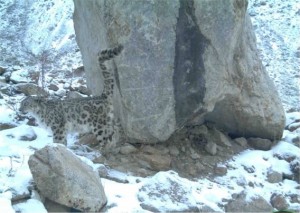
Mongolia, a snow leopard image on a trap camera. Photo by SLT and Panthera.

The Snow Leopard Trust has announced the Ministry of Geology and Mineral Resources have approved important snow leopard habitat in the Tost Mountains of southern Mongolia as official “Local Protected Area”. The SLT and the community lobbied hard in the face of many licenses for mining exploration in the area. It took three applications but now at the end of 2010 it’s good news for snow leopards. Congratulations to the Trust for its fine GPS radio collar research in Mongolia and now this important win to help save snow leopard habitat. A wonderful way to end 2010 for snow leopards in Mongolia.

Happy festive season to all snow leopards

Sibylle's Christmas tree - had to have at least one snow leopard on it :-)

Wishing all snow leopards and snow leopard conservationists and supporters everywhere a Happy Festive Season and may 2011 be a fabulous year for you all and our beautiful cats.

A very sleek Leon, father of cubs Tashi and Gobi at Melbourne Zoo. Photo by Glenn McColl.

Sometimes I think the snow leopards in our Australian zoos must get awfully confused with the southern hemisphere seasons but right on time, according to Adrian Howard (Howie), Senior Carnivore Keeper at Melbourne Zoo, our snow leopards are running around, scratching themselves up against tree trunks, posts and rocks to help shed thick woolly winter fur. Good thing they didn’t do it a few weeks ago, so far Melbourne has had one of the coldest summers ever. Howie says the cats adapt very well with the ability to grow and shed a lot of fur according to season.

Wild snow leopard sighted by KarmaQuest eco-tourists in 2007. Photo by Brian Keating, Calgary Zoo.

Wendy Lama from the eco tourism company KarmaQuest tells me there are still places available for the Winter 2011 snow leopard trek in Ladakh (India). I’ll be going along on this one and it’s a great opportunity to join a small group of hardy international travelers to search for snow leopards in this magnificent mountain habitat with Jigmet Dadul, the “top snow leopard tracker in Ladakh.”

Wendy says “KarmaQuest has an unbeatable track record of enabling snow leopard enthusiasts from around the world to see this elusive cat in the wild.  Every group has spotted a snow leopard as well as many varieties of bird and wildlife on this ten-day trek into Hemis National Park.

A Homestay house in Ladakh, India where local people welcome eco tourists and ear income in return for protecting snow leopards. Photo by Wendy Lama, KarmaQuest.

Your trip benefits snow leopard conservation with a tax-deductible donation to the Snow Leopard Conservancy and generates income for local villagers as an incentive to protect the snow leopard.

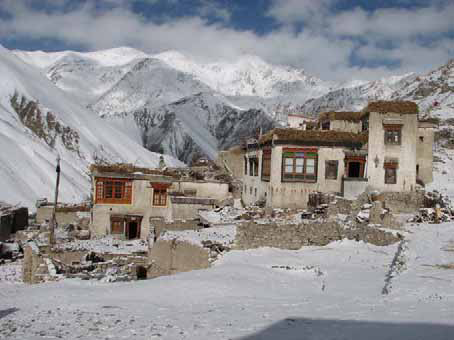
The experience of staying with Ladakhi families who share snow leopard habitat in traditional ‘homestays’ generates nearly as much positive visitor feedback as the snow leopard sightings. Guests enjoy the cozy ambiance; homegrown food cooked over elaborately decorated metal box stoves, and the chance to exchange stories and pictures with their remarkable hosts and hostesses.

Wendy has shared with us an excerpt from Brian and Dee Keating’s journal of their 2007 KarmaQuest Wintertime Quest for the Snow Leopard in Ladakh. (Brian is Director of Calgary Zoo.)

Rumbak village in snow leopard habitat in Ladakh, India. Photo by Brian Keating, Calgary Zoo.

“Today was a day to remember.  We saw the snow leopard, and not only saw it, but enjoyed its company for well over an hour. The day started off with coffee and tea in bed, delivered by happy staff.  We decided that the day’s strategy would be to stay around camp for the day, as the previous group’s cook had apparently seen a leopard twice, in the 6 days they were camped in this spot, when the group was out hiking for the day…

“After our first wash in over a week … (a bucket bath with some warm water!) we headed back to our valley rock lookout, sundowners and warm clothing packed and ready to go… Nurbu suddenly appeared below us on the trail, quickly informing us that there was a leopard sighting just 30 minutes down the trail, with the cat on a blue sheep kill yet!  We left all our stuff, and burst over the hill, and ran… Within 10 – 15 minutes, running almost the entire way, we were there, and so was the snow leopard!  He was lying quietly and patiently about 30 meters above his tangled kill, draped like a carpet of fur over the rock at the top of a small cliff.  His kill sat in a heap at the valley bottom like a pile of hairy burlap, with a magpie picking away at it, between two bushes within easy view of where we sat.

“The leopard watched with intent as all of us arrived in dribs and drabs.  A few of the group were already there when I got there, scopes, binoculars and cameras already in action.  The thick tail of the cat hung down long off the side of the slope, as he lay on a rock prominence, looking down at us with indifference… The fur on his face was stained red with blood, and the carcass looked seriously ravaged.  As we watched, the cat eventually settled completely, and dozed off, only opening his eyes now and again to check us out… The cat, an adult of approximately 6 to 7 years of age, eventually got up to move his position, but hardly a half a meter, and then flopped down again like a sack of heavy potatoes.  He blended in immediately when he laid down- his camouflage was simply perfect…

“Needless to say we were one happy bunch at dinner, with the chatter increasing in pitch as the shared Scotch had its warming effect.”

For information or to join this trip contact KarmaQuest at KarmaQuest@earthlink.net. Deadline for signing up is December 31, 2010.  Check their website.

Taronga Zoo in Sydney has released a video of the stem cell therapy operation on Kamala, their female snow leopard with the knee arthritis. It’s a fascinating insight into this new technology and we hope Kamala’s knee is a lot better after this. Story here.

Jennifer Castner, Director Altai project. Photo Altai Project.

As a result of my trip to the Altai Mountains in southern Russia this year, I got to know Jennifer Castner, Director of the Altai Project (TAP). Jenn, who lives in California, is fluent in Russian and passionate about this part of Russia. She’s lived and studied in Moscow and worked in Kiev and has traveled extensively in Siberia and the Russian Far East.  Jenn kindly accepted my invitation to be “Saving Snow Leopards Blog” first Guest Blogger and we warmly welcome her.

Altai mountains snow leopard habitat

Snow Leopard in Altai Sayan. Photo D Tseveenravdan WWF Mongolia.

“Sibylle invited me to talk about The Altai Project’s work and I particularly wanted to share information about a really exciting new part of our work, The Land of the Snow Leopard Project which will protect the northernmost population of snow leopards in the Altai Mountains in southern Russia.

First I’d like to say a bit about the Altai Project.  Our mission is to protect the natural and cultural heritage of Altai – this is a uniquely diverse, mountainous region of southern Siberia. Our goals are nature conservation, promoting renewable energy and environmentally sustainable design, and supporting indigenous organizations in their efforts to restore and protect their traditional lands and life ways.

Stunning Altai Mountains, snow leopard habitat in southern Russia. Photo by Sibylle

Some of the things we work on are assisting our Altai partners to strengthen conservation and anti-poaching measures, manage tourism effectively, and create strategies for long-term protection of sensitive areas. At a time when potentially destructive development projects are being proposed such as dams, roads, and pipelines, we support local campaigns against them. Also we do training on renewable energy technologies, energy efficient design, and the use of natural building materials.

But getting back to snow leopards. In the last year, TAP has joined a number of other groups (Fund for Sustainable Development of Altai, Arkhar NGO, Altai Assistance Project, Snow Leopard Conservancy, UNDP/GEF, and WWF-Russia) to protect snow leopards in the region. Altai and Tuva Republics are home to the northernmost population of snow leopard in the world, and while this snow leopard habitat is quite fragmented and at-risk, there’s still a sizable population of the animals in the region.

The Land of the Snow Leopard collaboration is a multi-faceted project. Its objectives are to conduct scientifically valid camera-trap monitoring of snow leopards in the Argut Valley in Altai and also to engage the local population in new ecotours, wildlife monitoring, souvenir production, and other tourism services. We hope this combination of science and sustainable community development will rekindle the connection of indigenous Altaians to their landscape, and in particular, to teach Altaians to value the importance of protecting snow leopards.

You can learn more about this exciting new snow leopard project and TAP’s work, by joining our Facebook cause and visiting our website.”

Thanks to Sally Walker of Zoo Outreach Organisation who has a close association with Kabul Zoo for sending this email to “Saving Snow Leopard” Blog about the AFP (Agence France Presse) article on the director of the Zoo, Aziz Gul Saqeb’s trip to India to get animals for the zoo, including a snow leopard. We posted the AFP article a few days ago but Sally maintains the report was incorrect. It’s good to hear that Kabul Zoo staff are keen to make proper improvements before they take on animals there.

Sally writes ”Aziz and his colleagues were invited to India and Nepal only for the purpose of training which they participated in Nepal and then for a tour (again for purpose of training) of good zoos nearby Delhi. I praise all efforts of the staff of the Kabul Zoo, the Kabul Municipality of Kabul for their very hard work and also the North Carolina Zoo and its many partners for raising funds to start the restoration of Kabul Zoo after its virtual destruction by war. Aziz did not state they had come to collect animals, that was a presumption of the AFP reporter.

“So far as I know the administration and staff of the Kabul zoo are working hard to bring it up to a standard that would permit them to interact with zoos in the rest of the world as equals and thereby participate in some conservation activities (already they are immersed in conservation education as I described in the article), then, perhaps including obtaining other animals. I’d like to clarify, however, that zoos today (good zoos, at least) are very careful about obtaining from or sparing animals to other zoos. The organized zoo community (the good zoos) has thus far been very helpful to Kabul Zoo with funds to rebuild and for training. Aziz, himself, protested the claim stating (and this is a real quote from the man) “we are not ready!”

“The Kabul Zoo staff is, however, in a whirlwind of activity to rebuild the zoo as a better zoo than ever. In its day, the Kabul Zoo was of international standard as a joint project of the Kabul University, some external professors and Kabulians. Time and particularly the war took its tool on the zoo but and it is now on a very positive course of action to restore itself even better than before and join the global zoo community as a conservation partner. The five persons who came (Aziz, Director, Amadhi, Advisor to Mayor of Kabul, Rohella, Director of Culture, Najib, Education Officer and Abdul, Veterinary Officer) are all very keen to have a zoo that all the zoos and NGOs who have assisted them will also be proud of… that is their priority before they bring any animals.”

Sally Walker, founder of Zoo Outreach. Photo Zoo Outreach

I see from a news report today Kabul Zoo officials are keen to restock their Zoo after severe damage over the last 20 years of conflict in Afghanistan. I wondered if staff and the facility are ready to take on the responsibility and safety and well being of new animals? Certainly for the troubled people of the country a well run and humane zoo would be a boost to confidence and education.

AFP reports Kabul zoo director, Aziz Gul Saqeb, who is leading a zoo team to India said “”Afghanistan wants an elephant, a leopard and a snow leopard from India because at present it does not have these animals.

Indian authorities have agreed to help us regarding the upkeep of the elephant once it is transported to Kabul,” he said after inspecting animals in a state-run zoo in the northern Indian town of Kanpur.

Snow leopard habitat in Afghanistan

Snow leopard photo captured in Afghanistan in 2009 by WCS.

But is the Zoo ready to house new animals like a snow leopard? Sally Walker, a wildlife and zoo conservationist and founder of the Zoo Outreach Organisation recently visited Kabul Zoo and reported on her efforts and those of zoos in the west, USAID and Wildlife Conservation Society to help with education of local staff and rehabilitation of the zoo facilities. According to Sally’s report improvements have been made, so perhaps the time has come for a few new animals to be given a home there.

Importantly the Zoo is educating its visitors – adults and school kids alike, about animal treatment and conservation, as sadly there’s been a history of animal taunting in the past. With the support of other agencies in Asia and the rest of the world, it would be wonderful to see the benefits that a good zoo can bring to the people of a country. A professionally run zoo could improve conservation of Afghan wildlife as well. Snow leopards are highly endangered in Afghanistan’s snow leopard habitat and the zoo could play an active part in educating the youth of the country to help protect the cats.