≡ Menu
Shimbu at Melbourne Zoo

This beautiful photo of Shimbu was taken by one of her keenest admirers, Glenn McColl, who regularly photographs the snow leopards at Melbourne Zoo. It's a lovely photo that all who knew Shimmie will treasure.

Sad news recently from the team at Melbourne Zoo that Shimbu, our lovely 21 year old female snow leopard had passed away. All of us snow leopard sponsors knew she wouldn’t be with us much longer, but still it was a sad day for us. Shimmie, as she was called by keepers and visitors, had been in the Zoo for many years. Until about 18 months ago, she shared an enclosure with Gregor, who was also 21 years old when he died.

For Shimmie and Gregor both to reach such a wonderful age was a great success for the Zoo staff, the two snow leopards were certainly adored and looked after. I know one of the keepers at least, shed a tear when he said goodbye to her. “She’s been here as long as I have, she was a great girl” said Adrian Howard.

Read more about snow leopards at Melbourne Zoo, Australia.

Dr Tom McCarthy

Dr Tom McCarthy and snow leopard Aztai in Mongolia. Photo Panthera/SLT

This week I caught up with Dr Tom McCarthy, the Snow Leopard program director for Panthera. Many of you will know Tom’s work in Mongolia, the first long term study of snow leopards in their wild habitat, which is having amazing success with the number of cats it is tracking in the mountains of the South Gobi.

I met up with Tom for lunch at the fabulous Pike Place Market in Seattle. This is one of Tom’s favourite places in his home town. It was a busy day, and lots of locals and tourists alike were watching the guys selling fish entertain the crowd by throwing huge salmon at each other. I love farmers markets and Tom showed me around the fish stalls with the largest crabs (jumbo King Alaskan) and salmon I’ve ever seen in my life. There were beautiful vegetable stalls with exotic flower-like mushrooms and huge containers of fat raspberries and strawberries. Members of Seattle’s Hmong community sold buckets of beautiful flowers, the dahlias which are now in season

Over lunch we discussed the future of snow leopards and Tom’s work. “I started my conservation career studying brown bears in Alaska in the early 1980’s. I had to capture bears that were causing problems in towns and then release them elsewhere. I knew I’d been doing that work too long when one morning my two young sons ran out of the house to the car and passed three cages with bears in them without even batting an eyelid.”

Pike Place market. Seattle's Hmong community grow and sell these magnificent dahlias.

In 1992 he worked with Dr George Schaller on a snow leopard project in Mongolia and was hooked. “George always said that we had to do long term work on snow leopards to get the data we needed. We knew so little about these cats.  A long term project like ten years was needed and now, luckily, that’s what we’ve got“

Tom’s work in Mongolia formed the basis for his Ph.D. and with this work he became the first biologist to use radio-collars to study snow leopards.

He’s delighted with the success of the work in Mongolia and credits his student, Orjan from Sweden with much of its success. “Orjan’s a natural for this work. It’s hard, it’s tough but he’s doing so well. He’s going to have captured more snow leopards than me,” he laughs. “In fact with three more cats, which I know he’ll get, this study will have collared more cats than all other previous studies combined.” Tom is justifiably proud of this landmark study.

The largest crabs I have ever seen. Pike Place market, Seattle

“The information we get from GPS-enabled collars gives us more information about snow leopard behavious, all of which we need to better protect them. We’ve taken thousands of pictures with digital camera traps too. And we can identify individual cats by their rosette patterns; each one is unique when you know what to look for.”

Tom spends a lot of time in the field and I was very lucky to catch him between trips to China, Mongolia and Tajikistan. He also spends time in Manhattan, Panthera’s headquarters. Panthera is the cat conservation nonprofit founded by Thomas Kaplan. “Thomas is an amazing guy. He and his wife founded Panthera a few years ago, They donated a lot of money because they asked themselves, what’s it going to take to save tigers, to save beautiful endangered cats like snow leopards? They are so committed and hope more people will join them. “

We talked a bit about how I got interested in snow leopards and I found out that one of the people responsible for me getting involved back in the 1990’s when I did an Earthwatch project , is  Joe Fox,  a good friend of Tom’s. The snow leopard world may be a small one but there are heaps of people dedicating their lives to saving these cats in the wild and Tom is one whose work will have major implications. It was a pleasure and a privilege to meet him.

Follow Tom’s remarkable long term snow leopard project in Mongolia on the Snow Leopard Trust blog.

Nadia with Rodney Jackson of the Snow Loepard Conservancy

Nadia with Rodney Jackson at the Wildlife Conservation Network Day. Photo by Sibylle.

“People in the cities in Mongolia don’t even know that we have snow leopards. I’d like to work with them as well as the village communities,” Nadia (Tserennadmid) Mijiddorj told me recently. She is a vibrant young woman determined to help save snow leopards in her country.

I met her at the San Francisco Wildlife Conservation Day where she told me her story. “My father is a biologist and studies the Gobi bear in the Great Gobi National Park near Bayantooroi, Mongolia. As a child he took me into the field with him. That sparked my interest in nature and the environment.

“When I was in the 5th grade I saw a glimpse of my first snow leopard. Then later I met Tom McCarthy (who now runs the long term snow leopard project in Mongolia). I used to hang out with his kids and he inspired me to understand how important the snow leopard is to our country.”

Nadia works with Snow Leopard Enterprises, run by the Snow Leopard Trust. About 300 women in 20 communities have received training and materials to make beautiful traditional handcrafts like rugs and clothing. The handcrafts are sold by the Trust around the world and all the income goes back to the women and their communities.

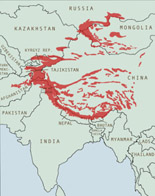
Mongolia snow leopard habitat

Mongolia - stunning landscapes and snow leopard habitat. Photo Wikipedia

“We visit each community every year and work with the women and talk to the kids. The kids learn from their mums, about the value of animals and conservation. I’d really like to work more with children; they can be a powerful message to the rest of the community too.”

As part of her work in these communities Nadia has developed a snow leopard teaching tool for teachers providing basic information in Mongolian. But for now she’s studying for her future work with snow leopards. She recently got a Wildlife Conservation Network scholarship and is studying for her Masters in Wildlife Sciences in India. “I got it with the help of Rodney Jackson, so that was really great.”

It was a real privilege to meet Nadia. I’m sure with her determination and learning she’s going to play an important role in the future of snow leopard conservation in Mongolia.

Rodney Jackson Snow Leopard Conservancy

Rodney and Darla with their car, registration plate “Unica”, latin for snow leopard.

I’ve been so lucky to spend the last two days with snow leopard ‘power couple’ Rodney Jackson and Darla Hillard at their home and the home of the Snow Leopard Conservancy in Sonoma, California.

Rodney and Darla are just fabulous – charming, friendly and incredibly hardworking.  They’ve been studying snow leopards for thirty years.

“In that time I’ve seen thirty cats” laughed Rodney. “One for each year!”

Yes, one for each year of walking through boot leather in dangerous high altitudes, gasping for breath in thin air, eating meager rations and sleeping in freezing tents, I thought with admiration.

During those 30 years Darla and Rodney raised money for vital research projects and established ground breaking community conservation efforts in India and 5 other countries to help villagers and snow leopards live in harmony. They would have saved countless cats’ lives in that time by changing villagers attitudes and behavior.

Sibylle and Rodney Jackson fromSnow Leopard Conservancy

Sibylle with Rodney Jackson at his home and the office of Snow Leopard Conservancy in Sonoma, California

For two days I hung out with Darla and Rodney, talking almost nonstop about their work and the driving need to continue. “Sometimes I feel time is running out, but I also know if we preserve habitat in the right places the cats can come back” said Rodney.

Darla is the author of ‘Vanishing Tracks: Four Years Among the Snow Leopards of Nepal’ about their work in that country. She is a powerhouse of energy. She  promotes the Conservancy’s work, publishes books and other materials, engages supporters, and more. She loves the arts and crafts of the people who live in snow leopard territory and the house is full of paintings and textiles with snow leopard motifs. “Count how many snow leopards you can see in this house” she laughs.

While I was with Rodney and Darla a huge box of camera traps arrived in a Fedex parcel. We unpacked them and one was tested that night – on Smudge the cat, as she went in and out of her cat door. The camera trap worked, not only did we see Smudge coming and going but also a cheeky raccoon trying to get into the kitchen to eat her leftover food.

Rodney pioneered the use of non-invasive, remote camera traps for photographically “capturing” snow leopards and using the data to identify resident cats and to track them over time. He’s become such an authority that he’s been invited to Saudi Arabia next week to train people in the use of the camera traps. “We’re hoping to get film of the critically endangered Arabian leopard which hasn’t been seen in 8 years.”

Snow leopard camera trap

The camouflaged camera trap on the left. The small black reader unit on the right allows researchers to see the pictures immediately in the field rather than waiting to download them later.

Consulting work like this just fuels Rodneys motivation to continue work on the magical snow leopards. He recently made contact in the Altai Mountains in Russia with people honoring the cats as sacred. “Now Darla and I want to explore merging the world of facts with the spirit world, as well as continuing our science.”

Regular readers of the this blog will know that Rodney was again recognized by the prestigious wildlife conservation prize, the Indianapolis Prize, for his incredible snow leopard conservation work when he was nominated as a finalist this year.

He and Darla are going to be busy for a long time time. But I knew too, as I farewelled them, that if snow leopards do continue to survive in the wild long term, the cats (and the rest of the world) can give a big thanks to Rodney and Darla.

Blog readers can support Rodney and Darla’s fabulous work by learning more about it, buying books and other items and donating to their community and research projects on their website.

This famous photo is one of Rodney’s from a camera trap. It’s become one of the world’s iconic wild snow leopard photos.

Charles Knowles, founder of WCN

Charles Knowles, founder of WCN opening Conservation Day. Photo by Sibylle

“You can’t have cats without a lot of cat food” is how Dr Ullas Karanth from Wildlife Conservation Society India spoke about his work saving tigers in India. “Fifty years ago I thought there was no hope for tigers but with so much work being successful I’m quietly optimistic. But conservation is long term, you can’t have quick deals.”

Yesterday I heard an engaging Dr Karanth speaking at the  9th Annual Wildlife Conservation run by Wildlife Conservation Network (WCN) in San Francisco. About 700 people came along to hear twenty of the world’s top wildlife conservationists speak passionately about their work with endangered animals and the communities sharing their habitat.

Dr Karanth’s stories gave some insight into the challenges researchers faced working with wild animals. “Yes we have radio telemetry, wonderful technology and its easy to put on a collar, but how do you catch the damn thing? Also tracking tiger is horribly boring because you don’t see them very often. You have to follow their Pee-mails, as I call them, the scent markings and the poops.”

Founder Charles Knowles placed the event in context when he said “we are in the middle of a mass extinction rate in our history. Today one out of 1000 species goes extinct every year. While it is truly a catastrophe we believe there is hope and by working with local communities and the world’s best conservation agencies we can make a difference.”

Hundreds of people listening to Rodney Jackson

Hundreds of people at Rodney Jackson's snow leopard conservation session. Photo by Sibylle

Knowles founded WCN in 2002 and since then they have worked in 30 countries. “We have raised $15m and I want to tell you 93% of that goes directly into the field.”

Actor Edward Norton, spoke about his involvement with a Massai community project and his dissapointment the US has not signed the UN Convention on Biodiversity. “Although I’m talking to you about the political level, my passion is at the community level. The most effective work is small projects making a difference on the ground.”

This was supported by the many speakers telling stories of their work with local communities where support and education has helped change attitudes towards wild animals from being pests to being a appreciated and an asset.

Hundreds of wildlife supporters heard speakers like Rodney Jackson from the Snow Leopard Conservancy, Laurie Marker from Cheetah Conservation Fund,  Iain Douglas – Hamilton from Save the Elephants and more.  All had stories like working with hunters who are now conservationists, supporting women through handicraft sales and helping  villagers increase income with eco tourism.  Rodney Jackson quoted one villager in Ladakh India, “the snow leopard has gone from being a pest to becoming the necklace around around our mountains” through the work of the Snow Leopard Conservancy.

Snow Leopard Conservancy stand at Conservation Day

Lisa from the Snow Leopard Conservancy selling products and talking about projects

Exhibitors from lots of other groups working with wolves, Saiga antelope, African Dogs, Pandas, Orangutans and so many more shared stories at their tables and sold beautiful craft and art works by the communities they work with. Tables were overflowing with stuffed toy animals, handstiched carpets, cushion covers, beautiful beaded braclets and more.

There were also harrowing news stories of animal losses that could be avoided. All the more sad when we think that often it only takes as little as $5 a day to make the difference between poverty and a good life for a villager and the life and death of the animals. But we heard so many success stories of collaborative work between communities and these agencies that it was truly an inspiring day.

Harrison Ford getting chest waved for the planet.

Harrison Ford getting chest waved for sake of the planet. From video ad by Conservation International.

I know Harrison Ford supports wildlife conservation but I didn’t realise the lengths he goes to. He did a TV ad for WildAid – “Don’t buy it” – where he says to a Tiger pal, “If some one tells you don’t worry about the slaughter of tigers and elephants, there are lots of them out there….don’t buy it. Never buy illegal wildlife products. When the buying stops, the killing stops too.”
It’s a good ad with a charming Harrison and a charming tiger pal but I noticed the You Tube video only got 5300 views in two years. But the conservation.org video he did for the campaign “Lost there, felt here” got over 290,000.
What’s the difference? The “there’ in the ‘Lost there’ is rainforest deforestation in the Amazon and the “here’ in “felt here” is Harrison’s hairy chest being violently dewaxed. Ouch! Goes to show we love a message with humour. The analogy is made between the forest and Harrison’s chest hair. His pain shows us that in both spoiling and saving the planet, everything is interrelated. Snow leopards everywhere thank you, Harrison. Check out the video here.

Rinchen's story

Rinchen Wangchuk's snow leopard conservation story. Photo SLC

What an inspiration Rinchen Wangchuk is! He works with the Snow Leopard Conservancy (SLC) India in the remote and magical Himalayan region of Ladakh. This video made by Mateo and David Willis shows how Rinchen and the SLC encourage local villagers to conserve the snow leopard. They’ve built snow leopard proof fences for the livestock and helped villagers get income from the trekkers that come to see the land of the snow leopard by providing Homestay accommodation. Rinchen says “the people used to see the cat as a pest. Now you see the sign in Rumbak village that says “welcome to the snow leopard capital of the world.”

Rinchen Wangchuk Interview from Snow Leopard Conservancy on Vimeo.

Snow Leopard Trust Mongolia project

A map showing the movement of the GPS collared snow leopards in the Snow Leopard Trust's Mongolia project. Photo SLT / Panthera. See more on SLT Blog.

The amazingly successful Snow Leopard Trust GPS collar project in Mongolia has another female to follow, joining young Zaraa. So far all the other cats that have been collared are males. This female is 36 kg and 115 cm in body length with a lovely 98 cm long tail and believed to be between 4 and 6 years old.

Make sure you follow this wonderful project tracking the footsteps of  this exclusive group of wild snow leopards over vast territory in the remote mountain snow leopard habitat of Mongolia. This project has been going for two years and continues to collect important snow leopard facts to help with community conservation programs of benefit to the local people as well as the long term survival of the cats.  Read all about it on the Trust’s Blog.

Bryan Christy. Photo by Michael Bryant.

Bryan Christy of National Geographic investigates illegal wildlife smuggling. Photo by Michael Bryant.

If snow leopards and other endangered wildlife protection is going to be meaningful then prosecution for offenders is vital. Good news today that Anson Wong from Penang in Malaysia, dubbed “ the world’s most notorious wildlife dealer, has been sentenced to prison after a lock on his suitcase containing legally protected snakes broke on an airport conveyor belt.

Wong has smuggled many species of critically endangered wildlife including snow leopard pelts.

National Geographic’s Bryan Christy wrote an expose of Wong’s activities in January this year which helped spur the Malaysian government to action.

Anson Wong

Anson Wong sentenced for wildlife smuggling.

Snow Leopard Blog was interviewed on Southern FM.I’ve been offline on this blog for over week but still busy with snow leopards. A few  opportunities for spreading the word about the cats arose recently. I’ve was interviewed on Southern FM Radio and talked at a Greensborough Community event close to my home. In both cases it was great to see the number of people who wanted to be informed and cared about endangered wildlife in general but also they were fascinated to learn about the snow leopards. It’s always a treat to see the animal anew through some one else’s eyes when they see a picture for the first time and learn about the amazing places it lives.