≡ Menu

Beautiful rare wild snow leopard seen by KarmaQuest / Snow Leopard Conservancy trek participants in northern India during a previous winter trek. Photo by Brian Keating.

there’s still a bit of time to sign up for the Snow Leopard Conservancy and KarmaQuest trek in search of wild snow leopards in the Himalayas. This is such an exciting project (a two week trek in February 2010 to search for wild snow leopards and their prey). The previous winter teams have all seen wild snow leopards ….amazing…you all know that this is a rare thing indeed, rarer than the proverbial hen’s teeth.

check out the project info here.

This would have to be one of the most amazing wildlife experiences ever…truly the chance of a lifetime!

GPS stalking of blue sheep - snow leopard prey.

GPS stalking of blue sheep - snow leopard prey. Photo Massey university, New Zealand.

Researchers at New Zealand’s Massey University Institute of Natural Sciences will be placing global positioning satellite (GPS) collars on Bharal, the blue sheep of the Himalayas in the Annapurna region of Nepal. They are called blue sheep as their fur is brown to blue. They are also very distinctive with tightly curled horns.

The Bharal is one of the major prey species for snow leopards and the region is remote and at very high altitudes so in the past its been almost impossible to study these sheep. Questions the researchers will want to answer include are there enough of these sheep to support the snow leopard populations?

Project Leader Achyut Aryal from Nepal says “this region is one of the last refuges for species such as snow leopards, brown bear, wolf, lynx and, importantly, their keystone prey species, the blue sheep.”

The researchers will track 10 sheep for two years across the high mountains to learn their grazing habits, movements and population numbers.  Another innovation of the project is to involve New Zealand school children who’ll be able to track the movements of the sheep on computers in their classrooms.

More on this story here.

More facts on blue sheep here.

Oruktam slippers from Snow Leopard Trust shop.

Very cute and comfy Oruktam slippers from Snow Leopard Trust shop. These and more beautiful items makes lovely Christmas presents.

It’s that time of year again and I’d like to remind you all that the Snow Leopard Trust shop has a wonderful collection of crafts made by people in Mongolia through the Snow Leopard Enterprise program.  I mention this at least a few times a year so bear with me if you know about it already:-)

This is so worthwhile…you get a lovely gift, either for yourself or to give a loved one, the people who made the item get financial support and the snow leopards that live in the remote mountains are supported by the villagers and the herding communities…talk about the old win/win!

As for me, I’ve got my eye on these gorgeous Oruktan slippers – aren’t they cute? Check out the SLT Shop here.

There have been many successful snow leopard cub births in zoos across the world this year (including our own Melbourne Zoo) and I must say I sometimes forget how fragile the breeding programs can be. Sadly two cubs born in May this year at the Welsh Mountain Zoo have died recently after coming down with feline cowpox. This cowpox is carried by small mammals like voles and wild mice and common in domestic cats in the UK. More from the BBC here.

Hopefully zoo staff and vets around the world can learn from these sad deaths and it won’t happen again. The Zoo says its hopes the snow leopard parents, mother Otila and her mate Szechuan will breed again next year.


Tracking snow leopards in Mongolia. Map from Snow Leopard Trust blog.

Tracking snow leopards in Mongolia. The different colors represent the different snow leopards. Map from Snow Leopard Trust blog.

The Snow Leopard Trust’s Mongolia project is going full steam ahead and the team is getting heaps of data on the cats they are watching – check out the blog for the movements of Saikhan, Shonkhor, Aztai, Itgel and Tsagaan in the Gobi desert and the Tost and Toson Bumba Mountains of Mongolia. Isn’t technology wonderful? Just to think we can watch where these cats are moving across remote and mountainous region – fantastic. Not only that, but by seeing a cat stay in one place for a few days the researchers know the animal has made a kill and is eating.

Check the SLT blog for regular exciting updates. Learn more detail about all the cats that have been radio collared on the blog About the Cats Page.

Bayara. Photo from Panthera website.

Bayara. Photo from Panthera website.

 Here’s the next recipe to celebrate the snow leopard blog’s first birthday. I’m covering a recipe from each of the 12 snow leopard range countries. I haven’t been to Mongolia so I recently asked Bayarjargal (Bayara) Agvaantseren the Executive Director and founder of the Snow Leopard Conservation Foundation (SLCF) in Mongolia for a suggested recipe. I’ve wanted to blog about Bayara anyway as she recently won the $25,000 Rabinowitz-Kaplan Prize for the Next Generation in Wild Cat Conservation. The prize goes to “a special individual who has already made a significant contribution to conserving wild cats.” 

SLE rug from mongolia. Photo by Sibylle.

SLE rug from Mongolia. Photo by Sibylle.

I’m a big fan of Bayara’s as she is the one who started the community-based conservation program now known as Snow Leopard Enterprises (SLE) in Mongolia. SLE supports the semi-nomadic herders in Mongolia, helping them increase their income through handicraft production in exchange for their tolerance of snow leopards. I’ve blogged about the beautiful crafts these people make before and indeed have a number of their rugs hanging on my study wall. They are sold here through the Snow Leopard Trust website. I’ll give another plug – they make wonderful Christmas presents and it’s definitely that time of year to to think about presents. 

Bayara began her career in snow leopard conservation as a member with Tom McCarthy’s (from the Snow Leopard Trust) snow leopard research team. She worked as a translator with herders and helps to understand human-snow leopard conflicts. She’s also been key in formulating Mongolia’s National Snow Leopard Policy and most recently played a key role in initiating the first ever long-term ecological study of snow leopards in South Gobi, Mongolia. 

See more about the prize on the Panthera website.

Mongolian steamed Buuz. Photo from Mongolfood website.

Mongolian steamed Buuz. Photo from Mongolfood website.

Bayara’s recipe is for Buuz – which is dough filled with traditionally lamb in Mongolia, but can be filled with chicken, beef or vegetables and then steamed. While I haven’t ever made them with lamb (not one of my favourites I must say) I have made them with chicken – absolutely delicious. The secret is all in the steaming method and making sure they don’t stick to the steamer which for some reason mine do all the time. Bayara suggests this recipe here.

 I’ve created a page for all the Snow Leopard blog birthday recipes together – see it here.

EIA logoThe Environmental Investigation Agency (EIA) recently conducted undercover investigations into the illegal big cat skin and bone trade in China and found it easy to get tiger, snow leopard and other leopard skins.

‘China has really run out of excuses. They tell us they are doing their best, but we have been warning them about this for years and there are still huge gaps in their enforcement effort. If they can put a man into space, they can do more to save the wild tiger’, said Debbie Banks, Lead Campaigner at the Environmental Investigation Agency.

The EIA team did three weeks of undecover work during July and August this year and captured the illegal trade on film using a hidden camera while they enquired about animal skins on sale. During this time they were offered 11 snow leopard skins as well as many other cat parts. In a sad video the sellers show skins from Nepal, Mongolia, Pakistan and Afghanistan. “We can get you anything you want,” they say.

While buying and selling any big cat parts is definitely illegal in China it seems a lot of this activity is actually not too difficult to find in many parts of China including Tibet. Researchers found local officials in the vicinity of the shops trading the illegal goods and people at a horse festival in Tibet openly wearing skins in view of local authorities.

The EIA believes that the skins are less in demand from Tibetans themselves these days – perhaps the plea from the Dalai Lama in 2006 for Tibetans to stop wearing skins of endangered animals has worked. But demand from middle class and wealthy Chinese business people, army personell and government officials has not dropped. The skins are bought for home décor or clothing in Tibet and China, costing huge amounts of money that more people can now afford. A snow leopard skins costs around $US2200.

According to the EIA the illegal trade is organised by extensive criminal networks. ‘There is some law enforcement in China, in a few regions, but there are whole swathes of the country where this trade is allowed to carry on with almost no fear of detection. A mixture of corruption and apathy is helping to decimate endangered species and is indicative of what is happening to the wider environment,’ said Alasdair Cameron of EIA.

The EIA has provided the Chinese government with this sort of evidence for over 5 years but there appears so much localised corruption that little has changed.

The Environmental Investigation Agency is a UK-based Non Government Organisation that investigates and campaigns against environmental crime including illegal wildlife trade.

See BBC story and video here.

India Today imageSee interview with Debbie Banks from India Today TV.

Jigmet Dadul, best snow leopard tracker in Ladakh. Photo kind permission of Snow Leopard Conservancy.

Jigmet Dadul, best snow leopard tracker in Ladakh. Photo kind permission of Snow Leopard Conservancy.

In 1997 I trekked in Hemis National Park, in Ladakh, in the northern Indian Himalayas. Along with 8 other volunteers and two snow leopard researchers (Dr Joe Fox and Dr Som Ale) we searched for scrapes, scat and any markings that told us that snow leopards still survived here in these awesome mountains after decades of being hunted for fur and body parts. We found a few signs but never saw the elusive cat. Not surprising as until recently even researchers working for decades in the wild seldom spotted these cats.
At that time the local villagers felt snow leopards were the enemy – the cats often killed domestic livestock if they weren’t able to get wild prey. Trekkers passing through these mountains had no idea that an animal called the snow leopard even existed let alone that this was one of its native habitats. There was huge uncertainty about their future. Could the beautiful snow leopard ever gain a claw hold for survival in these spectacular mountains?

But next February, in 2010 I’ll be there again…this time 12 years older, a bit rounder in the middle and in the dead of winter…yikes…

12 years later so much has changed. Thanks to the Snow Leopard Conservancy (SLC) and other conservation groups the villagers today supplement their agricultural-based livelihoods by helping keep the snow leopard alive.
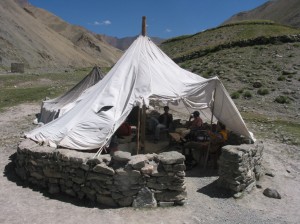
 

Cafe stop high on the trek. Parachute Cafe. Photo by kind permission of KarmaQuest.

Cafe stop high on the trek. Parachute Cafe. Photo by kind permission of KarmaQuest.

Villagers offer home stay where trekkers use traditional accommodation, eat local food and learn about the Ladakh way of life. Village women also have businesses tending parachute cafes for thirsty trekkers on high mountain trails. *

KarmaQuest Travel, a US-based company has been running winter snow leopard tracking trips with one of the world’s most renowned snow leopard researchers, Dr Rodney Jackson, Director of the Snow Leopard Conservancy to this part of the world since 2005. And why go in winter? Well winter is the time snow leopards come down to lower altitude and offers the best chance of seeing these rare and endangered cats in the wild.

The other trip members and I will join the SLC-India staff on their winter monitoring activities, studying the snow leopard when it descends from the snowy mountaintops in search of food, studying prey species and the snow leopard’s habitat.


Solar cooking technology. Indian Himalayas. Photo by kind permission of Snow Leopard Conservancy.

Solar cooking technology. Indian Himalayas. Photo by kind permission of Snow Leopard Conservancy.

No doubt we’ll all be thinking about the 2007 winter group that was lucky enough to observe a snow leopard eating its kill for more than an hour. Thus far, KarmaQuest group members have seen a snow leopard every year! Considering that less than 100 Westerners had seen a snow leopard in the wild before 2005, this is a phenomenal rate of success!  And all thanks to the years of study, tracking and conservation efforts by Dr. Jackson and his Ladakhi team, of which Jigmet Dadul – reputed to be the ‘best snow leopard tracker in Ladakh’– will be there to help us beat the odds.

These treks go most years. It is a fantastic opportunity. Check out the website from the folks over atKarmaQuest  and talk to Wendy Lama, an Ecotourism Specialistwho has been travelling and working in this part of the world for many years. This is the trek of a lifetime, it would be wonderful if I saw you there too.


*Parachute cafes – my other half wondered “are they cafes where adventure parachutists drop in to for a tea or latte?” No….they portable cafés made out of – you guessed it – parachute material.

Our thick fur doesn't like global warming.

Our thick fur doesn't like global warming.

This blog supports “Blog Action Day” today, October 15th. It’s a global annual event uniting thousands of bloggers when today we post about climate change and global warming. What a great idea, to be linked to thousands of like minded people helping to bring ideas and action and learning about climate change across the globe. We are all in this together.

So just for the record. Snow leopards like the snow, they like the cold. That’s why they are snow leopards. They like it very cold up in their mountain habitats. They don’t have that thick fur, huge warm tail so they can spend time in the tropics. They are not happy with global warming. There is a lot of scientific evidence to show that the average temperature of the Himalayas is actually rising faster than many other parts of our earth. See The Age (Melbourne) article on receding glaciers in the Himalayas.

We CAN take action people. We CAN all do something. Turn the aircon off, eat less meat, drive a smaller car, drive less……it’s all doable. Think of those beautiful snow leopards and let them enjoy snow and cold for more centuries to come. Support Blog Action Day – 12,017 blogs – 155 countries – 17,875,239 readers.

Stop the presses! Gordon Brown, PM of the United Kingdom has joined the bloggers on this today and Greenpeace and Oxfam have also taken part. CNN has just done a feature story on Blog Action Day and not surprisingly Blog Action Day is the top Google search.

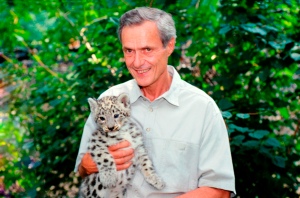
George Schaller with snow leopard cub. Photo by WCS.

George Schaller with snow leopard cub. Photo by WCS.

I’ve mentioned George Schaller many times on this blog – Ok, he’s my hero. He’s probably done more for snow leopard conservation than anyone else on the planet. George won the Indianapolis Prize in 2008 and during 2009 used the money  for snow leopard activities in China. Currently Vice President of Panthera and Senior Conservationist for the Wildlife Conservation Society, George visited China’s Qinghai Province in May 2009 to  help initiate snow leopard programs supported by Panthera, an organization whose mission is to conserve the world’s 36 species of wild cats.

The Indianapolis Prize has just reported on George’s work there. Most of his work was conducted in the Sanjiangyuan Reserve (“Source of Three Rivers Reserve”—Yellow, Yangtze, Mekong ), which covers nearly 58,000 square miles, primarily at elevations above 11,800 feet.  In addition to assessing snow leopard presence and threats, the trip provided Peking University Ph.D. student Li Juan with the training she needs to start a snow leopard study this year. George and Juan traveled more than 2,600 miles to evaluate potential study areas for the student’s research project, and George will continue to mentor Juan as she pursues her Ph.D.

While in Asia, George met with representatives from the Snow Leopard Trust and Shan Shui, one of the leading conservation organizations in China , to create a new collaborative snow leopard research and conservation program. These organizations signed a long-term agreement that will bring much needed expertise and funding to efforts to save snow leopards in China , where as much as 50 percent of the remaining wild population exists.

“George Schaller’s extensive research, fieldwork and training have been essential to saving snow leopards in regions of China ,” said Tom McCarthy , Director of Snow Leopard Programs for Panthera. “I can’t think of a better use of the Indianapolis Prize funds than teaching future generations the urgency and necessity of wildlife conservation.”

“The important aspects of this project for me,” added Michael Crowther, president and CEO of the Indianapolis Zoo, “are its collaborative and long-term nature.  It’s George’s innate ability to bring people together and to forge alliances that overcome the short-term problems of political or geographic conflicts in order to serve the greater good that makes him a hero for me, and for the world.  It seems he has again worked his magic for the snow leopards.”