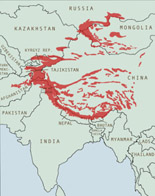
“It was the shortest seven minutes of my life” Aishwarya Maheshwari, a researcher with WWF India (a wildlife protection group) said after making the first confirmed sighting of a snow leopard in Kashmir in over 10 years. The region has seen a decade of political conflict and fighting between India and its neighbor, Pakistan.
Maheshwari and his three field assistants were observing a herd of Asiatic Ibex (a type of mountain goat) almost 4000m above sea level in the mountains of Kashmir, northern India when they saw pug marks and scat of what looked like a carnivore.
Suddenly there was a cloud of dust and through their binoculars they spotted a snow leopard chasing the Ibex who were running in all directions. The researchers were able to watch the cat for 7 minutes before it ran away.
This is good news for Maheshwari and his WWF India team who are doing a baseline wildlife study of the area.

Wild snow leopard about to be released in China. Photo Xinhua
A female snow leopard was released back into the wild in northwest China this week after receiving care for a respiratory tract infection. She hesitated a few seconds after the cage was opened, then rushed to the woods without looking back at the people in the wildlife protection group who had taken care of her since she was found 6 weeks ago. “She was exhausted and panting when she was found. We believed she was too sick to hunt from an infection and so she came into the village to look for food,” said Zhao Chongxue, a researcher with the Gansu Endangered Animal Research Center. Staff added medicine to food and water for the snow leopard for 10 days essentially curing her, Zhao added.
The animal is listed as endangered in China, the same level as the giant panda. Full article Snow Leopard Network.
A good news story, let’s hope the local population can help protect her from poachers who may have been following the news. According to the Research Center staff, the area where they released her is ideal snow leopard habitat, sparsely populated and a lot of prey species.
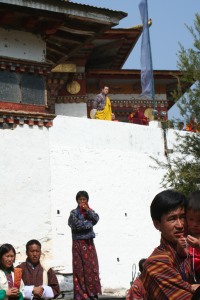
Bhutanese King wearing his traditional yellow robe. Photo by Sibylle
Bhutan is the tiny Himalayan kingdom east of Nepal and south of China, that invented the idea of “gross national happiness” being as important as “gross national product. With a population of only 600,000 (mainly Buddhists), the country’s mountains are excellent habitat for the endangered snow leopard.
I visited Bhutan recently and spoke to many local people who knew about snow leopards but who’d never seen one and didn’t know anyone who had. The current young King is very pro-environment. Projects were visible everywhere during my visit, like school kids doing community work cleaning up litter every Saturday morning in the main towns and a town in the hills being converted to solar energy because the endangered Black cranes were killing themselves on the electricity lines each season as they came to feed.

Map of Bhutan. Source Wikipedia
There are probably only about 100-200 snow leopards left in the wild in Bhutan and WWF is working with Bhutan government agencies on snow leopard conservation. So far they’ve set up a payment scheme for livestock killed by snow leopard in order to stop retribution killing, taught local staff conservation practices and set up an antipoaching squad. Let’s hope this work leads to more “gross national happiness” for Bhutanese people and the snow leopards sharing their magnificent mountains.
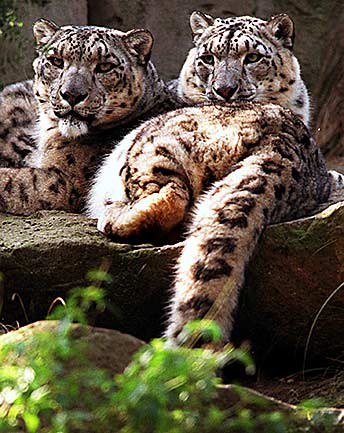
Gregor and Shimbu Melb Zoo. Photo by Jay Town Herald Sun
Here’s an interview I did recently with Adrian “Howie” Howard, Senior Carnivore Keeper at Melbourne Zoo. He’s talking about the two old snow leopards.
“Simbu and Gregor, our two snow leopards that were together for 15 years. They obviously formed a bond over the years, and looked for one another and spent time together. After he died last year Shimbu would call for him in the mornings, she did that for a few months so it was obvious she missed him.
She still calls occasionally but she’s a relaxed cat these days. She likes her food and has now accepted that she doesn’t have to compete with him any more for her tucker. She’s retired now and she can do what she likes. If it’s a little bit warm she’s straight back inside in the back and that’s OK with us.
She’s a relaxed cat, a terrific cat. She’s a great character, as was Gregor. Gregor was one of those cats that you remember for your whole career. I’ve been here for 15 years so I’ve worked with Gregor and Shimmy for my whole career. Losing an animal like him is very difficult, he was a special cat and I’ve been privileged to look after him.
Shimmy’s doing well for an old girl. We gave Shimbu a full medical a few months ago, we gave her an anesthetic, she’s a bit hard of hearing and her eye sight isn’t what it used to be and she’s also a bit stiff, but hey, she’s 20 years old, that’s seriously old – over 100 years old for a human.”
Tashi and Gobi at Melbourne Zoo get fed a range of food now that they are fully weaned (which happened at about 4 months according to Senior Carnivore Keeper Howie.) The other day he put a number of rabbits into their area and Meo, mum, got to them first but as soon as the cubs ran up to her she gave them up and each cub got stuck into a rabbit. They also really like chicken although for some reason both mum Meo and dad Leon seem to prefer goat.

Cub at Melbourne Zoo. Photo by kind permission from passionate snow leopard sponsor Glenn McColl
I had coffee with a couple of the Zoo staff again yesterday and looked in on the snow leopards as usual. I wasn’t expecting much action from them in the middle of the day and sure enough they were all very quiet. Shimbu, the grand old dame, was fast asleep amongst the rocks. It was amazing – as I walked close to her exhibit area I was positive I spotted her, but when I got close, of course it was a rock. It still surprises me, even after years, how well their beautiful fur provides for camouflage.
The cubs Tashi and Gobi are growing. Howie, the senior Carnivore Keeper told me that now, at 6 months of age (this week), Tashi (f) weighs 13.1 kg and Gobi (m) 12.7 kg. I asked if it was usual for the female to weigh more at the same age and he said “she’s just a bit faster into the food!” Mum Meo was also resting as was dad Leon next door. Leon was lying on top of his wooden platform with his enormous tail hanging down in all its glory. A gaggle of school kids were mesmerised by the size and thickness of the tail and stood for a long time, watching as it twitched in his sleep.

IUCN Red List
The IUCN Red List of Threatened Species is the world’s most comprehensive inventory of the global conservation status of plant and animal species. It is the list which ranks the status of each species on the basis of many criteria and helps governments, conservation agencies, the public and policy makers understand how urgently action is required to make sure a particular species survives.
The IUCN (International Union for Conservation of Nature) aims to have the category of every species re-evaluated every 5- 10 years, knowing that habitat loss, global warming, illegal trade and other threats can quickly change the status of animals and plants. The status is reviewed through IUCN Species Survival Commission (SSC) Specialist Groups, which are Red List Authorities with responsibly for a particular species. Currently the snow leopard is one of over 7000 animals that are considered to be threatened with extinction. The status of endangered means that the snow leopard has a very high risk of extinction in the wild. More about the IUCN red List here.

Nepal Himalayas. Photo by Sibylle
Last Friday I celebrated Himalaya Day (29th May) with about 70 people from the Melbourne arm of the Australian Himalayan Foundation. There was good Indian food and a video of the Foundation’s current work in Ladakh where Garry Weare has a team teaching simple principles of western medicine to the local amchis.
For many centuries, amchi (traditional male and female doctors following the Tibetan medical tradition) have been the only access to medical treatment throughout Ladakh. Today they are still the main medical health providers especially in remote areas.

Alfred Gregory with ice ax he used on the 1953 Everest acsent. Photo The Age by Joseph Feil.
The AHF also do fund raising for the Snow Leopard Conservancy’s Ladakh programs. Special guest for the evening was Alfred Gregory, known as Greg and now 96 years young, who became world famous after he was chief photographer on the successful 1953 Edmund Hillary and Tenzing Norgay Everest expedition. Last year Greg published a beautiful book of his photographs from the expedition and all over the world. Although Greg was originally British he now lives in Emerald, just outside of Melbourne. Greg recently became an Australian citizen, prompting us all to be very pleased that we had an Australian on this first successful Everest expedition 
Alfred Gregory “Photographs From Everest to Africa.”

SLT Mongolia project team in yurt. Photo Snow Leopard Trust
Read the adventures of “Cookie guy”, also known as Orjan, a Swedish researcher working on radio collaring snow leopards in Mongolia. The locals like laughing at Orjan but he’s sure good at collaring wild snow leopards and collecting huge amounts of field data for the Snow Leopard Trust, an important wildlife protection group.
Over the last 12 months he and a local team have successfully collared 6 snow leopards in southern Mongolia. With GPS collars they’ve already learnt that the area the cats cover is over 1000 square km and covers more villages than previously thought. Important information because it turns out there are far more villages sharing the snow leopards’ habitat than the researchers knew. These are villages not taking part in the Snow Leopard Enterprise project and therefore still not supported financially if a snow leopard kills their livestock. Read about Orjan’s continuing work here.

Snow leopard proof corral. Photo Snow Leopard Conservancy
When snow leopards kill domestic livestock in the villages of the Himalayas they are usually then hunted and killed by the owners in retaliation. It’s easy to understand why villagers would do this. Often these sheep and goats are the only livelihood they have, representing meat and money without which they and their families would starve.
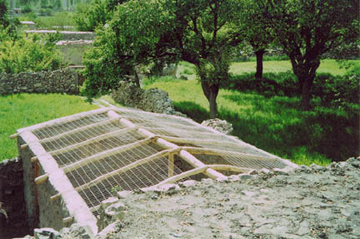
Snow leopard proof corral in Pakistan. Photo by Snow Leopard Conservancy
About 10 years ago many of the conservation agencies working with villagers realised that there was a simple solution to this problem – building better snow leopard proof corrals. Although the idea is simple, the tools and material like cyclone wire are relatively expensive and so donated by the agencies working with village people. With co-operative planning the Snow Leopard Conservancy for example, investigated the existing predator proof strategies of villagers in India and Pakistan.
They’ve come up with solutions that meet local needs and completed over 30 corrals (livestock pens) throughout northern India since the program began, serving over 200 households and over 3,000 head of livestock. Now that the xorrals have proper doors, windows and roofs made of wire mesh the snow leopards are no longer able to get into them. This story shows us another example of the potential for snow leopards and people to live side by side in a shared habitat.