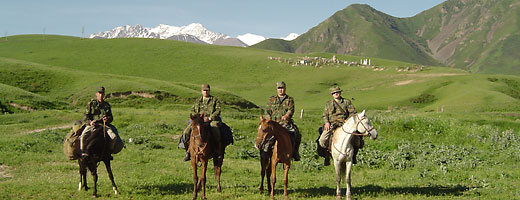
NABU Gruppa Bars anti poaching unit. Photo by NABU.
The “Gruppa Bars”, an anti-poaching unit was set up to save snow leopards in the Kyrgyz Republic 10 years ago with the help of funding from the German Conservation Agency NABU.
Gruppa Bars means ‘snow leopard’ in Kyrgyz. The team has far-reaching powers and is equipped with weapons. They have the power to arrest suspects and seize live animals, skins, weapons and other evidence.
In the last decade the Gruppa Bars have captured 180 poachers and confiscated many snow leopard pelts as well as furs from other endangered animals. They’ve also confiscated and destroyed hundreds of traps. There’s no doubt this team has made a huge difference in saving snow leopards in the country.
Since the late 90’s living standards fell sharply after the dissolution of the Soviet states and the demand for snow leopard parts (for traditional medicine in China) and fur meant the cats in Kyrgyzstan have been hunted relentlessly.
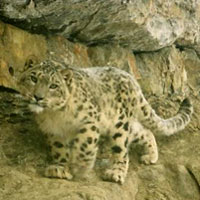
Female Alcu injured by a trap. Now lives in a reserve. Photo by NABU.
A few years ago three live cats were saved after they’d been captured in brutal traps. All had parts of their paws removed because of the traps and can’t hunt successfully or feed themselves. But they’re now living protected in a large enclosure in a NABU supported wildlife reserve.
Many of the conservation programs I’ve discussed on this Blog wouldn’t be possible without the hard work of the folks at the Snow Leopard Trust.
You can turn your love for these beautiful cats into action today! Right now, your donation to the Snow Leopard Trust can have a big impact. Five donors, including the Woodland Park Zoo in Seattle, will match every donation dollar one-for-one, up to $40,000. Please help protect snow leopards and donate today. Here.
The ABC ran this beautiful program last night, our second snow leopard program on Melbourne TV in a week! It tracks the filming of a female snow leopard and her cub by Nisar Malik, a Pakistani journalist along with cameraman Mark Smith. They spent 18 months and two extreme winters getting footage of the cat hunting, resting, playing.
Malik was one of the team who got the first ever videos of wild snow leopards in 2004 for David Attenborough’s Planet Earth – The Mountains episode. He was so bewitched by the animal at the time he felt he had to go back and make a full length documentary about it and its habitat in the wilds of the Hindu Kush, the remote mountains where Pakistan meets Afghanistan.
After the first winter when the two men filmed the female and her cub they return later in summer after the devastating earthquake in Pakistan only to search for 8 weeks in vain. The only thing of interest they see are marmots, the small rodents snow leopards love to feast on.
Mark Smith films them from a hide but after two weeks he says wearily “I hate marmots” and hope they deafen each other with their vicious shrieks. Having spent many hours myself counting marmots in freezing weather, on my own, with nothing more than a chocolate bar to keep me sane, I know exactly how he feels.
Radio collared female. BBC film by Nisar Malik.
Anyway Malik and Smith return again the next winter and meet their female cat again, only to discover she’s been radio collared. Malik is shocked (and I must say I was too when we see how its done). But, listening to the Snow Leopard Trust’s Tom McCarthy explain and see the cat doing her normal hunting and other behaviours we understand that she’s OK. We all know it’s important to get information about the cats in the wild in order to protect them longterm and this is really the only way.
Garry Barker "The Age" newspaper on Snow Leopard O/S
We’ve all known for some time that Apple’s soon to be released operating system is named Snow Leopard (aka Mac OS X 10.6). And why not? I can see that the company and the product would like to be associated with a species that is hardy, built for incredible performance, speed, agility and astounding endurance in harsh environments.
But as Garry Barker The (Melbourne) Age’s Apple guru, pointed out today there is also the flip side to this story and perhaps Apple can help make history here.
Barker says – “… we should observe that an irony under the excitement about Apple’s Snow Leopard is that the real, furry cats are on the endangered list. Perhaps a dollar or two of the OS’s price could be donated to help save one of the more beautiful species on earth.”
Good on you Garry, for pointing that out. So how about it, Apple? A couple of dollars to the Snow Leopard Trust and the Snow Leopard Conservancy could make a HUGE difference to the future of this species and the people that share its harsh habitat, a difference that can mean life or death for both.
Illegal trade in wildlife in Asia is estimated at over $10 billion dollars, second only to weapons and drug smuggling. This is a staggering and potentially depressing story.
But ASEAN nations have recently made major commitments at an ASEAN Wildlife Enforcement Network (WEN) meeting to improve enforcement and also halt habitat depletion. A sad case is that tiger numbers in Asia have gone from over 100,000 to just 4,000 in the last 90 years.
ASEAN WEN member map
WEN was formed in 2005 and is the world’s largest wildlife law enforcement network that involves police, customs and environment agencies of all 10 ASEAN countries – Brunei, Cambodia, Indonesia, Laos, Malaysia, Myanmar, the Philippines, Singapore, Vietnam and Thailand.
For a full report on what the WEN meeting agreed to and the work of WEN see here.
The ABC’s Eric Campbell has trekked through the high altitude Hemis National Park. (Publisher’s note – this is the area where I watched a wild snow leopard for 8 hours in 2011 while trekking with the Snow Leopard Conservancy India Trust.) Eric has made a program for Foreign Correspondent to be screened on Tuesday 5th May, 2009 at 8pm on ABC.
Eric Campbell Foreign Correspondent ABC
This part of northern India is now being called “snow leopard heaven” because of the conservation programs supporting the cats, their prey species and the local villagers living there. The work being done here could be a template for saving big cats around the world. It’s a dramatic and remote landscape where people still largely survive off subsistence agriculture, as they have for centuries. There are no roads, and virtually no mod cons. Many villagers have just a few hours of solar power each day, and use animal dung to heat their homes and cook.
Campbell meets local farmers who are being trained to use remote control cameras to track the leopards. They’re also given assistance to construct predator proof pens for their livestock. Women can now earn money by providing food and accommodation for trekkers. And the farmers are educating school children about biodiversity.
Attitudes have changed, and snow leopards are now valued and protected.
There is also an interview with film maker Mitchell Kelly who was the first person to film snow leopards hunting and mating in the wild. (See Video clip from Mitchell’s film “Silent Roar” on the Video page of this Blog).
A video from the Melbourne Zoo snow leopard sponsor’s day. Carnivore Keeper Adrian Howard, better known as Howie, tells stories about the birth of Tashi and Gobi and how first time mum, Meo rose to the occassion.
More than 2000 names were suggested for the new snow leopard cubs at the Melbourne Zoo before zookeepers decided on Tashi for the female and Gobi for the male.
Tashi, (I know this as my girl Australian terrier is called Tashi,) is the Tibetan word for lucky.
And Gobi of course, is a large national park in southern Mongolia where the highly endangered snow leopard is found.
Cubs named today and it's Tashi and Gobi. Pic by HeraldSun
An excited group of 80 snow leopard sponsors met the new cubs at the Melbourne Zoo last Saturday. Adrian “Howie” Howard, one of the senior carnivore keepers introduced us to the cubs and their Mum, Meo. Over a couple of hours Howie entertained us with information about breeding and the births as well as stories of snow leopard behaviour in the wild. We learnt about the successful Melbourne Zoo breeding program with dad Leon and mum, Meo who now have a 3 month old boy and girl cub.
Excited snow leopard sponsors
There were yelps of excitement and camera clicking as we watched the cubs eat their breakfast of chicken and then play with each other and mum. They ran up the tree branch, rolled through the grass and generally gave an Oscar winning performance for the sponsors who were delighted. One sponsor had driven for over two and a half hours to arrive at the zoo by 8.30 in the morning, true dedication. Another, Margaret, now in her late 70’s had recently broken her pelvis and was still walking with a stick but she wasn’t going to miss this for quids.
We also met 20 year old Shimbu, or Shimmy as Howie calls her, the snow leopard matriarch who was tucking into a huge piece of goat for her breakfast that morning.
Cubs on tree branch. Pic by Martin Terlecki, Melbourne Zoo.
Paul Clarke, the energetic Development Manager from the Zoos Victoria Foundation who organised the event was stunned by the overwhelming response from the sponsors. “People emailed me back right away, saying they’ll be here. One woman who lives in New Caledonia said she tried to get a plane but there were no seats available. Amazing!”