≡ Menu

The man-made rock wall of snow leopard Anu’s den in Mongolia. Photo SLT / Panthera

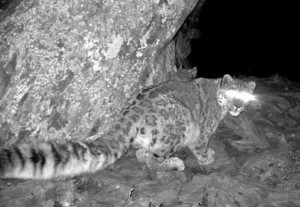
Snow leopard birthing dens are also called natal dens. They are used by wild females when ready to give birth and are almost impossible to find because of the cat’s elusive nature and the remote, steep mountainous terrain in which they live. But in a world first recently, the Snow Leopard Trust / Panthera Mongolia study found two dens belonging to radio collared female cats.

What do we know about snow leopard dens to date? The answer is not that much. The Mongolia study will provide lots of new information. The two dens found by the research team are both high up in narrow rock canyons and only six kilometres apart.  Interestingly the first one found is a large cave with a manmade rock wall blocking off the front entrance. Presumably local people had made it for shelter or to shelter their domestic livestock. The female snow leopard named Anu by the research team found it and thought it was a good place to give birth to her one cub. Obviously she was not disturbed by smells of the human or animal previous occupants.

The other den was up a canyon in an enclosed narrow rock crevice. The female called Lasya, gave birth to two cubs there.

“As we stood outside the den we could hear the cub and smell the cats but not see anything inside the den, “said PhD student Orjan Johansson. Tom McCarthy, Executive Director of Panthera’s Snow Leopard Program, said “We have spent years trying to determine when and where snow leopards give birth, the size of their litters, and the chances a cub has of surviving into adulthood.”

New cub in a cubbing den with saw dust at Philadelphia Zoo. Photo Philadelphia Zoo.

Cubs remain in their protective dens while the mother snow leopard hunts, and she comes back frequently to nurse and feed them. Female snow leopards rear cubs on their own. They have no male partner or other females to help take care of the young. This means the cubs are alone for some  time, so the den must be in a secretive hard to find place.

What features does the ideal den have? Apart from being remote it should have a narrow entrance easily guarded, and perhaps a flat ledge in front from which the cat can watch for threats and for prey to capture. There should also be a good water source nearby. From the SLT / Panthera photos we see the earthen floor of the cave is covered in dried grass.

The mother will try to hunt close to the den, but depending on where wild prey like argali, ibex and marmots etc are located she may have to go long distances. For her to be confident of leaving cubs the cave must be concealed well.

Perhaps the mother even choses more than one den site before birth so she has a backup one to move the cubs to should she need it. This happens in some cats like cheetah for example when they perceive their first den to be unsafe.

Does the female use the same den for cubs in following seasons? We know snow leopards cover huge amounts of area in their wanderings, sometimes hundreds of square kilometres. However some researchers believe female cats do return and have estimated long use of the same den by a cat by the amount of fur, bones and other litter found there.

To date a lot of researcher’s knowledge of snow leopard behaviour in dens and during birth is based on observations of snow leopards in zoos.

In captivity zoos provide the pregnant snow leopard with a breeding den (also called a cubbing den) often made of wood or concrete and lined with straw or saw dust to keep the floor dry and well drained. In recent years zoos have been able to place a camera into the birthing den so that many videos of births are now available.

Zoo staff have learned that the pregnant female needs quiet and a place where she can feel completely safe. In earlier research it was found loud noise and strange keepers can affect the pregnant female adversely and in some cases cubs were born prematurely and died.

Darla Hillard of the Snow Leopard Conservancy wrote about the world’s first ever radio collared snow leopard and her cubs’ birth in 1985. The research team decided not to investigate the den because of their concerns about the impact on mother and cubs.

“It became clear that our collared female #965 had mated during this time (1984) for the following spring her activity pattern changed so abruptly that we knew for sure she had given birth.

From telemetry, we knew where her den was situated, and the temptation to have a look was almost overwhelming. The uncertainty of what #965 might do if her neighbourhood were invaded by humans ruled out any possibility of exploring the area what if she abandoned her babies, or tried to move them away and one or all of them died? We had no choice but to leave for our summer break without knowing how many cubs had been born to #965, missing the good chance of seeing the offspring of the world’s first radio collared snow leopard. We could only hope to recontact her when we returned in the fall, and that we’d get a glimpse of the cubs.”

Darla writes that later they saw her with two happy and healthy cubs.

We look forward to more information on the mothers and cubs in the SLT / Panthera study over the coming year.
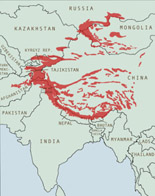
Dr Philip Riordan and his team from Wildlife Conservation Research Unit, Department of Zoology, University of Oxford and the Wildlife Institute, Beijing Forestry University have been studying climate change impacts on snow leopards and the people sharing their habitat in China.
As China has about half of the total world’s snow leopard population and the mountain regions of Asia are being significantly impacted by climate change this is very important research work. The team intends the work to help policy makers in the region act to protect habitat, the livelihoods of local people and the endangered cat.

The team conducted field studies across China since 2008 focusing on snow leopards, their prey and on the way local people sharing snow leopard habitat use the land. The research shows direct and indirect impacts on snow leopards from climate change including increases in human populations into habitat areas. Increased livestock and grazing by domestic sheep and goats means less food for snow leopard prey animals like wild blue sheep. Sadly when snow leopards have less wild blue sheep as prey this means less snow leopards can survive.

The findings from this important study are being presented at the International Conference on Managing Protected Areas under Climate Change (IMPACT) in Dresden, Germany later in September 2012. Photo from the China project, Dr Philip Riordan.

Tshewang Wangchuck, snow leopard biologist from Bhutan and Executive Director of the Bhutan Foundation collecting snow leopard scats to research the number of cats still living in the Bhutanese mountains. Photo National Georgraphic.

Snow Leopard biologist, Snow Leopard Network member, explorer and Snow Leopard Conservancy board member  Tshewang Wangchuck from Bhutan possesses an unusual collection of three hundred scat (feces) samples from elusive snow leopards in Bhutan. In 2009 Tshewang received a grant from the National Geographic to research snow leopards and their attacks on villager’s livestock in Bhutan. His studies of snow leopard scat can show how many cats live in this habitat. He recently returned from a summer of research fieldwork in Bhutan. This week the National Geographic interviewed him on their ‘Explorer of the Week’ webpage.

What inspires you to dedicate your life to nature?

Coming from a country like Bhutan, it is easy to be drawn toward nature—so much of our existence depends on it. I have always loved the mountains; they are beautiful, grand, and awe-inspiring, and these qualities often ground you and make you realize how insignificant humans are in the bigger scheme of things. Yet, we can be the cause of so much destruction for our environment as well.

The snow leopard is an elusive, majestic large carnivore that roams our mountains. In learning about them I get to understand and appreciate so many other facets of harmonious coexistence in the mountains. While this cat is threatened in many parts of its global range, Bhutan offers a safe haven for the snow leopard. It is important that we continue to conserve this beautiful cat, but also address challenges faced by yak herders who live among the snow leopards, occasionally losing livestock to the predator.

It is important that conservation is guided by good science, and it is this that we hope to achieve through the work that we do. Inspiring the next generation of local biologists is another goal I hope to achieve.

Read the rest of the interview at National Geo Explorer of the Week.

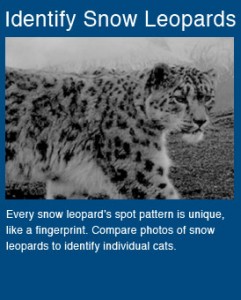
Did you know every snow leopard’s spots are unique? Just as well as this is one way scientists identify them.

The Snow Leopard Trust invites you to take part in its Mongolia research study by identifying individual snow leopards by their spots and the patterns on their fur. The Trust’s project, in partnership with Panthera gets thousands of photos each season from the many remote cameras they have set up in the field. These cameras are triggered to take photos when an animal passes and the photos are then used by the scientists to identify individual cats so they can count accurately the density of the animals in a particular area. This helps answer the big question of whether the habitat can support the number of cats found, as each animal needs territory and enough wild prey to survive.

This is a great idea and having had a go I’ve found it’s not that easy counting snow leopard spots! The Cat Cam webpage gives you instructions and suggestions. For example you can look for distinct clusters of spots on a small part of the body like the forehead or the tail.

Happy spotting at Cat Cam.

Russian Prime Minister Vladimir Putin with Mongol the snow leopard. Putin now admits his story that he had saved the snow leopard from poachers was a media stunt, something that Russian and international wildlife conservationists knew all along. Photo Getty.

Russian President Vladimir Putin this week admitted what many wildlife conservationists have known, that most of his adventure ‘saving’  wildlife were carefully staged.

Until now Putin went along with state media in portraying him as a man with a conservation conscience and acting on that conscience to save wild animals directly himself.

But this week he admitted in an interview with Kremlin critic and journalist, Masha Gessen that most of his wildlife interventions were staged. Gessen confronted Putin after he went up in a light aircraft this week to fly with cranes. She had been fired as editor of the Vokrug Sveta magazine for refusing to cover the crane stunt.

Putin admitted the stunts were “over the top”.

“The leopards were also my idea,” Putin was quoted as saying. “Yes, I know, they were caught before but the most important thing is to draw public attention to the problem.”

The snow leopard staging refers to a media event last year when a snow leopard named Mongol was abducted  from his habitat in a nature reserve, airlifted 100 miles to a neighbouring region, and held in captivity for a week before Mr Putin’s came to ‘release’ him. Injuries he was supposed to have sustained through poachers were in fact caused by the poor animal throwing himself against his cage for a week, bloodying his nose.

According to Reuters News Service Putin’s spokesman Dmitry Peskov told reporters in the Black Sea resort of Sochi, where Putin is spending a few days this week, that Gessen had provided “a correct account of the meeting except for some insignificant details.”
Read the Reuters article here.

The Snow Leopard Scouts Lower Mustang act out a street drama showing challenges snow leopards face sharing their habitat with villagers in the mountains. In this photo we see a student playing the role of a snow leopard caught in a livestock corral. Photo SLC.

The Snow Leopard Scouts of Lower Mustang in Nepal recently performed a dramatic and unique snow leopard street drama called “Mountain Queen, the Snow Leopard”. The young local students performed in Muktinath, a beautiful village sacred to Buddhists and Hindus 3700m high in the Himalayas.

The Scouts acted out challenges faced by snow leopards including being caught in a livestock corral. The event was held during the Yartung (horse-riding) festival (2-3 August 2012) which attracts hundreds of people from the local region. The street theatre is a great idea and an engaging way to send a message about the importance of snow leopard conservation to local villagers, civil servants as well as the many international visitors trekking through these spectacular mountains.

The Snow Leopard Scouts are an initiative of Dr Som Ale and the Snow Leopard Conservancy (SLC -US) who are exploring novel and ground breaking ways to make community-based conservation interesting and engaging for young and old. As well as this street drama the Snow Leopard Scouts of Lower Mustang also plan to publish this story in a colourful comic book for a wide circulation.


A happy snow leopard scout with his certificate in front of the spectacular mountains he shares with snow leopards in Nepal. Photo SLC.

For more on this story and more photos from Dr Som Ale of the Snow Leopard Conservancy see their Live Journal Blog.

A dramatic National Geographic video showing the collaring of the first snow leopards in Afghanistan recently. The video shows how the snow leopard is given medical attention by vets, weighed and measured before being released with a satellite collar.


Yesterday I wrote about why snow leopard researchers use satellite collars on wild snow leopards to collect data. This interview with Orjan Johannson from the Panthera / SLT snow leopard project in Mongolia’s South Gobi desert shows the role that satellite collars played in the recent discovery of the first ever wild cubs in a den. (Interview by James Fair, environment editor of BBC Wildlife Magazine.)

These photos of the cubs and their mum Lasya were taken by Orjan and his team.

“How did you find the cubs?

We caught and collared two adult females last year. Then, towards the end of May this year, 2012,, the GPS on their collars indicated that they were restricting their movements to a small area. So we thought that they were about to den and give birth.

What happened next?

Both females disappeared, and we spent 12 days listening to the radio signals from their collars. They were in a small area, but the mountains are full of crevices so it was hard to know exactly where.

How did you work it out?

Approaching a possible den site, we realised from 50m away that one of the females was there. Getting closer, I heard the cubs and I could smell them, too – adults don’t usually smell.

How did you get the footage?

The cats were behind a rock wall 1m high. No one wanted to put their head above the wall, so we attached a video camera to an antenna.

We were really pleased to get the cubs on camera, because it will help us in our efforts to persuade politicians to protect the area.”

Satellite collar for snow leopards. Photo WWF Russia

Satellite collar for snow leopards. Photo WWF Russia.

Over the last 30 years a lot of what researchers have learned about snow leopards has come from collars attached to the cats. Although this is invasive for the individual cats concerned the data has changed our knowledge of what snow leopards can do.

But how do these collars work and how long have they been used by snow leopard researchers?

Radio collars, also sometimes called VHF (Very High Frequency) transmitters emit radio signals which are picked up with a hand held receiver connected to an antenna. Generally they can be heard within a distance of 12 -15 km if weather is good and you have line of sight.  However if you are following a snow leopard chances are you are in very mountainous terrain and the signal may be difficult to trace. These collars also don’t work if cats roam a long distance which is often the case with snow leopards that can move over 100km in a few days.

Satellite collars on the other hand send signals even in extreme weather and from great distances via satellites which orbit the earth and scan for these collar signals. Researchers’ computers are able to find the exact location of the snow leopard and plot his/her movements over many months as long as the cat has not lost the collar and the batteries still work. Collar signals may also reveal when a cat stops moving either for feeding on a kill for a few days, preparing a den for births or because the cat has been injured or died.

Satellite collars are ten times as expensive as conventional radio collars (between $2000 and $3000).The technological development in new collars now means that they last much longer and can do more than the early collars. The Global Positioning System (GPS) unit calculates the exact location of the collar on an hourly basis and stores the information in the collar. The Lithium–ion battery is designed to last at least 18 months.

Although information is sent via email researchers also need to retrieve the collars after they drop off the cat at a designated time, usually after a year. Cats don’t suffer with the collars, can still hunt, mate and breed with them, but researchers will never leave a collar on for more than about a year.

Dr Rodney Jackson with Tin, one of the first ever wild snow leopards captured and radio collared. Nepal early 1980's. Photo Snow Leopard Conservancy.

Dr Rodney Jackson, the world’s foremost snow leopard expert and Founder and Director of the Snow Leopard Conservancy, was the first ever to radio collar cats in Nepal in the early 1980’s. He called this first cat “Ek”, the Nepali word for ”One” and throughout Nepal’s most severe winter he captured and collared another five cats. He not only proved it was possible to capture snow leopards, immobilise them safely and collar them, but to also get unique and useful data this way.

The first ever cat fitted with a GPS satellite collar was Bayad-e-Kohsaar (Urdu for “In Memory of the Mountains”). Bayad as she was known was collared in Chitral Gol National Park in northern Pakistan on 17 November 2006. A team headed up by Dr Tom McCarthy from the Snow Leopard Trust worked with Pakistan’s North West Frontier Province Wildlife Department and WWF–Pakistan.

Bayad is known to many viewers around the world from footage in the BBC’s Planet Earth TV documentary. Her movements were tracked for 14 months and yielded more data than ever before with the use of radio collars. Bayad was recorded as she moved, rested and slept for those months until the collar was programmed to fall off. When the collar dropped in January 2008 it wasn’t found by the researchers for two months due to the incredible remote and steep terrain. The team only found it after building their own device with an old FM radio. Bayad had dropped the collar inside a deep crevice at Shali Gol, the buffer zone of Chitral Gol National Park.

Bayad, first snow leopard captured and fitted with a satellite GPS collar, Pakistan 2006. Photo Snow Leopard Trust / Panthera.

During her time with the collar Bayad moved from Pakistan over the border into Afghanistan. Although some data was received for a few months no signals were received due to severe noise interference but enough signals came through to enable the research team to follow some of her movements.

Dr McCarthy said, “The collar could hold between 500 and 1,000 GPS location coordinates, which sheds light on the behaviour of an animal that is notoriously difficult to study. It will show us her range, how far she moved in an 8 hour period, in a month and whether she got close to humans in her travels.”

Today organisations like the Snow Leopard Trust and the Snow Leopard Conservancy continue to work with this amazing technology which will help in the race to save the endangered snow leopard.

School kids writing poems and drawing snow leopards at the opening of the Koch Agash Museum in the Altai region of Siberia, Russia. Photo SLC.

In 2010 I visited the beautiful remote mountains of the Altai, a region of which I was painfully ignorant. During two weeks of trekking through the landscape looking for snow leopard sign I came to realise how special and fragile this place is.

This week the Kosh-Agach Cultural Museum, in the deep south of the Altai Republic (Siberia, Russia) opened with a snow leopard display of photos and information about the rare cats which still live in very small numbers in the most remote parts of this region.

The new cultural centre in the small town helps to educate the local people, other Russian visitors and foreign tourists about the rich natural history of the Altai with its magnificent wide steppes, taiga thickets and the splendour of massive snowy peaks.

Many of the local people here are herders who have become aware of their role in preservation of the wildlife including animals like snow leopards, foxes, wild goats and sheep, ground squirrels as well as thousands of varieties of birds. The local school kids have recently started celebrating snow leopards with an annual snow leopard day.

All of these activities are supported by the Snow Leopard Conservancy, Foundation for the Sustainable Development of the Altai (FSDA), United Nations Development Programme Global Environment Facility (UNDP/GEF), the Centre for Additional Education of Schoolchildren of the Altai, and the Worldwide Indigenous Science Network.

“It was really wonderful last week to open the new cultural center with staff of the Ukok Nature Park. Children came directly from summer camp held in the mountains near Kosh-Agach; they gave a small concert and read their poems, “ said Chagat Almashev, Director, FSDA, Altai Republic who started The Altai Assistance Project (AAP) in 2003.