≡ Menu

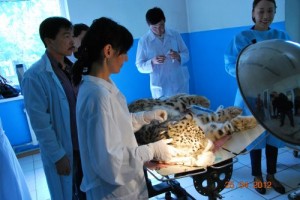
Snow leopard Pirate being prepared for his eye surgery in Kazakhstan this week. Photo CA - News

Two snow leopards, Pirate and Leader had eye surgery this week in Kazakhstan Almaty Zoo to prevent blindness. The snow leopards came from Kyrgyzstan and the operation on each lasted for over 2 hours. The snow leopards were anaesthetised and underwent surgery to correct defects in the eyelids. The surgery is similar to surgery on two snow leopard cubs, Kimti and Dian at Philadelphia Zoo last year. The problem of coloboma, a medical condition that causes irritation and infections from hairs touching the eyes is not uncommon in zoo births of the cats and needs to be corrected surgically to avoid blindness and give the cats quality of life and potential to breed.

According to Head of the scientific and methodological department of Almaty Zoo, Dr Ergali Bekkulov, the snow leopards are in good condition, although there is no guarantee at this stage that recovery will be complete and they may have to have more surgery later.

Snow leopard Pirate getting anaesthetic before eye surgery. Photo CA - News


Dog and snow leopard encounter in Tajikistan.

Dog and snow leopard encounter in Tajikistan photographed by villagers.

Another amazing story of snow leopard encounter with dog. This time with incredible photo. This report from Stefan Michel, wildlife expert with the Nature Protection Team in Tajikistan.

“In Zong, Wakhan valley in Tajikistan, villagers reported attacks by snow leopards on livestock. Once a dog defended the herd, the snow leopard ran after the dog, which escaped to the herder. The snow leopard even touched the herder, who was – understandable – shocked.

 Our project team had difficulties to believe the story. So we provided the villagers with a digital camera. The result – you can see! Now a project application for predator proof barns is under preparation. The villagers will soon apply to the agencies in charge for assigning the area to them as community based conservancy to develop tourism and sustainable hunting.”

With more and more villagers coming into snow leopard habitat across all range countries the likelihood of dog and snow leopard encounters will increase. Stories to date suggest sometimes the snow leopards loose prey to dogs and other times they are able to defend it. In any case the sort of community program Stefan describes above is important to stop encounters from ending in harm to either animal, dog or cat. (Photos courtesy of Tanya Rosen and Stefan Michel.)

The Spiti or Chamurthi ponies that were attacked by the snow leopard. One pony was killed by the cat but village dogs chased it away before it could take its kill up the mountain to its lair. Photo Gaurav Sharma.

“Saving Snow leopards” blog was recently contacted by Gaurav Sharma and his brother Vikas Gupta with the following amazing story of a snow leopard being chased away from its pony kill by village dogs.

“It was the summer of 2010 in the beautiful valley of Pin, in Spiti District of Himachal Pradesh, India. The river Pin was flowing in its full swing, bestowing the resident people and wildlife with its pure and crystal clear water.
The villagers of Pin, with their temporary stable for Chamurthi ponies were just guarding the stable with sticks and stones from the various creatures for whom Chamurthi is the best food available. One of them, is the king of the chain, the Snow Leopard. Just waiting for the sun to set, to catch hold of one of his prey, the leopard in his late age, was sitting on top of a mountain onlooking everything happening in his kingdom.
It was 4 in the morning, when all the ponies started running all afraid from the stable, saving their lives. At this moment, the king, the leopard just took a shot. Taking his prey, a small pony to the top of the mountain, the leopard seemed drunk after quenching his thirst from the blood of the small animal.
My brother and I and the local villagers saw suddenly 4 dogs. They seemed to arrive from nowhere, and start poking the leopard all over. Where did they come from, was the first question in everybody’s mind! The wild dogs, left, born, new, old, they are all over, disrupting the whole chain!! It came as a shock when one of the dogs bit the snow leopard on his thigh, which made the cat leave his kill and run off up the mountain.
It is more than just a concern, when some creatures from other kingdoms, threaten the reign of the snow leopard  king!”

Thanks so much for sharing this story, Gaurav and Vikas, this is a once in a lifetime thing you guys saw. I hope the snow leopard was later able to get wild prey and not have to rely on ponies belonging to villagers.

At least 6 snow leopards found on the photos of camera traps just retrieved from remote Ravmeddara Gorge in Tajikistan. Photo Panthera.

Camera traps to collect snow leopard photos have now become routine but I can only imagine the excitement when researchers check what they’ve got on the cameras they retrieve after months out in the wild valleys and mountains.

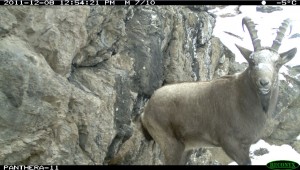
A few days ago camera traps were retrieved in the mountains of Tajikistan after being set between November last year and April this year in the remote and beautiful Ravmeddara Gorge. And researchers were elated at what they found. Photos of six individual snow leopards and ibex, the wild goat that is good snow leopard prey.

Since 2008 traditional hunters have been supported by the Nature Protection Team, a Tajik NGO and the German government to establish community rangers. Their role was to stop the rampant poaching of ibex that had been going on.

Ibex, wild goat, photographed on camera trap in remote mountains of Tajikistan. Researchers found that the ibex population has increased since local people have become rangers and helped stop poaching. Photo Panthera.

Stefan Michel, wildlife expert of CIM-program with the Nature Protection Team, said “The evidence of the presence of such a large number of snow leopards shows that local people have successfully brought the ibex population back to a size which can support several snow leopard families.”

Now researchers know there are over 400 ibex here.

Munavvar Alidodov and Khalil Karimov, Nature Protection Team, who just came back from retrieving the traps, said “the rangers are very proud of the results of their work and hope that the presence of snow leopards and ibex will attract tourists. Income from future regulated hunting of ibex will support their conservation activities and the social-economic development of the villages involved.”

Cordyceps, a type of mushroom found in snow leopard habitat in Bhutan and other parts of the Himalayas. Photo Wikipedia.

Dr Rinjan Shrestha is a conservation scientist for WWF-US, Eastern Himalayas Program and he’s currently in the small Himalayan Kingdom of Bhutan working on a project researching snow leopards and mushrooms. Rinjan recently led a survey team that captured the first photographic evidence through camera trap survey that snow leopards are thriving in Wangchuck Centennial Park.

He is back in the field in Bhutan and sent a short report of his current activities to “Saving Snow Leopards” Blog.

“For my assignment in Bhutan, I am currently working in the central range (27° 51’ N, 90° 39’ E) of the Wangchuck Centennial Park.  Our objective has been to count blue sheep numbers and estimate snow leopard population in the region by employing direct counts and camera-trap surveys, respectively. So far, we have completed blue sheep counts. The camera traps were systematically laid out in late winter and early spring this year. I expect the first round of data to arrive by the last week of May, 2012.  I’m also planning to assess the impact of Cordyceps (mushroom) collection on the activity and movement of snow leopards in the region.

Cordyceps is a type of fungi (mushroom) also called the Chinese caterpillar and the name intriguingly means “summer plant and winter insect” because of its changing appearance in the seasons. They have for hundreds of years been regarded as medicinal by the Tibetans and Chinese and are collected by people in the high ranges of snow leopard habitat.

Bhutan snow leopard habitat

From left: Gempo Wangdi, Tenzing Wangdi, Dr Rinjan Shrestha, Leki Dorje, Nawang Tashi and Tenzing.

The information collected by Rinjan and his team  is vital to understand the health of snow leopard populations in this part of Bhutan and we look forward to hearing the outcome of his work in months to come.

Rinjan says “The photo here shows my field crew, consisting of park ranger, Tenzing Wandga, forester Leki Dorje (an expert high-altitude botanist), forester Nawang Tashi and intern Gempo Wangdi. We were also accompanied by Chhokpa, the headman of the Nasphelle village, and Tenzing, a horseman with 12 horses, who is always ready to fix tents, bags and boots with his magic needles and yak hair threads.”

You can read more on the WWF Blog.

So the snow leopard holds one formal world record.  We all know about longest tail etc, but that isn’t it.  Guiness Book of World Records has given the snow leopard this record – it is “the highest living land predator whose range extends across twelve countries in the mountainous regions of Central and southern Asia. Amongst the highest altitudes at which this rarely-seen cat has been photographed is by cameras hidden at 5,800 m (19,000 ft)”. Just another reason this cat is so special.


Himali and other villagers from the local Snow Leopard Conservation Committee set up camera traps to catch snow leopards on camera. © WWF-Nepal

I’d like to share this story from a WWF snow leopard conservationist in Kanchenjunga region of Nepal. It shows first hand the tough relationship between villagers and snow leopards that can often end tragically for the cats. But this story has a wonderful outcome and shows how snow leopards and villagers can live together.

Himali Chungda Sherpa is a champion for the snow leopard. But he didn’t start out that way. Long before he was chairman of the local Snow Leopard Conservation Committee, Himali sought his own revenge against these mountain cats.

When Himali was a young boy, his parents sent him into the pasture to care for the family’s herd of yaks. Early one morning, he discovered three calves were missing.

After hours and hours of looking for his calves, he caught a glimpse of the animals from high on a rocky ridge. Himali scrambled down to the spot, only to find scraps of his calves remained. Next to them were three full-bellied snow leopard cubs. Their mother had killed the calves to feed her young.

 “At that moment, I was so angry that all I could think of was revenge,” recalls Himali. In a fit of anger he scooped the cubs into a sack and threw them in the river.

Kanchenjunga on Nepali India border. This region is home to snow leopards now being protected by villagers and WWF funded support.

That night he heard the mother snow leopard crying for her children from up in the high mountains. In the pasture below, his yak was longing for her calves.

“It was then that I realized what a sin I had committed. I promised never to harm a snow leopard again,” says Himali. “Today, my passion is to save them.”  

Himali and others are now at the forefront of community-led efforts to save snow leopards. WWF supports their work by training them to survey and monitor snow leopards. We also help the community promote wildlife ecotourism and find solutions that benefit both people and snow leopards.     Read more about WWF snow leopard work.


The famous Stephen Oachs photo of a snow leopard which was used in the Express Tribune story about a man who had been killed by a common leopard.

Sadly villagers in the remote town of Rawalkot in Kashmir didn’t realise that there has never been a case of a snow leopard attacking a human. Last week a snow leopard climbed up a tree near the village and locals, fearing for their safety, shot the animal dead. It also seems probable that locals sometimes confuse snow leopards with the common leopard, a cat that has attacked and killed humans in the past.

Mr Waseem Khursheed,a local businenessman, witnessed the killing. “A snow leopard climbed up a tree and remained there for eight hours in the town of Banjosa, some 18 kilometres from Rawalkot.” Villagers tried to scare the leopard with firecrackers, but when this didn’t work they decided to kill it instead. Mr Khursheed reported  the villagers skinned the snow leopard and distributed its meat among the locals as it’s thought to have medicinal properties.

According to the Jammu and Kashmir Wildlife Act, the killing of a snow leopard can result in imprisonment of up to 6 months and/or fine, but charges are rarely made and not if it is considered self defense.

According to snow leopard expert, Dr Rodney Jackson, “To my knowledge there are no known, authenticated incidents of a human losing his or her life due to a snow leopard attack. This cat is amazingly shy and rather docile. Really, the opposite is the case given the number of stories of snow leopards — caught in a livestock pen — being stoned or beaten to death by angry villagers.”

Unfortunately confusion between the common leopard and snow leopard will continue when even a newspaper like the Express Tribune publishes the wrong photo in its stories about common and snow leopards.

A visitor to a Himalayan Homestay in ladakh is shown how felt is made by the host of the house who makes toys and clothes which are sold by the Snow Leopard Conservancy india Trust.

Felt making is thousands of years old and has been practiced in many cultures to make clothes, tents and toys. The felt fabric is made by matting and pressing wool and this wool is then used to make handicrafts.

Recently the villages of Saspoche and Ullay in Sham Valley Ladakh, India were trained in felt making of wild animals, including snow leopards for sale to travellers to Ladakh. The Snow Leopard Conservancy India Trust (SLC IT) arranged for Ute Meuser, a Waldorf teacher and expert on dry felting techniques, to train men and women to make handicrafts that will increase their income and help raise awareness of snow leopards in this area. The crafts will be sold in the SLC IT’s Snow Leopard Interpretive Centre in Leh, Ladakh, just in time for the coming summer peak trekking season.

Wool from domestic goats and sheep make the felt used by villagers for crafts.

Cover of ‘Irbis, the Snow Leopard’ – the book by Oleg and Irina Loginov from Kazakhstan.

Today Darla Hillard, Education Director of the Snow Leopard Conservancy shares a review of the new book “Irbis, the Snow Leopard” by Oleg and Irina Loginov from Kazakhstan. Darla is the author of the amazing “Vanishing Tracks – four years among the Snow Leopards of Nepal”, the remarkable story of her and Rodney Jackson’s years of ground breaking snow leopard research.

Here Darla writes about Irina and Oleg’s book.

I met Oleg Loginov in summer 2011. We both were in Gorno-Altaisk, capital of Siberia’s Altai Republic, to attend the town’s first Snow Leopard Day festival. We were very impressed by the children from rural villages, who sang and danced on a stage in the town center. Each performance was a tribute to the beautiful endangered snow leopard, calling for conservation action, to ensure that Siberia’s “Silver Wonder” continues to roam the magnificent Altai-Sayan Mountains. What a great occasion, then, on which to receive a copy of IRBIS, The Snow Leopard, the book that Oleg and his wife, Irina, produced under the UNDP/GEF Biodiversity Conservation Program!

The beautiful mountains of Kazakhstan are snow leopard habitat where the Kazakhstan Snow Leopard Fund works to protect the endangered cats.

IRBIS is a gorgeous hardbound volume. At 8.5”x11” (21.5x28cm), the pages are large enough for stunning photos and paintings of snow leopards and the landscapes in which they live. Oleg knows snow leopards.  He worked with them at the Almaty Zoo, and he and Irina founded the nonprofit Snow Leopard Fund to educate the general public and leaders of the Commonwealth of Independent States (CIS) about Kazakhstan’s snow leopards. In addition, Oleg wrote the Conservation Strategy of the Snow Leopard in Kazakhstan, which was officially approved in August, 2011.

One of the many beautiful photos of snow leopards in the book.

In the chapter on the various groups working to protect snow leopards, Oleg presents a set of recommendations for actions that should be taken in the CIS countries.  I believe that the tourist, or other reader unfamiliar with the issues—a target group for this book—will appreciate this information, and knowing that positive steps can be taken.

The text for IRBIS was originally written in Russian, and the English translation isn’t perfect. But in my opinion the passion that Oleg and Irina pour into this volume far outweighs any errors.

A lovely children’s fairy tale by Irina, Spirits of the Sacred Mountain, is based on the indigenous Altai people’s worldview of the snow leopard.

Oleg chose photos that capture beautifully the spirit and force of these elusive big cats. He points out that most snow leopards are born under the sign of Taurus, since the females give birth between late April and early June. One trait of Taureans is a calm and predictable nature.  Oleg tells of Renat Minibayev, who went in January 2010 to visit his beekeeper friend in the mountains of Dzhungarsky on the boarder of China and Kazakhstan. Minibayev went on a ski walk to a nearby canyon; there he had an amazing encounter with a snow leopard. He took thirty photos, some from a distance of 1.5 meters. He said that over the time he and the cat watched each other, he fell in love.

That’s what Oleg and Irina hope for this book—that people will fall in love with snow leopards and join the fight to save them.

IRBIS, The Snow Leopard is available for a donation of $300 in support of the Snow Leopard Fund’s programs. Orders can be made by emailing the authors at irbisslc@yandex.kz.  Tax deductible donations (in the US)  earmarked for the book can be made via the Snow Leopard Conservancy, who will forward 100% of donations to the Snow Leopard Fund in Kazakhstan.