≡ Menu

Dr Rodney Jackson, one of the world's foremost snow leopard researchers has been nominated a third time for the pretigious Indianapolis Prize for wildlife conservation. Go Rodney!

Dr Rodney Jackson, the first person to radio collar a wild snow leopard and director of the Snow Leopard Conservancy has been announced as a three-time finalist for the Indianapolis Prize, the annual $100,000 award for unique contribution to wildlife conservation.

Rodney has done and continues to do a huge job in protecting snow leopards in Central Asia. His focus is on research and community education especially promoting cross-boundary cooperation between snow leopard range countries. Snow leopards don’t understand country boundaries so its important for agencies to work together. “We see  again and again (that) a conservation approach of a single country here and there will not work long term. There needs to be cross-boundary cooperation, ” Rodney said.

Good luck Rodney, we hope third time lucky for you and the SLC! You desereve it!

Jigmet Dadul from the Snow Leopard Conservancy India Trust watching a female snow leopard in winter 2011. Jigmet is probably the most successful snow leopard tracker in all of the animals range countries. Photo by Sibylle Noras.

Jigmet Dadul from the Snow Leopard Conservancy India Trust (SLC-IT) has done it again! The group he took out in Hemis National Park in Ladakh (India ) with KarmaQuest travel had fantastic multiple snow leopard sightings. This wintertime trek has now had four years in a row of success in tracking and finding a snow leopard. It was this trek that I did last year where we were able to watch a female cat for 8 hours, a once in a life time experience that I’ll never forget.

Jigmet says of his success this year, “We did saw snow leopards 4 times, three sighting was quite far, one was for three hours. Rest two sighting was quite close from me, but I don’t have time to take pictures, I have to show the snow leopard to the group. Two sighting was in Husing Nullah, another one sighting was close to the camp, the last one in Rumbak gorge.”

Congratulations to Jigmet and all the team and everyone at SLC – IT and to Karma Quest. For anyone keen to to see wild snow leopards in their own habitat this is THE trek! The experience of this team and the success of the local villagers in this part of the Indian Himalayas in protecting snow leopards is outstanding. Together the conservationists and the villagers can just about guarantee a sighting at this time of year and that is a unique wildlife experience. KarmaQuest and SLC-IT will offer this trek again next year in February, so make sure you are a part of it, contact KarmaQuest.  (Update from May 2012 – The 2013 Winter trek is already full but there will probably be a second one so don’t hesitate to contact KarmaQuest.)

Technology now transmits a signal to researchers when a snow leopard is snared. This means the cats are reached very quickly by researchers and time the animals are captive while sedated and radio collared is shorter than ever before. Photo Panthera.

“I wouldn’t have wanted to be in the poacher’s shoes” says Dr Tom McCarthy, Panthera’s Director of Snow Leopard Programs in a fascinating webinar called “The Science behind saving Central Asia’s Mountain Ghost”. Tom was talking about conservation programs where villagers promise not to harm snow leopards in return for support with selling crafts. A poacher did kill a cat in one village and the women lost their bonus and were furious with the poacher.

This is an hour long talk and worth ever minute of listening as Tom goes through a huge amount of information about snow leopards, their habitat, the threats facing them and the first ever long term study on snow leopards in Mongolia. “We do a lot of listening to people in snow leopard areas and there is no cookie cutter approach to this . What will work in Mongolia might not work in Pakistan or Bhutan.”

One of the most fascinating topics is the way the Mongolia program now traps snow leopards to put collars on them and the technology that alerts the researchers so the time the cats spend in the snare is very short compared to years ago.

Hear and see webinar here.

Community members of the Doyan valley of Gilgit-Baltistan, Pakistan spotted a group of four snow leopards near their village a few days ago. The endangered and shy cats stayed for 5 days while local Mr. Naseer ur Rehman informed Gilgit-Baltistan Wildlife Department about them. he then very carefully and from a distance took this video.

It brings lump to my throat to hear school kids and villagers in Nepal say “this cat has one life and has a right to live it too.” Awesome work by Dr Som Ale, Nepal National Trust for Nature Conservation, Disney Friends for Change and Snow Leopard Conservancy to get this world first program going. School kids learn about snow leopard by setting up remote cameras in the field. This is the first program to truly involve local children in planning and monitoring.

The Bronx Zoo based Wildlife Conservation Society (WCS) did a study during a few years ago that found military personnel in Afghanistan were supporting the illegal wildlife trade by buying furs coats and animal products including snow leopard pelts. Most buyers did so because they were not aware that it was illegal and that the wildlife was endangered. Consequently WCS worked with the Department of Defense to educate them and explain threats posed by the illegal wildlife trade to combat missions. This video, narrated by acclaimed actor/director and United Nations Goodwill Ambassador for Biodiversity, Edward Norton, informs U.S. military personnel about the consequences of buying illegal wildlife products when stationed overseas

Amazing footage of two wild snow leopards sniffing out all the prey that come into their territory has been filmed as part of a survey in Bhutan’s newest national park. The film shows a number of cats scent marking around a particular rock and then all the prey animals that came to the rock in the days after. It shows Tibetan wolf, threatened Himalayan serow (a wild goat), musk deer and a number of blue sheep. All of these animals are prey for the snow leopard living in Wangchuck Centennial Park in Bhutan.
Field biologists from the Government of Bhutan and World Wildlife Fund (WWF) captured over 10,000 images during the camera trap survey. “The findings are phenomenal as these are the first snow leopard images recorded in Wangchuck Centennial Park,” said WWF’s Dr. Rinjan Shrestha, who led the survey team. “It suggests that the network of protected areas and corridors is helping to link local snow leopard populations, which will be invaluable to ensure long-term persistence of snow leopards in the region.”
Read more here.

Wow, great news. Snow Leopard Enterprises has won the BBC Worlld Challenge. It was considered an innovative business model that also benefits the environment. The program helps herders in Mongolia make and sell fine wool handicrafts to increase their income. In turn, herders sign conservation contracts pledging to protect snow leopards living in their area.

  “Snow Leopard Enterprise works with over 250 families in Mongolia to protect snow leopards and improve the quality of life for herder families,” says Brad Rutherford , Executive Director of the Snow Leopard Trust , who visited with program participants in August. In 2010, every pledge to protect snow leopards was upheld and snow leopards were kept safe across over 25 communities. “Through Snow Leopard Enterprises, we’re improving the conservation status of snow leopards across roughly 50,000 square kilometers of prime snow habitat in Mongolia ,” says Rutherford , “and thanks to the World Challenge we’ve been able to increase recognition and support for this important program.”

 More than 600 proposals were submitted to World Challenge in 2011, from which a panel of judges selected 12 projects to compete. According to BBC World News, over 70,000 voted were cast for the 12 projects and the top three winners were chosen based solely on the number of public votes.

 With the most number of votes, Snow Leopard Enterprises earned the coveted top spot in the competition. As a first place winner, the Snow Leopard Trust will receive a cash prize of $20,000 to advance conservation for snow leopards and Snow Leopard Enterprises will be featured in international versions of Newsweek Magazine and on BBC World News.

Radhika Kothari from Snow Leopard Conservancy India Trust. She and her team are doing conservation education, engaging with tourists and working with local villagers and wildlife officials to protect the snow leopards in Ladakh, a spectacular part of the Indian Himalayas.

I recently did a telephone interview with Radhika Kothari from the Snow Leopard Conservancy India Trust in Leh, the captital of Ladakh in northern India. She talked about the exciting camera research and community conservation programs they are doing, and this is some of the most successful snow leopard conservation work around.

Radhika and her team are very busy and here she explains some of their recent new initiatives to save the beautiful snow leopards in this part of the Indian Himalayas.

“To strengthen scientific research, we chose two areas, Ulley and Saspoche. We got 10 camera traps from Panthera and 5 from the Department of Wildlife Protection (Jammu & Kashmir)  this summer. We got photos from these and counted four, possibly five individual cats.  These 10 cameras were a trial but next year hopefully we’ll be able to set up between 30 and 40 cameras and that will give us good science to tell real number of snow leopards here.

 We consulted with local communities all the way. And we do all this work with the collaboration of the Wildlife department here in Ladakh.

 As far as the communities go, first we involved then with idea of camera traps so that they would accept the cameras and understand what they were for. Then the local people identified an area where there are ibex (major prey of snow leopard) and this area will now be solar fenced and the community is helping with that work too.

 Another project we’re doing is livestock insurance program in western Lladakh and recently we opened our new Snow Leopard Conservation Interpretative Centre at the SLCIT offices in Leh. We showcase information on the cats and Ladakh wildlife and our work. Any one can drop in and for free watch 2 movies we show – Silent Roar and Ladakh Natural history documentary. We’ve also started selling the handicrafts made by local women so there are lots of good reasons for people to drop in and see us.”

I was very lucky to meet with these hard working folks last February when I trekked in Ladakh and saw a snow leopard in the wild. Snow leopard sightings here are very possible and the future wellbeing of the cats, their prey and the villagers that share the spectacular mountain habitat is being protected by the hard work of the SLCIT. Well done, team!

Marc Foggin  is founding director of international NGO Plateau Perspectives and associate professor in the School of Geography and Life Sciences at Qinghai Normal University. He’s worked on conservation and community development projects in Tibet for 15 years.

He recently contacted “Saving Snow Leopards Blog” to report on exciting local snow leopard conservation work from this area of Tibet which has one of the highest densities of snow leopard in the world.

One of the first wildlife monitoring teams from a local grassroots organisation and the local monastery participated in snow leopard conservation work together with Plateau Perspectives. They observed many signs of snow leopards, including prints, scrapes, scat and traces of recent kills. Photo Marc Foggin.

“In a remote area of Yushu Tibetan Autonomous Prefecture, in China’s western Qinghai province, local Tibetan herders have been actively protecting the snow leopard and other endangered wildlife in the high grasslands and mountains for more than a decade. Now, with help from non-profit organisation, Plateau perspectives, and the Sanjiangyan National Nature Reserve, they are also using “camera traps” to photograph the animals and document their distribution, range and behaviour.

The people of Muqu village are supporting snow leopard conservation by serving as park wardens, environmental advocates and as partners in applied wildlife research.

When locals are treated as genuine partners and allowed to voice their concerns as well as sharing their knowledge, there is a real opportunity to find better models for a sustainable future. If we are to succeed in protecting the snow leopard, for example, we must equally protect its fragile habitat. To protect the snow leopard is to protect the entire landscape and many other species and habitats will in this way be preserved as well.

For over a decade, around a dozen members of Muqu village have served as wildlife monitors and searched for snow leopards in their rugged mountain terrain. Many different signs can be seen – prints, scrapes, scat and kills – and several times a year, these herders report all their sightings as well as any instance of livestock predation or poaching. Now, with technologies such as global positioning systems (GPS) and digital cameras activated by motion sensors, an increasingly clear picture of the conservation situation is emerging.
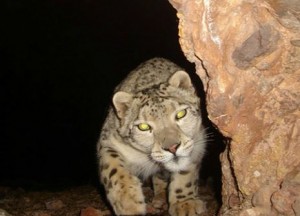
This photo of a snow leopard was taken by camera traps on 8 January, 2010 in the Tseren mountains. Photo Marc Foggin.

Since 2009, over a dozen camera traps have been set in the mountains of western Yushu, located according to the extensive knowledge of local herders. Nine individual snow leopards have already been captured on film, within an area of about 150-square kilometres.. Many other species also live here, including blue sheep, Tibetan antelope, wild ass, wild yak, black-necked crane and saker falcon.

But when snow leopards and wolves flourish, the number of livestock killed by these predators rises – and herders are starting to ask about financial compensation. On the one hand, people want to protect the land and wildlife, but on the other hand, the cost is sometimes high. Developing alternate sources of income for local herders is crucial, and the solution currently being explored is ecotourism.

While there are many challenges to developing a viable and equitable ecotourism project, the potential benefits have swayed tourism bureaus and several responsible business partners, community representatives and non-profit organisations to get involved.
Together we can find solutions to protect the high mountains, the grasslands and the wildlife of the Tibetan Plateau. And both the elusive snow leopard and local herders will enjoy the results