≡ Menu

A beautiful snow leopard sleeps in her wild home in the Indian Himalayas. Photo Sibylle Noras & Jigmet Dadull.

Who doesn’t?

Earlier this year I had the time of my life watching a snow leopard in the wild in Ladakh, India. I went on a fabulous trek with KarmaQuest and the Snow Leopard Conservancy to the Himalayan mountains in Hemis National Park and with the support and professional tracking of Jigmet Dadul and his team we found a magnificent female cat on our 7th day and spent the entire day observing her.

Snow leopards are rare and elusive; many biologists have studied them for decades and only caught a glimpse or two of the cats. So believe me it is an amazing experience and a privilege to see one in the wild. This trip is being offered again in February (6th to 22nd 2012) and my friend from KarmaQuest, Wendy Lama tells me there are still two places left to join this group.

Don’t miss this opportunity to see a snow leopard in its own wild habitat and contribute to snow leopard conservation in Ladakh. Led by a Ladakhi snow leopard expert wildlife spotter, assisted by trained local scouts and a high-powered telescope in camp, you’ll have the best set of eyes prowling the landscape for you. You’ll also stay with a Ladakhi family in a Himalayan Homestay where you get to share the local way of life, meeting villagers and sharing their food and swapping stories.

Part of the trip cost is a donation (in many cases tax deductible) which directly supports snow leopard conservation in Ladakh through the Snow Leopard Conservancy India Trust. The folks at the SLCIT are hard working and dedicated and passionate. Its due to their work with ecotourism development programs that benefit and inspire the Ladakhi people to protect snow leopards that make it possible for the cats to thrive in this part of the Himalayas today.

If you’ve always had a dream to see a snow leopard in the wild, go with this group. Each winter group for the last four years has seen a cat, so without a doubt this will be the best chance you’ll get.

Just a reminder if you haven’t voted in the BBC World Challenge the Snow Leopard Enterprises are in the competition and would love to have your vote. This fabulous project supported by the Snow Leopard Trust helps local women sell handicrafts and earn income and help protect the magnificent snow leopard that shares their Mongolian habitat.

Vote now (before midnight 11 November) and the project stands to win publicity and finacial support. Thanks folks :-)

Dr Som Ale searching for snow leopards in the rugged region of Mustang in western Nepal. Photo SLC.

The Kathmandu Post reported today that a census of snow leopard has started in Mustang district, a remote part of western Nepal which is believed to be snow leopard habitat.

“Conservationists say this is the first time a snow leopard census is being conducted in the country.
Nine video cameras have been installed in several areas, including Jomsom, Muktinath temple and Lubra, to count the endangered species. The moderately large cats are found along the northern frontiers in Nepal, mainly in Mustang, Mugu, Dolpa and Humla.

Snow leopard specialists Karan Shah and Dr. Som Ale and Rajkumar Gurung are part of the campaign initiated by National Trust for Nature Conservation, Annapurna Conservation Area Project and other organisations.

“The census aims to find the exact population of snow leopards and conserve them. We believe it will help bring awareness about conservation of leopards among people,” said Ale.  He said the population of snow leopards would be ascertained within two months. The cameras were installed in the areas situated from the altitude of 4,000-5,000 meters and two persons have been deployed to look after each camera.

According to Dr. Ale, 300 to 500 snow leopards are found in Nepal at the height of 5,000 to 6,000 meters and their number is rapidly declining.” Article by Shiva Sharma.

Sad passing of Dr Pralad Yonzon, founder of the Resource Himalaya Foundation. Photo ESC Nepal.

Himalayan conservationists are mourning the untimely death of Dr. Pralad Yonzon of Nepal , the founder of Resources Himalaya Foundation, and the team leader of Environmental Graduates in Himalaya (EGH).  Dr Yonzon was a Fullbright scholar and designed many protected areas in the fragile Himalayas.  In a 2005 interview he spoke of his snow leopard work in Bhutan. “I usually do wildlife survey and design national parks. Design in the sense, we are trying to see whether the range allocated for wildlife is good enough or not. We did the survey for tigers and snow leopards in Bhutan. In Nepal, you cannot think of tigers and snow leopards in one national park, but in Bhutan you do.”

Dr Yonzon, was a keen champion of snow leopard conservation throughout his long career and he was also the primary author of Nepal’s first Snow Leopard Action Plan in 2003.

As well as his research on wildlife in the Himalayan region, Dr. Pralad Yonzon was also the first president of the Society for Conservation Biology – Asia Section.

He described the work of the Resources Himalaya Foundation as, “we are outspoken and we want the coming generations to know 30 years, 100 years later, that there were a bunch of people who spoke at that time and they knew what they were talking about; that they were intelligent, experts and they knew about their land and people.”

Dr Tom McCarthy of  Panthera said in a message to the Snow Leopard Network “Dr Yonzon will be sorely missed by his many colleagues and friends.”

Dr Jane Goodall, world renowned primatologist, considered to be the world's foremost expert on chimpanzees.

Hard to believe it’s a year since I attended the Wildlife Conservation Network  Annual Wildlife Conservation Expo in San Francisco last year. WCN recently had their 10th Annual Expo and the biggest yet, with 1,100 guests and 22 of the world’s best wildlife conservationists.

Keynote speaker this year was Dr. Jane Goodall and I’m sorry I missed this event, it would have been wonderful to hear her inspirational stories. Dr Rodney Jackson of the Snow Leopard Conservancy has been a partner with WCN for many years and he spoke about the current work of the SLC.

Congratulations to the WCN for putting together this amazing event and supporting so many wildlife conservation projects. It’s a great way to bring these wildlife champions and the public together.

Surgeons operating on two snow leopard cubs at Philadelphia Zoo born with coloboma, a dangerous eye abnormality. Photo Philadelphia Zoo.

Two snow leopard cubs, Kimti and Dian, born in June at Philadelphia Zoo have had major surgery to correct coloboma, a medical condition that causes irritation and infections from hairs touching the eyes. Both cubs had the small areas of the centre of their eyelids missing, a condition that is not uncommon in Zoo births.

The two males, born to mum Maya, were treated by a medical team consisting of 4 veterinary opthalmologists. The team did all sorts of things to make sure the operation would be a success, including getting the cubs familiar with the sights and smells of the operating room, and doing their best to make sure the cubs’ mother welcomed them back.

The surgeons deliberately didn’t operate until the cubs were four months old so that if Maya rejected them they were weaned and could be fed by Zoo staff. Usually when domestic pets have this type of operation they are given an Elizabethan collar so they can’t scratch or lick the wounds but the medical team decided this was not a good idea for the cubs as there was a chance their mother may not recognise them or even attack them.

Kimti and Dian, two cubs with coloboma, an abnormality of the eye. They were recently operated on at Philadelphia Zoo. Photo Philadelphia Zoo.

One the cubs had a second stint of surgery but the medical team is optimistic for the health of both cubs.

The Zoo plans to show the cubs to the public next month.

Dr Alan Rabinowitz CEO Panthera. Photo NY Daily News

Congratulations to Panthera CEO Dr. Alan Rabinowitz who has been awarded the 2011 Lifetime Achievement Award for Conservation at this year’s Jackson Hole Wildlife Film Festival. Launched in 1991, the Jackson Hole Wildlife Film Festival attracts hundreds of international leaders in science, conservation, broadcasting and media.

Dr Rabinowitz is recognised as one of the world’s leading field biologists and is an expert on big wild cats. He joins Dr George Schaller, one of the world’s leading snow leopard researchers  who won the Lifetime Achievement award in 2003.

Panthera was started in 2006 and develops and implements global conservation strategies for the largest, most imperilled cats – tigers, lions, jaguars, cheetahs and snow leopards.

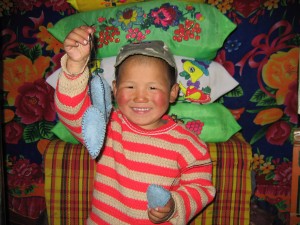
Happy Mongolian boy with a craft toy made by women in the Snow Leopard Enterprise scheme. Photo SLT.

One of my favorite Snow Leopard conservation projects is a finalist in the BBC World Challenge Competition.

Please vote for Mongolian Snow Leopard Enterprises  This wonderful organisation helps save snow leopards in Mongolia by providing villagers with income producing alternatives so that they do not poach the endangered cats. Women all across central Asia are being taught skills to produce beautiful crafts sold by the Snow Leopard Trust, giving them incomes for their families. It’s a great project and would be a wonderful reward to the women of Mongolia and snow leopard conservationists to win this. Vote here now and help snow leopards win this prize. You can vote till 10th November.

A surprising announcement that the BBC wants to close down its 4-year-old Wildlife Conservation Fund, which has raised nearly $5 million for endangered species including snow leopards.

The fund has raised the money mainly from fans of their fabulous wildlife documentaries, financing over 80 programs around the world. David Attenborough’s Planet series (in the Mountain epsiode) had magnificent footage of a snow leopard stalking a wild sheep to feed it’s cub. This was a world first and often when I talk to people about snow leopards they say “oh I saw one on David Attenborough!”

It was great that the BBC not only bought the lives of endangered species into our living rooms but also committed to fund raising and action to help these animals. Sadly that seems now to be under threat as part of cost cutting.


Team commemorates opening of Mount Noshaq to climbers. Anthony Simms from WCS Afghanistan. Photo WCS.

After the recent good news of remote cameras photographing more snow leopards in Afhganistan comes another piece of good news. The country’s highest mountain, Mount Noshaq (7492 metres) is again open to the mountaineering community after many years closure due to conflict and insecurity.

Mount Noshaq is located in important snow leopard habitat in the Hindu Kush Mountains of the Wakhan Corridor. Other important species on the mountain are Marco Polo sheep, urial and ibex (wild goat), all snow leopard prey.

Village conservation education will help snow leopards.

Afghani villagers at conservation education program. Photo Haqiq Rahman WCS.

The Wildlife Conservation Society’s Afghanistan Program Technical Advisor, Anthony Simms commemorated the opening with a climbing expedition a few weeks ago. He was accompanied by a team, which included Tim Wood (the first Australian to reach the summit) and Aziz Beg (only the third Afghan national to reach the summit).

During the 1970’s Afghanistan was a major destination for many young international tourists going across Asia to Europe and I was one of those, spending 5 wonderful weeks there one winter. I’m so delighted that this area, with snow leopards, is now safe again.

Snow leopard habitat Afghanistan

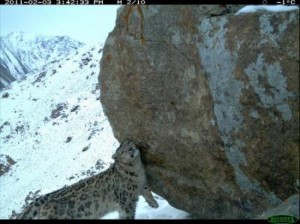
Recent camera trap photo of snow leopard in Afghanistan suggests more cats in the Wakhan region than previously thought.Photo WCS.

“This expedition marks the revival of a once popular tourist site that was forgotten during the country’s political unrest,” said Peter Zahler, Deputy Director of WCS’s Asia Program. “Despite the turmoil that continues in some parts of the country, Wakhan is just one of a number of areas in Afghanistan that are very safe from a security standpoint, and where tourism is already providing jobs and improved livelihoods for local people while providing an incentive to protect the country’s fragile environment and wildlife.”

Well done WCS! They are are working with over 50 local communities across the country to help management of natural resources and building community conservation programs that protect wildlife and improve villagers’ livelihoods. They’ve trained 59 community rangers to monitor snow leopards and other species and supporting conservation education in schools. More information see WCS Afghanistan Program.