≡ Menu
Snow leopard Hemis National Park Ladakh. Photo Sibylle Noras / Jigmet Dadul

Our snow leopard looking across the valley at us. We watched her for 8 hours. Photo Sibylle Noras / Jigmet Dadul

What were the chances to see snow leopard in the wild?

Our group of six landed in Leh, the capital of Ladakh and we spent a few days acclimatising to the Himalayan altitude (3600m) by visiting stunning Buddhist monasteries and walking the hills. As we prepared for our 9 nine nights sleeping in tents out in the Rumbuk Valley I was thinking each day, the snow leopard will teach me patience. I will need to trek gasping for breath and sit watching on high ridges in snow and ice for hours.

Although this beautiful mountain area, the Hemis National park, is prime snow leopard habitat, I knew it would be unlikely I would see a hint of the cat local people call the ‘Ghost of the Mountain’, the ‘Ghost Cat’. I thought to myself, I will be happy, no, ecstatic,  with a sight of a whisker or a tail. No way could I know beforehand the amazing sighting our small group was to have. Later people would say we had been not just lucky, but blessed.
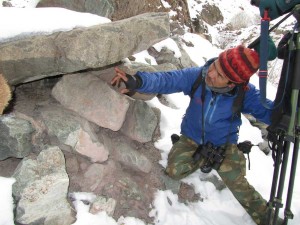
Jigmet tracking snow leopard in Hemis National Park

Jigmet tracking snow leopard in Hemis National Park. He found pugmarks, scrapes, scat. Photo Sibylle Noras.

Our leader, Jigmet Dadul from the Snow Leopard Conservancy India is the number ONE snow leopard tracker in Ladakh. He is a charming man who was born and bred in these mountains and spent years learning the secrets of the snow leopard’s world. He has seen more snow leopards than anyone. That was a great start.

Looking for scats, scent and pugmarks

Once we left the township of Leh and were trekking out on the trail in Hemis National Park our days had the same pattern. At 7 am Jigmet goes off scouting in the valleys, either alone or with one or two of our group. His young son Gyaltsen is also with us, a snow leopard tracker in the making and he often went with his dad, whistling and almost running up the steep hills.

But Jigmet’s morning was always the same. He walks the valley floor looking for snow leopard sign like pug marks (paw prints), scat (feces) or better still, cat movement. Once he’s walked past rocky outcrops where cats may linger he smooths over the snow to cover his tracks. If a snow leopard makes a track later it is easier to see. Once he showed me a pugmark in the sand near a rock. He indented his fingers into the sand next to it so he could tell how old the mark was. “Only one day”, he said with a smile.

Our tents in the snow in Husing valley Hemis National Park.

Our tents in the snow in Husing valley Hemis National Park. Photo Sibylle Noras.

Sleeping in tents in the snow

Meanwhile at 7 am Samstang, our most gregarious kitchen staffer, would wake us with a cup of tea each in our own tents. A luxury, cradling the hot cup in the hands as the wind howled outside and dawn slowly broke over the mountain tops. A precious few minutes snug in the warm sleeping bag before the race to get up and dressed with chattering teeth. The tent was always freezing and I soon learnt to put the tooth paste in the sleeping bag so it would not be frozen in the mornings.

At 8 am we’d have a huge hot breakfast in our blue communal dining tent, the most amazing scrambled eggs, porridge, toast and jam. When Jigmet came back around 8.30 would give us a report of any sign. Usually he had good reports, a pugmark here and there.

After Jigmet had his well deserved breakfast we’d start off, each day in a different direction, up to a different ridge up a different valley, but all long slow treks through thick snow and on icy rock. The frozen river beside us girgled underneath its layers of ice.

The days were cold, often we guessed around minus 10 degrees. I found the going tough, trekking up to high ridges and sitting on rocky outcrops in the snow, scanning 360 degrees around us for hours in the cold. It had definietly been a lot easier dowing this on my first treks thirty years ago. The mountains were older and so was I. But the aluring prize of seeing one of the most secretive and seldom seen wild cats was worth the effort of bursting lungs, leg cramps and exhausted muscles.
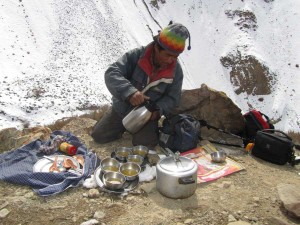
Choespang brought our hot lunches

Choespang brought our hot lunches and tea each day we were scanning for snow leopard. Photo Sibylle Noras.

Each day, when we reached our scanning ridge, we would sit for many hours on cold rocks or tree stumps with binoculars and scopes poised. Although there was a lot of snow on the ground we were lucky that during our entire trek no fresh snow fell and despite being whipped by winds on these ridges, we were at least dry.

How many people have ever seen a wild snow leopard?

As we scanned we made many jokes about seeing a nose, an ear, a tail? How many people have seen this cat in the wild, I wondered? I knew many snow leoaprd biologists, dedicated and hardy people who had spent years doing their research out in the field but had never seen a wild cat. Why would I get to see one in the 9 days I had available?

Jigmet radioed back to camp at lunchtime, telling our team where we were. A little while later, up came Choespang, the oldest of our kitchen staff, shuffling at great speed in his rubber boots, carrying 2 thermos flasks, one for soup, one for tea. Amazingly he also carried a pressure cooker full of hot rice. We were so happy to see him. His hot goodies kept us going till about 5 pm, close to when the sun went down and it became even colder.

Blue sheep are prime snow leopard prey

Blue Sheep are really a type of wild goat and are prime snow leopard prey. This small group kept us amused for hours the day before our snow leopard sighting. Photo Sibylle Noras.

The snow leopard’s companions. Counting other wildllife,

The first four days we saw lots of Blue Sheep. These delightful animals are actually wild goats although they look like a type of deer. They are primary snow leopard prey. We also saw two beautiful red foxes, with their rusty colored body fur and white plume tails. One day we saw 4 Golden eagles, beautiful birds. They take baby Blue Sheep and throw them onto the rocks below to kill them before they eat them.

Each day we saw tantalising pug-marks, snow leopard tracks in the snow. We also saw spray scent marks on rocks, telling us that snow leopards were moving through the valley. Snow leopards like to keep out of each others way and they communicate via these sprays, telling the few that share the range habitat, where they are, are they male or female.

It’s estimated there are about 30 snow leopards in Hemis National Park (at 4000 square km the largest NP in India). Jigmet said where we were searching there were 5 to 6 cats. A big job to find a cat the size of a large dog, with fantastic camouflage in a hundred-square km of high altitude valleys.

On our first day we had met a group of trekkers who’d seen a cat way in the distance for a short time. We hoped that their luck would rub off on us. Even with their 600m lenses it was tiny sighting but I thought to myself, I’d be happy with that. We heard of another group here recently for 17 days that didn’t see a cat at all.

The nights were freezing, around 20 degrees below zero. The condensation from my breath froze into tiny icicles around the top of my sleeping bag. Luckily the bag was excellent, made for the Indian Army that had to sleep on glaciers up here in the Himalayas. I had never in my life seen such a thick sleeping bag, the thickness of a huge bed mattress, but it did the trick.

Snow leopard tracks on the frozen river.

Snow leopard tracks on the frozen river. Photo Sibylle Noras.

Friday the 25th February started like all the other days.

Jigmet had gone out with Thomas and John at 7.30 trekking up the Tarbung valley looking for sign. Katie, Jamie and I were sitting down to breakfast when KC Namgyal, Jigmet’s colleague at the SLC ran into our tent, yelling “Shan! Snow Leopard!”. OMG! I dropped my breakfast plates and the cup onto the ground without thought. I grabbed my stocks and camera, almost fell over trying to pull boots on quickly. I ran with Namgyal, along the frozen river. Every now and then we had to run on the river rather than at its frozen edges. I heard the water rushing beneath the ice and was petrified. I guessed we ran about 300m along the river, then 300 m along rocky scree with a ridge that was only about 20cm wide and past a boulder hanging in thin air. I ran, walked, almost crawled and dragged myself 500m along the valley and up an incline for 200m. It all seemed like a hundred km to me, as my lungs were bursting and my boots filled with snow (in the rush I’d forgotten to tie on my gaiters). But all I could think about was seeing this snow leopard! What if it moved before I got there? Would a cat stay still in one place for so long?
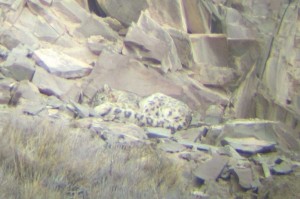
Our snow leopard sleeping

Our snow leopard sleeping on her rocky ledge. Photo Jigmet Dadul and Sibylle Noras.

Finally I got to the long telescope.

I looked up at the rocks across the valley and saw the most beautiful cat in the world and immediately burst into tears. Jigmet was sitting further up and he called to me. Another 5 mins of breathless climbing and I looked into his scope which had an even better view. I burst into tears again!

Jigmet said it’s a female, about 7 to 8 years old. The scope made her look as if she was about 50m away, we saw her lie and stretch and look up. At times she was asleep and her front paws would push up into the air and make little running movements as if she was chasing Blue Sheep in her sleep. Then she’d open her eyes and peer at us, if one of us walked down the hill. She could see us but it was obvious she felt no fear. Then she’d wrap her enormous tail around herself like a scarf.

I could not believe my luck in seeing this beautiful beautiful cat. It was my sixth trek  into high altitude snow leopard territory and today was the one day I had been hoping for for so many years.

Our snow leopard watching us across the valley.

Our snow leopard watching us across the valley. This shot was taken with my compact camera through the scope. Although its blurry I love it as it gives the cat a ‘ghost like’ appearance. Photo Jigmet Dadul and Sibylle Noras.

Altogether we watched our magnificent snow leopard for 8 hours.

Jigmet thought she’d just eaten a Blue Sheep and so would rest for a few days before moving on. Occasionally she’d stand up and put her rear end down as if about to nestle, then suddenly turn around and lay down in the opposite spot staring out at the wind, at birds, at scents across the valley until she fell asleep again.

Late in the afternoon the others started going back down to our camp. I couldn’t bear to tear myself away, she was still in that spot, sleeping calmly. Finally close, to 5 pm, Jigmet said we had to go. It was getting dark and we negotiated the hills down and the trek along the frozen river with a torch and finally came into camp in the pitch dark. I had spent as much time with this queen of the mountain as I possibly could.

That night in the dining tent we toasted the snow leopard

We toasted Jigmet and toasted ourselves. The fact that we’d had such a day with this mystical cat was remarkable and special. But more importantly we toasted the Snow Leopard Conservancy and the local people of this region who were now helping to protect their spectacular and iconic  “Ghost of the Mountain”. May there be many many more generations of snow leopards in the cold valleys of Hemis National Park.

Thanks Jigmet, thanks to our hardworking staff team who made fabulous food, kept the ‘hottie bottie’s’ coming into our sleeping bags at night and looked after us so well. Thanks to KarmaQuest for their great organisation. And thanks to Thomas, Katie, Andrew, John and Jamie for being such charming companions on this incredible trek. I’ll never forget this day.

Leh, pic from wikipedia

The town of Leh high in the Himalaya

Message from Sibylle at Leh, Ladakh, 18 Feb:

“Arrived in Leh at 3800m to a fabulous sunny sky and minus 10 degrees.

The flight along the Himalayas was spectacular with not a cloud in the sky. Our small group has met up at our guesthouse and tonite we’ll meet our Snow Leopard Conservancy hosts.  They’ll tell us all about their work and the trek we’ll take day after tomorrow.

Leh town is quiet, many locals have gone down to warmer climes and tourists are staying away till summer.  I’ve spoken to a guy at the guesthouse whose tiny village about 20 km away had a snow leopard visit recently.  However, I’m truly in wilderness now so won’t be able to post for the next two weeks.  See you then with many stories of our wonderful cats.”

Arrived in Leh at 3800m to a fabulous sunny sky and minus 10 degrees. The flight along the Himalayas was spectacular with not a cloud in the sky. Our small group has met up at our guesthouse and tonite we’ll meet our Snow Leopard Conservancy hosts. They’ll tell us all about their work and the trek we’ll take day after tomorrow. Leh town is quiet, many locals have gone down to warmer climes and tourists are staying away till summer. I’ve spoken to a guy at the guesthouse whose tiny village about 20 km away had a snow leoaprd visit recently. However, I’m truly in wilderness now so won’t be able to post for the next two weeks. See you then with many stories of our wonderful cats.

A little bit of Australia in Delhi. Cafe OZ in Khan market where I mt up with three staff from India Snow Leopard Project.

I’ve had two enjoyable days in Delhi. Sightseeing around the Tibetan, Indian handicraft and spices markets, lunch at the grand Imperial Hotel (best tandoori chicken I’ve ever tasted).  I had a hot stone massage – first time ever – fantastic, so relaxing. Hard to believe being pummeled with hot stones could be relaxing but it is.

I had a driver for the 2 days, Jaspal from Amritsar, who turned out to be excellent and really knows his way around the roads and the use of the horn – a must in Delhi. We had a hiccup at the start though, when he screeched to a halt in the middle of the road and jumped out of the car, leaving me, surprised (!) in the back. He grabbed some plastic bags from the boot, ran onto a nearby nature strip and emptied seeds and bread into the air. This was immediately scooped up by a whirlwind of ravens, pigeons, butcher birds etc. I was in the hands of a “twitcher.”

But the highlight was definitely meeting up with Charu Mishra, Director India Program Snow Leopard Trust, and two of his team Yash Veer Bhatnagar and Koustuhb Sharma.

These guys really know snow leopards, between them have travelled thousands of miles in the Himalayas, worn out countless boots and studied the cats and their prey for many years. They’ve also been lobbying at the highest levels of government, state and federal for support to conserve India’s remaining snow leopards and their habitat.

Lamingtons made with sponge, chocolate and rolled in coconut. Just one of the typical Aussie tucker goodies available at the stylish cafe.

Coincidentally we ended up meeting at Cafe Oz in Khan market. I promise I wasn’t missing Aussie food already after 2 days. When the head waiter found out I was from Australia I was grilled on the authenticity of their lamingtons and pavlovas. I didn’t have the heart to tell him I’d never made either but then I had tasted a few so I could give an opinion that theirs were delicious and authentic. They made sensational latte too.

Many snow leopard stories were shared but my favorite was about Shonkor, a radio collared cat, part of the Snow Leopard Trust Mongolia project. Shonkor is being a bad boy. He’s killing domestic livestock and hanging around where he isn’t wanted. Charu says he’s been watching Shonkor’s radio sign on the computer as the boy gets closer and closer to villagers, and he, Charu then yells at the computer, “Go back, go back! Somehow it doesn’t seen to influence him J”

Turns out so far the herder who’s had stock killed by Shonkor hasn’t taken a shot at him, even though he has a gun. Instead he fires into the air. Part of the problem, Charu says, is the herder’s dogs are old and don’t bark at the cat as it comes close to the sheep. “He needs to retire those old guys, and get some young ones to do a better job. ”

Shonkor Panthera/SLT Mongolia project. Photo Panthera/SLT.

Shonkor with his radio collar that's showing the researchers he's hanging around domestic livestock too much. He's one of the cats in the Panthera/SLT Mongolia project. Photo Panthera/SLT.

It’s a good sign of herder attitudes changing that Shonker hasn’t been killed, but he does need to learn what he’s allowed to eat and what not. Hopefully he does that soon with a bit of help from dogs, herders and snow leopard conservationists.

Anyway its now nearly 9 pm and I’ve got to get some sleep. There’s three of us here in Delhi and we leave for the airport to fly to Leh, Ladakh at 4 am. Ugh! The things we do for snow leopards.

A snow leopard cub that fell off a steep cliff in private nature park in Tajikistan. Photo S. Michel.

A sad news story from Tajikistan reminds us of the dangers snow leopards face from their harsh habitat. Stefan Michel, from the Nature Protection Team in Tajikistan, found a dead snow leopard cub in a private conservancy park  near the border of Afghanistan.  The cub had fallen to its death. Michel noted that a markhor, (wild snow leopard prey) had also fallen to its death nearby.

When we see pictures of snow leopards, wild sheep and wild goats running up and down the incredibly steep cliffs of these mountains we marvel at their amazing agility. But sometimes the cliffs are just too steep and in this case the young cub had not yet learned how to negotiate them safely.

Steep cliffs in Tajikistan where the snow leopard cub fell and died. Photo S. Michel.

However the good news from this area is that snow leopards seem to be flourishing due to good prey stock and protection from humans in this private conservancy.

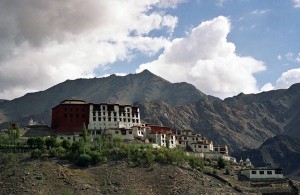
Ladakh is at very altitudes, above 3500m and as a Buddhist region has many stunning monasteries. Photo Wikipedia.

Finally ready to fly to Delhi tomorrow for a few days before flying up to Ladakh, high in the Himalayas on the China border. Entering the lair of the snow leopard!

I’ll be trekking with folks from the Snow Leopard Conservancy India who have been doing amazing research and community conservation work that has resulted in a safe habitat for snow leopards. But first a bit of R and R in Delhi, great food, shopping.

Ayurveda massages uses many natural plants including ginger and cardomon.

Am looking forward to meeting interesting snow leopard conservation folks that hang out there …and oh, a good pre trek massage.

John Shulman, author of "The Lama, the Snow Leopard and the Thunder Dragon". Photo John Shulman.

This month’s Guest Blogger is Professor John Shulman, a man of many talents  and truly inspirational. He’s a graduate of Harvard Law School, an internationally recognized expert in negotiation and conflict resolution and he recently co-wrote and directed the award winning human rights film “Justice.” But today he writes about another passion – the environment, children, wildlife and India. His newly published children’s book “The Lama, the Snow Leopard and the Thunder Dragon,” is an unputtdownable (even for adults!) read about a delightful threesome of child heroes who battle the villains of ‘Progress’ and ‘Development’ in the Himalayas. Karma, the world’s first vegetarian snow leopard, a blustery thunder dragon and a mysterious lama help them. John has kindly written about the book for Saving Snow Leopards Blog.

“I have three young children, who also happen to be the main characters of the book. I was inspired to write the book by my children’s interest in stories and what I found to be a dearth of inspiring stories set in India, which is where my family has lived for the past three years.

Book cover of "The Lama, the Snow Leopard and the Thunder Dragon". Photo John Schulman.

I also felt that many children’s stories do not address environmental issues and the story of colonialism in a credible, entertaining way. (They mostly either skirt these issues or deal with them in a manner that is less than honest.) I challenged myself to write a story that would work for children as an entertaining fantasy adventure but would also bring out issues that I feel are important for all children to understand.

In addition to the story’s themes, I wanted to offer my children—and eventually all children—an alternative to today’s video game/television/movie entertainment offerings. If our children are to think for themselves and eventually chart a healthy future for themselves, for our species and for our planet, they must develop their imaginations and their analytical thinking. These skills can best be developed through reading, I believe. I wanted the book to appeal to children’s sense of mystery and possibility, their innate sense of justice and fairness, and most of all their dreams for a life and future they (and we all) can aspire to create.

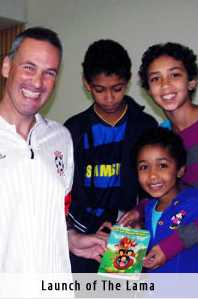
John at the book launch. Photo John Shulman.

My role models as “children’s authors” are Roald Dahl and Jonathan Swift. What they showed me is that with humour and bold storytelling, an author can reach both children and adults simultaneously. That was another idea I had in writing the story; I wanted to write a book that parents and grandparents could read to their children and grandchildren, and that would appeal equally (albeit in different ways) to both audiences.

So far the feedback I have had from children is that they find the story to be a rollicking good adventure—fair enough! Adults who have read the story tend to focus on the environmental and social messages—great!

The illustrator, V. C. Raghavendra, is exceptionally talented. When I first saw his concepts for the cover art, I was thrilled. The cover art is beautiful—appealing and evocative. I think Raghu’s depiction of Karma, the snow leopard, is particularly stunning. The illustrations at the beginning of each chapter also find just the right balance of hinting at what will follow and leaving room for the child-reader’s imagination.

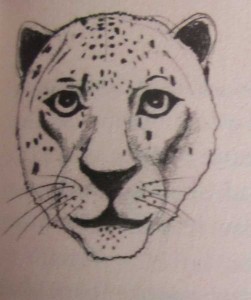
Karma the vegetarian snow leopard.

The snow leopard is one of the key characters in the story. Her name is Karma and she talks! Even more surprising than the idea of a talking snow leopard is what she says. It turns out that Karma’s life and perspective are a parable for the threats facing not only the Himalayas but all areas that are under increasing pressure from human economic “development” activities. While by reputation, a snow leopard is the iconic top predator of her domain, Karma explains that she has been displaced at the top of the “food chain” by humans, who have poisoned the Himalayan environment with pesticides and genetically modified plants in their desire to subjugate rather than cooperate with nature. Choosing not to ingest toxic accumulations of pesticides in the meat of her traditional prey (mountain goats), Karma has become a vegetarian snow leopard. So while humans may think they should fear a predatory big cat, the snow leopard in this story turns out to be a soft-hearted friend for the book’s child-heroes.

India faces unique challenges. It is a large country with a huge population. It is also the target of some of the most predatory, intense “development” activities that are often no more than a subterfuge for imperialistic profit-making schemes. India’s education system is gargantuan and not terribly responsive to today’s challenges, much less the challenges that are sure to arise and intensify in coming years and decades.

For the children of India—and the children of the world, for that matter—my hope is that this book will offer an alternative vision to the consumerist, exploitative “entertainment” to which children are currently subjected. I hope “The Lama” will entertain generations of children and spark conversations about what it means to be a citizen of the world, what it means to share this planet with other people and with other species. I hope specifically that Indian educators will find in “The Lama” a vehicle for engaging students in an ongoing exploration of how we can change our individual and collective behavior so as to live in a healthier, more sustainable manner.

I am personally committed to reaching out and connecting with children and adults who wish to find healthier ways to live. I know that while I may not have the answers, I enjoy asking questions and exploring wherever those questions lead us. I also hope to connect with organizations, such as the Snow Leopard Conservancy, committed to encouraging such exploration.”

The book is available from the publishers, Hachette India. For more information on John see his website.

Packing for Indian Himalayas snow leopard trek

Just a fraction of the gear I'm taking, including my favorite hot water bottle, worn boots and those Lecki stocks to take the weight of old knees ;-)

Well Melbourne has finally got it’s summer heat wave, with the last two days being almost 40 degrees. And I’ve just started to put together my gear of thermals, down jackets, sleeping bags and hot water bottle for the Indian Himalaya trip with the Snow Leopard Conservancy next month. Hard to believe that in just over two weeks I’ll be trudging in snow and wishing I was back in this heat wave.

I've discovered these toe warmers made in Japan, I sure hope they work. But how many to take, that's the question?

The team tells me it can get to about minus 25 degrees C which, the thought of which for a summer loving Aussie, is terrifying. Still, it’s during winter that the snow leopards mate and come down into lower altitudes so it may just be the chance of a lifetime to see one.

But I’m not taking chances, this is probably the most gear I have ever packed for a Himalayan trek and I’ve discovered special toe warmers you can put into your boots, I’ve got a dozen…maybe I should have more….maybe I need another hot water bottle, one’s not going to be enough.

Stay tuned…I’ll be writing about the location and the itinerary of the trek over the next few days.

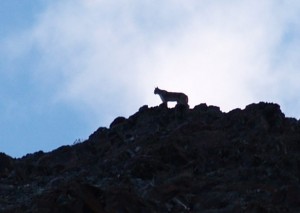
A wild cat on a ridge high up in the Himalayas. Photo courtesy Sumant Gupta, Trish McHugh and Andrew Dean.

It’s such a huge thrill to see a rare wild animal in its own remote habitat. Most of us live in urban environments far away from anything wild, so seeing a wild cat is certainly an unforgettable experience. And when you are hoping for a glimpse of one of the most elusive cats on the planet?

This week I got photos from a group of Australian eco trekkers who’d been in the high altitude Hemis National Park in Ladakh in India, with World Expeditions. They’d trekked long hours and into the high thin air of the Himalayas when they saw a big cat.

Elusive wild cat at 4350m in Indian Himalayas. Photo courtesy Sumant Gupta, Trish McHugh and Andrew Dean.

According to 2 of the group, Trish McHugh and Sumant Gupta “it was late evening, at about 4350 m above a tiny little settlement, one house really, at a place called Yurutse. We were looking up to a ridge above the low camp before Ganda La, so about 4350 metres and late evening when we saw it.”

Was it a snow leopard?

“We all thought it was a snow leopard and so did Norboo, our guide and our horseman.” They were excited and hopeful but close inspection of the photos once they got home showed it was another cat, a lynx that shares its habitat with snow leopards in this part of the Himalayas.

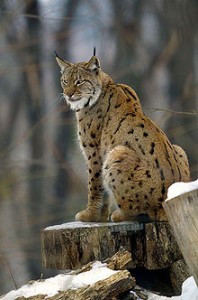
Lynx, a wild cat sharing habitat with snow leopards in Himalayas. Photo Wikipedia.

The lynx is a medium sized wild cat and from a distance it can easily be mistaken for a snow leopard – its typical solid wild cat body has white fur on the chest and large padded paws for walking on snow.  But up close you can spot the differences – the lynx has a short tail, very obvious fly away tufts of black hair on the tip of its ears and very long whiskers on the face.

Like snow leopards, lynx are usually solitary, although small groups of lynx have been known to travel and hunt together occasionally, something that only snow leopard mothers with sub adult cubs would do.

Lynx and snow leopards share habitats where there are high altitude forests. Although the IUCN Redlist doesn’t consider the lynx endangered, some populations are dwindling due to humans clearing forests and moving in livestock. In fact they face the same challenges to their habitat and their long term future as do snow leopards.

Close up photo of lynx shows similarities and difference to snow leopard. Photo Wikipedia.

I know the group would have loved it to have been a snow leopard, but seeing a beautiful wild lynx in its home habitat on a ridge in those magical mountains was pretty special too. And getting such great photos was an extra bonus. Well done team!

Irbi, the snow leopard mascot for the 7th Asian Winter Games to be held in Kazakhstan end of January 2011.

The 7th Asian Winter Games 2011, to be hosted in Kazakhstan, have chosen the snow leopard as their mascot. The Games are held every four years among athletes from all over Asia under the auspices of the International Olympic Committee. This year the event is expected to attract athletes from 45 countries and includes sports like skiing, ice hockey, skating.

Kazakhstan is one of 12 nations in Asia that has endangered snow leopards, but with many threats to snow leopard habitat in the country, the population is estimated to be a only a few hundred.

The mascot is called Irbi, the word for snow leopard in this region being Irbis. Hopefully the cute little guy will help bring a lot of attention to the plight of the endangered species and help educate people about conservation efforts.

The Games run from the 30th January – 6th February, 2011.

Local yak herders guide research team to locations where snow leopards are likely to be. Photo Tshewang Wangchuk.

Tshewang Wangchuk of the tiny Kingdom of Bhutan in the Himalayas is breaking new ground with snow leopard research techniques that don’t involve capture and collaring of the cats. Instead, Tshewang, who is the Bhutan Foundation’s Conservation Adviser and recipient of a National Geographic Society Waitt grant, has collected almost 300 hundred snow leopard droppings (scat).

Remains of blue sheep, a wild sheep that is snow leopard prey. Photo Tshewang Wangchuk.

The scat will be analysed to establish the population of the cats and the areas of their preferred habitat. So far it looks like the western part of Bhutan has more snow leopards, it is both drier than the east and also has more prey like the wild blue sheep.

“We want to see how effective it is to use noninvasive techniques. Other research methods are very intensive and you have to put in a lot of effort. For each scat sample collected we use GPS co-ordinates so later on we can go back and see which animal was found in which area and find out how connected animals are. It will not be very long before we come up with a population estimate.”

Field staff getting training with mapping, sampling, monitoring techniques. Photo Tshewang Wangchuk.

Tshewang also involves local people and local researchers in this work.

“We find the locals have a treasure trove of knowledge. There is a lot of indigineous knowledge that provides us with information of what the animals do and where they are. Local people not only have knowledge but they are very dedicated and take great interest in what we are trying to do.

“We need to build capacity at local level. We can’t always depend on a biologist flying in from London or from New York, coming in and doing our research for us and then leave and we don’t have the capacity. With this intention we place a lot of emphasis on empowering local researchers with training and equipment.”

See National Geographic video of Tshewang’s snow leopard research here.