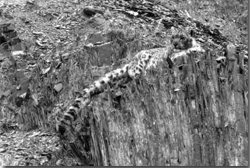
Martin Aveling's print of a snow leopard cub being auctioned to raise funds for conservation at AHF dinner. Photo by Sami Hisheh.
Last Friday the Australian Himalayan Foundation had its annual dinner here in Melbourne. It was an enjoyable dinner and about 350 people came together to celebrate their love of the Himalayas, its people, its culture and its wildlife. “Saving Snow Leopards” website donated a limited edition print of a snow leopard cub by well known British wildlife artist, Martin Aveling, and I’m happy to report it was successfully auctioned for $1500. Bidding started at $200 and quickly spread around the room until the fabulous sum of $1500 was reached. The successful bidder was Michael Eger, thanks Michael for your generosity in supporting snow leopard conservation.
Successful bidder, Michael Eger, with Sibylle Noras, publisher of "Saving Snow Leopards" website. Photo by Sami Hisheh.
The $1500 will go a long way in Nepal, towards a snow leopard conservation project in collaboration with the US -based Snow Leopard Conservancy.
AHF president, Peter Hillary, spoke about the school and health projects they support in the mountains of Nepal and northern India. He also commemorated Alfred Gregory, the Everest Expedition photographer, who supported the AHF and died in his 90’s earlier this year. Guest speaker, Li CunXin, spoke about his life, his book and the film “Mao’s last dancer”. Li is a truly inspirational speaker and his determination and ambition to break through his life of poverty in Mao’s China to become one of the world’s most celebrated ballet dancers is remarkable.
To help the Australian Himalayan Foundation support children and villagers in poor and remote communities check out their website.
Now here’s a great idea! Using Google maps to identify the location of news stories about snow leopards in China. Juan Li, a young Ph.D. student has created this Google map of snow leopards reported during the 20 year period of 1990-2009 by searching the Google News Archive.
She says” I am a Ph.D candidate of conservation biology, in Center for Nature and Society, Peking university. And my supervisor is Lu Zhi.
I did this map, just because I wanted to know more about snow leopard in China. And Google Alerts is a simple and easy way to collect the information. But Google Alerts did not provide the auto-link to the Google map. So I have to map the news manually. And I will keep this map updated.
I don’t mind you put it on your website, which is a really great website for snow leopard. Thank you. All the best wishes!”
Thanks to you Juan Li, this is a very clever idea and it’s good for researchers and people interested in snow leopard conservation in China that you’ve committed to updating it. We’ll publish it on a regular basis.
KarmaQuest's snow leopard ecotour saw a wild snow leopard in Ladakh, India. Photo by Brian Keating.
Yes, we believe it can. To share information on snow leopard ecotourism I’ve added a page about travel and conservation companies offering trips to snow leopard regions. There’s information on what ecotourism trips offer, what you can expect if you go on a snow leopard ecotour and how such trips contribute to local community conservation and snow leopard conservation. Checkout the Ecotourism page and some of the travel companies offering snow leopard trips. Biosphere Expeditions / KarmaQuest / Wildlife and Nature Travel /
9th wild cat collared in the Snow Leopard Trust's amazing Mongolia study. Photo SLT.
On the 25th April the ninth snow leopard was collared in the Trust’s ongoing Mongolia study. He’s a male, weighing 34 kg and Orjan, the Swedish researcher working with the team thinks he’s about 2 years old. The new male is currently called M8 – a very unromantic research name – but he’ll be given a more appropriate name soon to join his fellow cats with interesting names like Saikhan, Tsagaan, Devekh, Shonkor and Aztai.
The SLT team is now following six wild snow leopards using GPS radio collars in this mountainous region of the Gobi in Mongolia. Read all about this amazing study and the behaviour of the cats (and researchers) at the SLT base camp in Mongolia on the SLT Blog.
Just yesterday I wrote about the successful snow leopard breeding program at Darjeeling Zoo in north India. Well, news today is they have another cub! She was born 42 days ago and appears in good health.
Mr Alonkar Jha, Director of the Zoo said “this is a female cub and that is very important for our future breeding. Second thing is that we have learned by our experience that if a cub is born at this time, its health will be all right. Rearing of cubs is difficult during rainy season. So, now we hope it will grow well.”
Snow leopard with cub at Darjeeling Zoo. Photo Darjeeling Zoo.
The Padmaja Naidu Himalayan Zoological Park in Darjeeling, northern India has launched a two year project to research the nocturnal behavior of its snow leopards by keeping the animal under infra-red camera surveillance. The zoo, which has had a successful breeding program for many years, currently has six female and five male snow leopards. The most recent births were 3 cubs born in April 2009 to Neeta (female) and Karan (male).
“Even though other animals have been kept under surveillance, this is the first time that the snow leopard is being studied in this manner. We want to record the animal’s behavior at night,” said A.K. Jha, the director of the zoo.
The Central Zoo Authority, the governing authority for all zoos in India will over see the project.
The zoo lies at an altitude of over 2000 m so is ideally suited for snow leopards whose habitat is from 2000 m to 4000 m. At this altitude the zoo is able to specialise in breeding animals adapted to alpine conditions, and has successful breeding programs for not only snow leopards but other animals that share its habitat, like the critically endangered Himalayan wolf. The zoo is spread over 44 hectares and attracts 300,000 visitors every year.
Alxa league (red) in Inner Mongolia (orange) and China. Mongolians arrested for smuggling snow leopard skins. Map from Wikipedia.
Good to see Chinese authorities clamping down on the illegal snow leopard parts trade.
A news story this week reports Chinese police arrested two Mongolian citizens after finding two snow leopard skins and a snow leopard skull hidden inside their jeep at a border checkpoint, state media said Tuesday.Police in the remote Alxa League of north China’s Inner Mongolia region spent 10 hours searching the vehicle that had more than 40 hidden compartments, the official Xinhua news agency reported.The smuggled skins and skull had an estimated value of more than 200,000 yuan (29,000 dollars) on the black market, the agency quoted Zhao Jun, an anti-smuggling officer from the regional capital, as saying.
Experts say snow leopard skins from Mongolia and Kyrgyzstan are often smuggled across the borders to be sold in China or abroad.
Spiti Valley north India, soon to have Snow Leopard research centre.
Just a few days ago I wrote about the likely Snow Leopard Research Centre in Spiti Valley in northern India going ahead. Turns out there has just been a sighting of two snow leopards in that region. In the past there’s only been indirect evidence of the cats like pictures in trap cameras but this time “the team saw two snow leopards who were in a playful mood and remained in sight for an hour, raising hope for the success of Project Snow Leopard” said KS Thakur, wildlife conservator. This is really good news for the Project, hopefully the Centre can be set up soon and do great research, community development and education in this region where we still have the beautiful cats.
Ousted President of Kyrgyzstan, Kurmanbek Bakiyev, found to have private zoo with many endangered animals including 2 snow leopard cubs. Photo LA Times.
Update on yesterdays story about the snow leopard cubs in an illegal private zoo in Kyrgyzstan. BBC News confirms the property belonged to former President Bakiyev.
“A pair of snow leopards and two bear cubs were among the exotic animals found in the private zoo of ousted Kyrgyzstan President Kurmanbek Bakiyev. A golden eagle, two falcons, four African peacocks and Indian ducks were also found in the zoo at the family home in the southern Jalalabad region. “The inspection was conducted as part of criminal investigations brought against close relatives and friends of former president of Kyrgyzstan Kurmanbek Bakiyev,” a spokesman for the General Prosecutor’s office said. The prosecutors are considering measures to evacuate the animals for their protection.
Bakiyev was ousted during violent protests against widespread corruption and rising utility prices in the Central Asian state earlier this month. He has been granted sanctuary by strongman Belarussian President Alexander Lukashenko.”
Children in Tajikistan, Central Asia. A small country with endangered snow leopard population. Photo FFI.
Many snow leopard range countries are not well known by most of us and Tajikistan is no exception. I knew nothing about it before I became interested in snow leopards, but yes, they do have some. How many is not exactly known. So today I’ve added a page of information on snow leopard conservation projects in that small landlocked mountainous country in Central Asia. Check it out here.