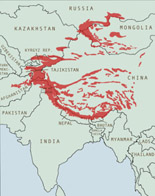
Leon at Melbourne Zoo. Photo by Glenn McColl.
I’m amazed at how dedicated and passionate people are about the animals they sponsor at Melbourne Zoo. Recently I spoke with Glenn McColl, a very keen snow leopard photographer about all the terrific photos he’s taken of Meo, Tashi and Gobi in the last few months. Glenn hasn’t done any formal photography training training but is self taught through reading and taking many pictures, seeing what works and what doesn’t.
He explained the secrets of his best photos.

Glenn McColl, keen snow leopard photographer at Melbourne Zoo
”Taking photos at Zoos takes time and patience as I’m sure you’re aware. Each visit I try not only too take a great shot, but also research a little into the behavior of the animal at a certain time during the day in order to know when they are most active. For the snow leopards, first thing in the morning when the Zoo opens and about the last hour before closing are the main times that I try to photograph. The cubs and Meo are most active around these times, as are many of the animals at the Zoo.I also like this time because of the lighting.”
Glenn is so enthusiastic about the cats that he’s planning visits to other zoos in Australia to photograph their snow leopards over the next few months.
“I’d love to do a trip to Mongolia some day just to be in the snow leopard’s habitat and hopefully see one in the wild. In the meantime, I’ll continue to work at my craft and support and sponsor these beautiful cats. Opportunities like my recent photo submission to the Snow Leopard Trust give me the greatest satisfaction in giving something back for the pleasure the animals give me from behind the lens.”
You can see more of Glenn’s photos on the Melbourne Zoo Friends of Snow Leopards website.
Support snow leopard conservation and the Snow Leopard Trust with Glenn’s photo’s on T-shirts and other products here.
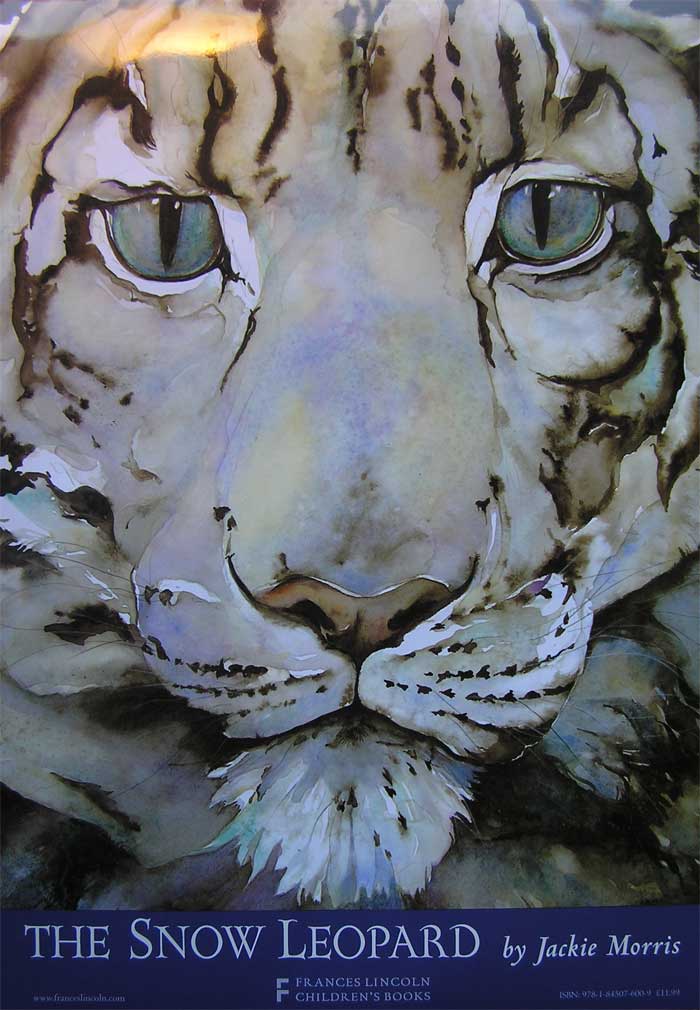
Jackie Morris 'The Snow Leopard' book cover.
Children’s author/illustrator Jackie Morris has written and illustrated a beautiful book, ‘The Snow Leopard’ about the Wakhi people in Afghanistan. Talk about being seduced by a book’s cover – the illustrations are beautiful.
The story, based on ancient village tales, concerns a shape-shifting guardian (the locals call them mergichans) in the body of the wide-eyed snow leopard. As a protector she guards an infinity of mountain realms and the people in them but it is time to find some-one to take her place. In this tale the snow leopard protector seeks out a young girl to train in the wisdom of guradianship. Not only is the story intriguing for kids (our friend’s young girl sat with the book for hours) but it also has a lovely (but subtle) environmental message about the future of mountains.
This book is a beautiful way to introduce young children to snow leopards. I was going to give the book as a present, but I can’t part with it, so will just have to buy another 
More about the Wakhi people and their supernatural snow leopard guardians on the Myths page of the Snow Leopard Conservancy’s website here.

Snow Leopard Vodka
Amazing how many different ways there are to help in the conservation of our beautiful wild snow leopards. Here’s another one. Glasgow whisky maker, Whyte and Mackay has committed to a conservation partnership to support the Snow Leopard Trust by donating 15% from profits of sales of their new Snow Leopard vodka.
The money will support a couple of projects in Kyrgyzstan and Mongolia both of which help educate local communities on their region’s fragile ecosystems. The aim of the community education is to inform children and adult villagers on how to protect the snow leopard as well as teaching new enterprises to enable them to earn more income.
[youtube=http://www.youtube.com/watch?v=-j3H6qDiZZE&hl=en&fs=1&]
This is exciting – we can see an indepth examination of the snow leopard cubs (now 6 weeks old) at Woodland Zoo, Seattle USA. There’s a lot to do, weighing, measuring, checking, vaccinations etc. This is the most comprehensive video of a zoo examination I’ve ever seen. And the little guys are so calm and placid, just quietly staring at everyone with huge sad eyes But they do get raw chicken for reward, their first ever hard food while mum Helen looks on. Congratulations to staff at the Zoo for doing such an indepth exam and videoing it.(Produced by Ryan Hawk.)

Traffic International "Fading Footprints" 2003
I’m reading one of the most comprehensive and powerful reports on the trade of wild snow leopards called “Fading Footprints – the killing and trade of snow leopards.”
It’s a huge piece of research, published in 2003 by TRAFFIC it makes quite depressing reading. At the time the research was conducted, despite legislation protecting snow leopards in most of their range countries, they are still being hunted and killed for furs and body parts for traditional medicines. When furs can be sold for $US300-$US800 its easy to see the incentive. Retribution killing by farmers protecting livestock is also still common especially in areas where they’ve had not education about how to protect their livestock.
Recognising that all the range countries have different challenges the report outlines many recommendations for how things could be improved, like strengthening enforcement of the laws. This makes sense. Having laws isn’t enough if they can’t be enforced then snow leopards hunting will continue. The antipoaching team, the Gruppa Bars in Kyrgyztan (see my recent blog post) is one example of this.
Other recommendations include helping the local communities that share snow leopard habitat which is one of the most important things that both the Snow Leopard Trust and the Snow Leopard Conservancy are doing. Its been found that when local communities understand how rare and endangered the snow leopards are they are willing to work to protect it if they aren’t financially disadvantaged.
The report is almost 6 years old. Much has been done by many dedicated agencies and people throughout the range countries. But there’s no doubt that the cats are still under huge threats.

Tashi in snow. Photo Penny Stephens. The Age/SMH
Meo and her two cubs, Tashi (f) and Gobi (m) got ten tons of snow today to celebrate the cubs’ 6 month birthday. Meo, who originally comes from a Zoo in a town in Germany very close to where I was born (on a snow storm night – many years ago) knows a thing or two about snow flakes and ice.
But not Aussie-born Tashi and Gobi. They hesitated before walking onto this funny white stuff. By the time they did venture onto it, mum Meo had found and eaten just about all the raw chicken that the keepers had put out today.

Howie with raw chicken and ice sculpture. Photo by Sibylle.
I asked Adrian “Howie” Howard, senior Carnivore Keeper about that and he said, “it happens, but she’s never let them go hungry or starve. In fact just recently she’s been pushing them to go and find the food for themselves rather than wait for her to find it and bring it back to them.” Howie had placed the chicken all through the snow as well as rubbed some onto the beautiful ice snow leopard sculpture that was also part of the celebration.
The whole thing was fun for the media and the zoo visitors and a wonderful enrichment experience for the cubs and Meo. Dad Leon next door missed out on the snow, but didn’t seem too fussed as he tucked into his breakfast and then had a snooze.
The ABC has an online interview with Howie about the snow experience today. And more pics from The Age / SMH.

Matt West, Australasian Snow Leopard Studbook keeper. Photo by Sibylle.
I had a good chat with Matt West today at Healesville Sanctuary which is part of Zoos Victoria / Melbourne Zoo. Matt’s claim to fame (one of them anyway) is that he’s the matchmaker for Snow Leopard breeding in Australian and New Zealand Zoos. As keeper of the Australasian Snow Leopard Studbook it’s his job to help zoos wanting to breed.
“We have to chose pairs as genetically diverse as possible. It’s important we protect against inbreeding and disease.” Matt was responsible for choosing Leon and Meo at Melbourne Zoo as a mating pair and he’s obviously done a good job – Tashi and Gobi are two very healthy and handsome cubs.
Matt works with the Snow Leopard Studbook keepers from all around the world, specifically in Europe, the US and Japan. The global Snow Leopard Studbook Keeper is Leif Blomqvist at Helsinki Zoo. Leif started the Studbook in 1976 when he did a massive bit of research to find out which zoos in the world had snow leopards, the gender and age of them and the source from which they came. Since then all snow leopards in zoos around the world have been listed in this book and breeding controlled to help the species develop a healthy population in Zoos.

Endangered mountain pigmy possum. Photo Matt West.
Matt is passionate about snow leopards and keen to see more bred in Australia where there is now a good body of knowledge about them. But he’s other passion also takes up a lot of time – the local endangered Mountain Pygymy Possum. These tiny little possums are native to our state and under threat from habitat loss and feral predation (the usual suspects unfortunately – dogs, foxes and cats.) Recent bushfires in our state threatened their habitat around the Mt buller area. Ironically during the devastating February Bushfire the Pygmy Possum and the endangered Tasmanian Devils had to be evacuated from Healesville when it seemed the Sanctuary was under threat. Luckily the sanctuary wasn’t touched.

Adult mountain pigmy possum. Photo Matt West.
Matt and others are working with a captive breeding program at the Sanctuary with the hope that some of them may be able to be released into the wild. You can read detail about the Melbourne Zoo program here.
[youtube=http://www.youtube.com/watch?v=i8iGxmjRrdc&hl=en&fs=1&]
Chocolate and Zoe strut their stuff at the brand new $10 m Allison Maher Stern Snow Leopard exhibit. Hot and cold rocks, scent enrichments, waterfalls, jungle, tree ropes, hiding food tidbits and more. This must be one of the most rich snow leopard environments in any zoo. If we must continue to have snow leopards in zoos it would be good to think that in years to come all snow leopards in all zoos around the world have such a living space … and more.

Hot and cold rocks. Central Park Zoo snow leopard exhibit. Photo by WCS / Julie Larsen Maher
Last week three elusive snow leopards were seen for the first time in Central Park, New York. Central Park Zoo that is, with its brand new Allison Maher Stern Snow Leopard Exhibit. The three cats were named by school children, and are two females, Zoe and Chocolate, and one male, Bo.
The exhibit must be one of the most state of the art in the world and cost over $10m. Its got heated rocks to take the winter chill off and shallow caves and trees that are strategically placed for keeping cool in summer. The area has been specifically designed for the snow leopards and includes many behavioral enrichments like interesting scents (of rabbits!) developed by the World Conservation Society. The design focuses on improving cat health and well being through stimulating exercises and activities for mind and body.
Visitors can get up close and personal through two close up glass areas and there is a lot of interactive graphic material for learning more about snow leopards and WCS’ work in the zoo and in the field to save these endangered cats.