≡ Menu
Director general of Afghanistan Environment Protection Agency Mr Mostafa Zaher asks Etsy to stop colluding with the sale of endangered species fur.

Director general of Afghanistan Environment Protection Agency Mr Mostafa Zaher asks Etsy to stop colluding with the sale of endangered species fur. (Photo UNEP).

Here is a genuinely heartfelt plea from  Mr Mostapha Zaher, the Director – General National of the Environmental Protection Agency, Afghanistan for Etsy to stop putting the 100 to 160 snow leopards left in that country at risk.

The killing, trapping, snaring, disturbing of the snow leopard habitat, as well as, trading in their skins, pelts and body parts is an illegal activity. These rare magnificent creatures of God are on the brink of extinction. We the people of Afghanistan request Mr. Chad Dickerson, CEO of Etsy.com to reconsider this cruel and vile trade. Please stop this insanity now. You have no right to create an outlet that destroys the wildlife of my country. Only between 100 and 160 snow leopards are left in my country and my Agency fully intends to protect them and their future. The snow leopard is on the critically endangered species list. Please listen to your heart and not to your profit. Sincerely, Mostapha Zaher Director – General National Environmental Protection Agency – Afghanistan

Help us help the Afghan people save their few remaining snow leopards, sign the petition here –

http://www.thepetitionsite.com/266/408/337/tell-etsy-that-endangered-animals-arent-products/

We’ve ramped up the campaign to encourage Etsy to take a stand against selling wildlife parts. Sadly Etsy’s CEO Chad Dickerson still maintains it is up to individual sellers to decide what they will and won’t sell on the site, including endangered animal parts.

The Snow Leopard Trust has also written to Etsy and started a petition after we discovered a seller listing snow leopard fur. Please help convince Etsy to take action. We have over 2000 signatories but want 10,000.

Sign the petition here – http://www.thepetitionsite.com/266/408/337/tell-etsy-that-endangered-animals-arent-products/

Other global sites like Ebay have very strict policies in place for its sellers and also keep an eye on what is listed. We ask Etsy to do the same. help save our wildlife and make the Etsy community proud.

Thanks for your support.

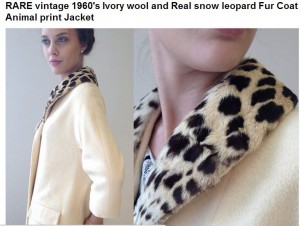
Etsy listing advertising real snow leopard fur I was horrified yesterday to see the world’s leading craft marketplace, Etsy.com complicit in selling endangered snow leopard fur. One of its sellers listed a woman’s coat advertised with “genuine real snow leopard fur” collar. I contacted Etsy immediately but they refused to take any action.

Selling snow leopard fur directly contributes towards extinction of this cat in the wild. Anyone concerned with the preservation of this species needs to take action when things like this happen.

According to the Snow Leopard Trust, “It is illegal to sell snow leopard part anywhere in the world.”

The snow leopard is listed in the Endangered Species Act of the US. Since 1975 it has been listed in CITES (the Convention on International Trade in Endangered Species of Fauna and Flora)

There is no doubt that the selling of endangered species fur fuels the demand which then encourages poaching. Poaching is one of the biggest risks faced by snow leopards and is the cause for the complete decimation of many species around the world.

Yesterday I contacted Etsy’s Marketplace Integrity department. Their response was “Beyond legal issues, it’s up to each member to make important ethical and moral decisions about what they choose to buy and sell on Etsy.”

Etsy is huge. They get 40 million unique visitors per month. It may or may not be that Etsy is denying its legal responsibilities. But it is certainly denying its social responsibilities. In a world where whole species are being removed by hunting for their body parts thousands of villagers, herders and international snow leopard biologists are racing against time to stop the same thing from happening to this magnificent species.

A few years ago Dalai Lama urged the Tibetan people to burn their snow leopard pelt cloaks. These were precious cultural relics but the Tibetans did so in their hundreds, to stop the trade and send a message to the world – “we want our snow leopards to live and not be something to wear on our backs for vanity.”

To the Esty seller we would like to say – this may or may not be real snow leopard fur. But the fact that you are advertising it as such and creating an aura of luxury and demand will harm this cat’s chances of long term survival.

We would like Etsy to remove the listing from its site. We would like the seller to destroy the coat. Help us convince Etsy by emailing your concern, (politely but firmly) to integrity@etsy.com and  posting a comment on the Etsy Facebook page.

To keep up with this story sign up to the email list – box at top right of this page.

Lhendup Tharchen, wildlife biologist from the tiny Himalayan Kingdom of Bhutan working to save snow leopards and tigers in the only habitat in the world where the two big cats overlap. Photo (c) WildCru.

Lhendup Tharchen, wildlife biologist from the tiny Himalayan Kingdom of Bhutan working to save snow leopards and tigers in the only habitat in the world where the two big cats overlap. Photo (c) WildCru.

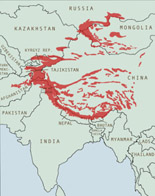
Lhendup Tharchen is a wildlife biologist and Park Manager in Bhutan. He is originally from Ura, a small village in Bumthang. Lhendup currently works in Jigme Dorji National park and his work focuses on the big cats, snow leopards and tigers, of Bhutan. Bhutan is the only country of twelve snow leopard range countries where snow leopards and tigers share habitat.

Lhendup is our guest blogger and he shares his excitement at the recent proof from camera traps of a snow leopard family in Bhutan.

“Some say “Mountain ghosts” and some refer to them as “Queen of the Himalayas”. I can’t resist to refer them as the” King of Himalayas”, the elusive and cryptic species , the snow leopard.

 Bhutan is known for its un-matching biodiversity richness. The per capita of biodiversity richness for a small country like Bhutan would beyond any doubt be one of the highest among the countries.  

 Until recently, when camera traps were not deployed for snow leopard surveys, irrespective of the concrete evidence reports from the field, many people questioned the true existence of snow leopards. It is at time a big question whether we really have snow leopards in Bhutan.

Not one, not two, but a family of three snow leopards captured by remote camera trap in Wangchuck Centennial Park (WCP) in Bhutan. Photo (C) WCP.

Not one, not two, but a family of three snow leopards captured by remote camera trap in Wangchuck Centennial Park (WCP) in Bhutan. Photo (C) WCP.

 This is where and when the modern technology rescued conservationists in Bhutan in raising our heads while talking on snow leopards. In a difficult terrain like Bhutan’s, no amount of energy would suffice the search for Himalayan kings, and last resort one would wish for is magic and magical powers. Rugged and in accessible  terrains compounded by high altitudes with low oxygen level  is not only an inhibiting factors for the researchers in Bhutan’s high mountain terrains, but a matter of daring to sacrifice one’s life to struggle with the available oxygen in those places. Up on the mountains, where you feel at the height above most of the places on the planet except for few peaks like EVEREST and its competitor ranges,  one will wish for only one thing, the SNOW LEOPARD rolling on its tail on the snow covered steep slopes.
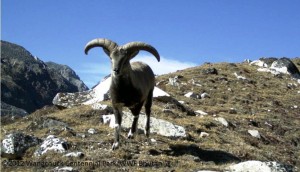
Blue sheep, a major prey species for the snow leopard in the Wangchuck Centennial Park in Bhutan. Photo (c) WCP and WWF/Bhutan.

Blue sheep, a major prey species for the snow leopard in the Wangchuck Centennial Park in Bhutan. Photo (c) WCP and WWF/Bhutan.

Findings from the camera trapping effort in the northern protected areas of Bhutan in last 2 years span has proven more than anyone could wish the proof to be.  Numerous individuals have been captured in Jigme Dorji National Park (JDNP) and Wangchuck Centennial Park (WCP).  Big cats are solitary in nature, but who said that they are lone animals. Like everyone do, they love their families. So is the Snow leopard family in WCP has been captured using the remote camera.

The officials of WCP, disregarding all the above hostile factors gave their best for the conservation and so did they get their best.  Thanks to all the dedicated heroes of WCP. There have been many records of pictorial findings throughout the snow leopard ranges, but to me at least, three individuals captured on a single shot in a  camera trap is probably the first one ever (pardon me if I have missed any from others parts of the world).

And that is how snow leopards survive in the KINGDOM of BHUTAN and Bhutan is  a special place for HIMALAYAN KINGS.”

Thanks for sharing your story, Lhendup, and we wish you and your Park colleagues and all snow leopard partner NGO’s good luck for this work. Bhutan has a wonderful record of environmentalism and conservation and it is awesome to see snow leopards thriving there.

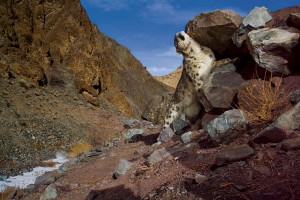
A snow leopard rubbing itself on a rocky ledge in Hemis National Park, Ladakh India. This photo was taken by wildlife photographer (c) Steve Winter with a remote camera trap and is featured in National Geographic Magazine.

A snow leopard rubbing itself to send a message to other snow leopards on a rocky ledge in Hemis National Park, Ladakh India. This photo was taken by wildlife photographer (c) Steve Winter with a remote camera trap and is featured in National Geographic Magazine.

Happy New Year to all snow leopards and snow leopard supporters. I have been away for the last month firstly at a Global Snow Leopard Workshop in Kyrgyzstan (more on that later) and then a few weeks of summer holidays (in Australia) with family and friends.
We have many plans to expand the Saving Snow Leopards website and blog which last November celebrated its fourth year. Thank you to the many hundreds of thousands of visitors and the many thousands of you who have made comments or sent me emails. We appreciate your concerns, suggestions and your support.
The snow leopard research and conservation community needs your help. As we enter 2013 many researchers believe numbers have decreased to just 4000 or so of our beautiful and precious cats in the wild.
Without your support, your donations and your involvement it will be impossible to ensure long term safe habitats for snow leopards in the wild in their 12 range countries. Organisations like the Snow Leopard Trust and the Snow Leopard Conservancy lead the way in research, education and community conservation. Each year they work with thousands of villagers, school children and herders to protect snow leopards. They spend countless hours in cold harsh climates learning more and more about how these cats survive in remote mountains. They help set up anti-poaching units to confiscate illegal snares and guns, they lobby governments and wildlife officials. All this takes money and support.
Thanks again for your support so far and I look forward to our journey over the next year. Together we can make 2013 a good year for helping endangered snow leopards.
Sibylle Noras, Founder and Publisher “Saving Snow Leopards” website.

The 15th snow leopard collared through the Panthera-SLT study in Mongolia. October 2012 Photo Panthera / SLT K. Suryawanshi.

One of the things snow leopard researchers get asked about all the time is the ethics of capturing and collaring snow leopards. Capture and collar is a research method used to study many animals in the wild but lay people often have doubts and questions about it.

Scientists would also prefer not to have to be this invasive in their study of wildlife but sometimes there are no alternatives to get information that will ultimately help towards saving an endangered species.

All reputable snow leopard research organisations like Snow Leopard Trust, Snow Leopard Conservancy and Panthera do rigorous testing of their capture and collaring methods to ensure each animal that is collared is treated safely.

Panthera recently put together this list of questions and answers on the effect of collaring on snow leopards.

They answer these questions.

What are the benefits of collaring wild snow leopards?

How do you know these collars even work? Do you test them before they go on wild snow leopards?

What happens when the snow leopards are collared?

Do the collars stay on for the cats’ whole lifetime?

How big is the GPS collar?

Do GPS collars compromise the snow leopard’s ability to hunt?

Do the GPS collars affect the cats’ ability to camouflage?

Do you use any other methods to gather data about these big cats?

Please read this list for the answer to these important questions.

Wild mum snow leopard with cubs discovered in den in Mongolia earlier in 2012. Photo SLT/Panthera.

The study team at the Snow Leopard Trust and Panthera Long Term Ecological Study in Mongolia has just analysed more camera trap photos from the last few months and there is at least one more cat with cubs. In July the Study found radio collared mums Lasya and Anu had cubs and were in two wild dens looking after them.

But now it seems now another female named F-9, and nicknamed Shinejh has cubs too. The SLT/Panthera  scientists in the field are working on confirming the exact numbers and the cats identity. Great news!

Keep up with more news on the Snow Leopard Trust Blog.

Saving the world’s endangered species like snow leopards and tens of thousands of others, will cost $US80 billion a year, estimates a coalition of international conservationists and academics. Naturally people are asking can we afford it?

But here’s the punch line according to a story in the UK Guardian. This amount is half that spent on bankers’ bonuses last year!!

Dr Jane Smart, global director of the International Union for Conservation of Nature’s biodiversity conservation group (the organisation responsible for designating the snow leopard as endangered), answers this question on whether we can afford to save endangered species.

Surely the financial costs of saving nature, our wildlife and ecosystems are tiny in comparison to the benefits of living in a healthy environment with good quality water, food and air. A compromised environment always means more medical costs, lower standards of living and lower life expectancy. Not to mention that having more forests and trees means we don’t need to waste the billions we are spending to deal with the release of greenhouse gases.


Author and children’s book illustrator, Naomi C. Rose wants to raise money to publish her beautiful book called “Where Snow leopard prowls, wild animals of Tibet”.

Naomi and her husband Robin Weeks have a small publishing business, Dancing Dakini Press, but it costs money to publish books so they have taken an entrepreneurial approach and started a KickStart project to raise the $8000 needed. The book looks absolutely gorgeous and you can see Naomi in this video showing her drawings and telling the tale.

Please support Naomi and Robin if you can. This  book will help children all over the world understand the beauty of our special cat, its fellow animals and the landscape of its home.

The only souvenir I found with a snow leopard design in over 2 weeks of searching the markets of the Altai, Siberia, Russia in 2010. Now, only 2 years later micro-finance projects help local women create many such items to earn an income and help save the remaining endangered Russian snow leopards. Photo Sibylle Noras.

During my trip to the Altai in Siberia, Russia, in 2010 it took 2 weeks of careful and determined scouring through local markets, shops and remote hilly roadside stalls to find one small tourism souvenir with a snow leopard on it. It was as if the cat wasn’t even known in its own homeland.

Now as part of a project to help the cats, World Wildlife Fund (WWF) has partnered with Citi Foundation (the philanthropic arm of Citibank) to fund projects to raise awareness of the revenue that could be generated from eco tourists coming with hope to see the snow leopard. Part of this project includes souvenir making, a common microfinance project for people in developing economies.

Microfinance is a concept helping people in developing nations all over our globe. Money is provided as loans, savings accounts and insurance rather than donations to villagers, small business people, herders and others who don’t normally qualify for bank loans. Often loans as small as $50 or $100 help people earn income for food, clean water and education for their children.

With support of WWF in the Altai microfinance is helping people create tourism businesses such as accommodation, souvenir hats, scarves and clothes etc. These are all alternative revenue sources to illegal poaching. Animals like the snow leopard have been brought to the brink of extinction but perhaps these initiatives might just help the cat survive in time.

“The idea is for people to understand that it is profitable to protect rare species,” said Mikhail Paltsyn, the Altai co-coordinator for the World Wildlife Fund, who has studied snow leopards for two decades.

Aiyara Yerkemenova, a 20 year old woman who with the help of micro-finance has built a museum aimed at tourists in the snow leopard habitat region of the Altai. Photo Howard Amos, MT.

The rare snow leopards once roamed the vast steppes of the Altai republic, but during the 1990’s were poached even by wildlife rangers as their incomes collapsed along with the former communist system.

Just one example is Aiyara Yerkemenova, aged 20, who has a child and an army husband often away. She was awarded a 70,000 ruble ($2,200) microloan from Citi Foundation to build a small museum on land near a beautiful river attractive to Russian tourists from the big cities. She has to pay the money back within 18 months but with the increase in tourists recently this is looking very possible.

The good news is, I’m told there are many snow leopard souvenirs. Hats, scarves and paintings with snow leopard motifs and designs are now at the roadside stands I found so bare of signs of this beautiful local animal only 2 years ago.