≡ Menu
Tahr are wild goats that are snow leopard prey

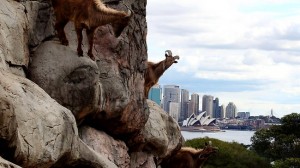
Himalayan tahr, a key snow leopard prey, have a new home at Taronga Zoo in Sydney. Photo Cameron Richardson, Daily Telegraph.

The Himalayan tahr is an ungulate or wild goat that shares snow leopard habitat in the rugged wooded hills and mountain slopes of the Himalayas in Nepal, India and Tibet. They are key snow leopard prey in this region and in summer graze in high pastures, then come down the mountains and form herds in the winter. Tahr have very small heads with large eyes and small pointed ears and red circles on their cheeks and are amazing rock climbers.

Taronga Zoo in Sydney has just built a new 3m-high walkway where visitors can get close to the tahr while admiring the stunning view of Sydney Harbour. The snow leopards at the Zoo are nearby and visitors can see both animals on this boardwalk.


Telengit community in snow leopard habitat southern Russia.

Telengit community of Altai mountains in southern Russia are fighting a gas pipelines which threatens them and endangered animals like snow leopards. Photo Cultural Survival.

Last year I travelled through a remarkable part of Siberia I knew nothing about, in search of Russia’s last snow leopards. In the Altai Republic and the Altai mountains I found a spectacularly beautiful region with a fragile landscape and local communities hanging onto unique traditions and livelihoods thousands of years old. Much of this is now under threat.

According to Jennifer Castner, Director of the Altai Project, a gas pipeline project between the Russian and Chinese governments is proposing to export natural gas from here to northwestern China.”The pipeline threatens a UNESCO World Heritage Site, national parks, and sacred lands. The Telengit people and Russian environmental organizations are calling on the international community for help to stop construction of this gas pipeline on the sacred Ukok Plateau.”

Altaians and the Telengit feel a strong connection to their land, shown here.
This video tells the story of Slava Cheltuev, a Telengit community leader and shaman from the Altai’s high altitude Kosh Agach district.

Now the local Telengit people are so concerned about the negative impact of the pipeline they are keen to get a meeting with Russia’s President Medvedev.

The UNESCO World Heritage Site is the Golden Mountains of Altai, which has been identified as cultural and environmental importance not only to the local Altains but also for the whole world community. The mountains being a vital habitat for endangered animal species like the snow leopard and argali sheep also influenced the decision by UNESCO.

The Altai Project is working with partners to help the Telengit and Russian environmental groups reroute the pipeline. The Altai seems far away, I know it seemed that way to me, but once I had a chance to see it and learn about it, I realised how important and special a place it is. You can read more and support this important issue through the Altai Project and their partners.

Intriguing candid photo of two snow leopards captured by a remote camera in Mongolia. I wonder what they are up to? Photo SLT and Panthera.

The Snow Leopard Trust’s (SLT) long term research project in Mongolia (partnering with Mongolian agencies and Panthera) is raising money by asking people to adopt one of the remote sensor cameras they’ve set up in the South Gobi province to film snow leopards in this beautiful region.

This is a lovely way to support ground-breaking work never before done in such an intensive way in any snow leopard habitat. You’ll see the candid shots of snow leopards going about their daily lives. Snow leopards are shy and secretive but these hidden cameras are revealing new information about them, much of it never known before. Share with the SLT researchers the candid smiles and yawns of snow leopards and see their prey from a ‘cats point of view.’

As a donor you’ll receive a package including a map showing the location of this year’s camera study, a CD with the black and white photographs from your camera and a special bound guide to help you identify the various animals your camera photographed.

If you like the idea of adopting a camera and help support this important project go to the SLT website.

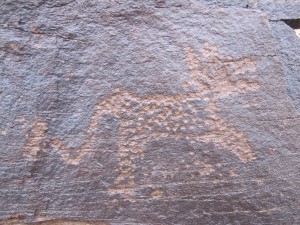
Snow leopard rock carving Tibet

A closeup of a detailed snow leopard rock carving from the Iron Age in Upper Tibet. We can clearly see the rosettes or spots of the cat. Copyright John Vincent Bellezza.

Petroglyphs are rock carvings made by many different cultures around the world since ancient times. People would use sharp stones and other tools to carve drawings into stone to record events and their world. The word comes from the Greek ‘petros’, meaning stone and the word ‘glyphein’, meaning to carve.

John Vincent Bellezza is Senior Research Fellow at the Tibet Center, University of Virginia, and Charlotteville, Virginia. A highly esteemed scholar and explorer, John has spent more than two decades studying Zhang Zhung, the ancient culture of western and northwestern Tibet, which was associated with the Bon religion, before the introduction of Buddhism.

John Bellezza has spent many years on painstaking research surveying rock art in Tibet. Copyright John Vincent Bellezza.

His studies included researching petroglyphs in remote mountain ruins and rock outcrops. One day he found these enchanting carvings. We can only surmise who would have made them and why but today they speak to us across thousands of years telling a story, a myth or a legend of snow leopards that some-one, all those years ago, felt was important.

I was in touch with John a few months ago and he’s very kindly agreed to share his snow leopard petroglyph photos with readers of Saving Snow Leopard Blog.

“These snow leopard petroglyhps were found in Uppper Tibet and they date from prehistoric times, probably the Iron Age (around the 10th to 7th century BCE).

One is a lovely close up of a snow leopard and the other a snow leopard with gaping jaws in pursuit of two wild ungulates (sheep or goats), with a crescent moon as well. We might surmise that this petroglyph depicts a dawn or dusk hunting scene, given the relative position of the moon.

Snow leopard rock carving from Tibet.

Photo of a snow leopard rock carving from iron Age Upper Tibet. Copyright John Vincent Bellezza.

In Tibetan the snow leopard is called sa’u. It is the undisputed king of the alpine and aeolian biomes of Tibet. (Aeolian biomes are the zone of the highest life, a zone based on atmospheric nutrients, a zone of the wind as first described by L. W. Swan). The snow leopard is noted in Tibetan ritual literature as belonging to the entourage of important mountain gods. These ancestral and protective deities are said to keep fierce carnivores such as the wolf, brown bear and the snow leopard like ordinary mortals keep sheep and goats. The oldest cultural record for the snow leopard is found in Upper Tibet, a land of vast plains crisscrossed by lofty mountain ranges that run perpendicular to the Himalayan Range. This is the rock art record, prehistoric carvings in stone of snow leopards. It is not clear if these depictions of solitary snow leopards represent biological or numinous (that is the spiritual) forms of the animal. Perhaps this great carnivore was rendered in both guises.”

A petroglyph, this one a large wild sheep with huge horns carved 2000 years ago on rock in Altai, southern Russia. Photo Sibylle Noras.

Thanks very much for sharing these John. During my 2010 snow leopard trip to Altai in Russia I became interested in petroglyphs after seeing many rock carvings on the steppe near Koch Agash where we were researching snow leopard habitat. I found lots of ibex (wild goat) petroglyphs but sadly no snow leopards. Kyrgyzstan has petroglyphs of snow leopards too, at the Issyk Kul Open Air museum in Cholpon Ata and there’s a very special rock with an image of a tamed snow leopard used by nomads in a hunt much like ancient Egyptians used to use tame cheetah. Amazing!

John’s two latest volumes, Antiquities of Zhang Zhung, have just been published and are online at  www.thlib.org/bellezza.

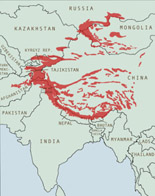
Snow leopard habitat in Mongolia being studied by Panthera and SLT

The Panthera SLT Long Term Ecological Study of snow leopards in Mongolia. This map shows the distance and movement of some of the cats with electronic collars.

Electronic surveillance has been in the news a lot lately lately with illegal happenings in the Murdoch UK newspaper empire. But one place where surveillance is OK is in the work researchers do in snow leopard habitat.

Snow leopards are so notoriously shy that the use of camera traps (which are set off by the cat’s nearby movement) is one of the best ways to learn more about them and their habits.

This week an article in the NY Times quotes Dr. Tom McCarthy, director of  Panthera’s snow leopard program as saying that electronic eavesdropping brings up all sorts of new information about the way snow leopards live. ” Evidence of two cats sitting together to eat dinner was quite a shock to us,” Dr. McCarthy said. “Beyond mating and mother-cub relationships, snow leopards are supposed to be solitary,” he said.

Dr Tom McCarthy, one of the world's foremost snow leopard researchers and conservationists.

Dr Tom McCarthy. Photo Panthera.

This is fascinating news and also supports the idea some zoos now have that snow leopards sharing exhibit areas may be happier than those that don’t. See our recent Guest Blog on Zoo studies on social nature of snow leopards in captivity.

Panthera, the Snow Leopard Conservation Fund (Mongolia) and the Snow Leopard Trust are doing a Long Term Ecological Study of snow leopards, the very first of its kind, in Mongolia. We look forward to more information like this to give the world a better picture of how these cats live.

Oleg and Irina Lognov's book Irbis - Snow Leopard to support the work of snow leopard conservation in Kazakhstan.

We haven’t written much about the snow leopards of Kazakhstan in this blog as there has been little conservation or research work done there in the past. This is rapidly changing.

“IRBIS – The Snow Leopard” about Kazakhstan’s rare snow leopards has just been published in English. Written by biologists Oleg and Irina Loginov this book was previously only available in Russian. It is a major initiative of Kazakhstan’s “Snow Leopard Fund” (Ust Kamenogorsk) with the financial support of the UN (UNDP/GEF).  The snow leopard is an important symbol in the history of the country and now efforts are being made to help its survival in the Kazakhstan part of the Altai-Sayan ecoregion which has for many years been known to be snow leopard habitat but has had few conservation or community development efforts focused there.


The beautiful mountains of Central Asia, snow leopard habitat in Kazakhstan

Oleg says, “In Kazakh public consciousness the snow leopard is often called “The Master of Celestial Mountains”, and it is a predator never attacking people. Snow leopard protection is still insufficient – more than 90 % of habitats of a snow leopard are not covered by especially protected natural territories.” Oleg believes snow leopards require more protected reserves in Kazakhstan. “All places of snow leopard habitat in mountains, as a rule, have no intensive economic activities, therefore can quite become extensive natural parks or game reserves.”

Oleg says the book has been written with great emotion and “is entertaining and accessible to the widest audience. It can be used as manual for schoolboys and students, and for the foreign tourists, wishing to learn more about a live symbol of “Celestial Mountains”, and in general for people loving the nature.”

The unique photos of a wild snow leopard in the book were taken in Almaty area in Dzungarian Ala-Tau (Kazakhstan) by Renat Minibaev. There are also beautiful snow leopard portraits by Raphael Kettsian from Ekaterinburg (Russia), and also water colour drawings by Victor Bakhtin, Victor Pavlushin and Oleg Loginov. Irina Loginov’s fairy tale ”Spirits of Sacred Mountain” is also included in the edition, illustrated with drawings by the author.

Irbis is the Russian and Kazakh word for snow leopard.

Congratulations Oleg and all those concerned and we wish you well with your efforts to protect the snow leopards of Kazakhstan.

The beautiful Book is a limited edition publication available for $300. Contact Oleg – irbisslc@yandex.ru

A recent WCS study has found more snow leopards in Afghanistan's Wakhan corridor than previously thought to be in that area of snow leopard habitat. Photo WCS.

News from a recent snow leopard study in Afghanistan suggests the war torn nation may have a healthy cat population in the mountains of the northeastern Wakhan Corridor. The Wildlife Conservation Society (WCS), supported by USAID, used camera traps to photograph the solitary and shy cats. The study has been reported in the June 29 issue of the Journal of Environmental Studies and was conducted by WCS conservationists Anthony Simms, Zalmai Moheb, Salahudin, Hussain Ali, Inayat Ali and Timothy Wood. The scientists trained local rangers to position the camera technology at 16 locations in the vast mountain region. Anthony Simms says “The camera trapping that has been conducted in Wakhan to date has primarily been aimed at training our rangers to use the technology, not for scientific purposes. However, we are just preparing to commence a snow leopard mark-recapture survey across a large swathe of the Hindu Kush mountains.”

If indeed the photos show individual cats and not the same few leopards in many shots this is welcome news that after many years of conflict the cats have not been killed or chased away. The WCS is to be commended for this work as well as the involvement of local communities to benefit people and the snow leopards in this corner of snow leopard habitat. See more photos on Snow Leopard Network website.

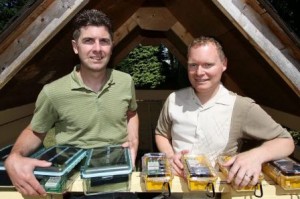
Greg Carney and Sean Burnett with their GPS-based poacher spotting device. Photo by Adrian Lam.

Sean Burnett and Greg Carney are Canadian economists with a hobby that may save snow leopards in the Altai region of Russia. They’ve invented a poacher-spotting device that employs heat detectors, underground sensors and satellite GPS monitoring to catch illegal hunters. Their Remote Anti-Poaching Intelligence Device uses heat sensor technology attached to a GPS which is triggered by heat of campfires and then sends alert  emails with coordinates to park rangers.

The protected park in the Altai Republic of Russia, has had a sad history of poachers shooting wild sheep and tracking snow leopards. To date the park authorities have had a difficult time catching them.

“If we find that this technology is successful there is no reason it can’t be used in anti-poaching activities all around the world,” said Altai Project director Jennifer Castner. “You have to know your landscape and your targets,” she said.

“A lot of people have a lot of ideas of what can be done [to catch poachers], it’s just a matter of finding amazing people like Greg and Sean who are willing to dedicate so much of their time,” Castner said.

Read more.


Nanda Devi, second highest mountain in India in Nanda Devi Reserve, now confirmed as snow leopard habitat.

Remote snow leopard camera shots shows the cats are moving higher up the mountains than ever before. More villagers are encroaching on snow leopard habitat and putting pressure on natural prey animals like wild sheep and goats. With less food and more people moving into their home territory snow leopards have moved from lower hilly regions to high mountain ranges of Himalayas in India.

Pictures captured by Wildlife Institute of India (WII) as part of the ‘Project Snow Leopard’ show there are no snow leopards at 3000m altitude.

Automatic cameras, called camera traps, trigger the camera as the cats move nearby. The WII project has identified 13,000 square kilometres as snow leopard habitat and installed cameras about 6 months ago in Nanda Devi Biosphere Reserve Park and Valley of Flowers.

Former Chief Caretaker of wild life, Anand Singh said, “Snow leopards are not getting proper food. The predators are finding it difficult to hunt their prey. If they are found at higher mountain ranges then it is for sure that they have shifted their base.”

Stunning Altai Mountains, snow leopard habitat in southern Russia. Photo by Sibylle

It’s hard to believe that a year has passed since I was in Altai mountains, Siberia, southern Russia, searching for snow leopards with a team from Biosphere Expeditions. We were out in this beautiful mountain range for two weeks and saw beautiful birds and groups of ibex. But no snow leopard sign. The team that is there now has been luckier! This report from Andy Stonach.
“On the first day of our Altai Snow Leopard trek we went to the top of Kara Gyem pass. It started off cold and wet, but then turned snowy. Well, after only about an hour of surveying, we found a very clear trail of guess what – snow leopard! The trail was around 10 days old and there were perhaps 40 individual tracks in the mud, mostly very clear Not content with this, our intrepid team then found a second snow leopard trail in the snow, and fresher, much fresher, probably made the night before we arrived; fantastic! Lunch amongst an amazing display of flowers and then watching two groups of Siberian ibex rounded off the day. Doesn’t get any better than that!”

Great news guys! So glad to hear that snow leopards are still out in these beautiful mountains.