This videos was shot during the snow leopard survey in upper Dolpo, Mid- Western Himalayas of Nepal. The snow leopard was killed and thrown into a cave to take revenge for it killing village sheep. Unfortunately where humans and these rare cats live so close together snow leopards do sometimes attack village livestock and villagers defend their livelihoods. For this reason it’s important we support the compensation and insurance schemes that organisations like Snow Leopard Trust and Snow Leopard Conservancy set up in these areas of snow leopard habitat. When villagers know they will get money for their dead sheep they are less likely to kill the snow leopards.
Many villagers and tourists share snow leopard habitat in Mustang Annapurna region Nepal. Photo by Sibylle Noras
A followup to the recent story about snow leopard poachers’ arrest in Nepal by WWF Nepal staff who were involved in the operation.
“Two poachers involved in trading of body parts of endangered wild animal were arrested on 28 may 2011 from Mustang district, a district situated inside the Annapurna Conservation Area Project (ACAP).
The district police office, Mustang, nabbed Shyam Lalchan, owner of a local guest house, and his employee Kulman Ghale with two snow leopard pelts.
Spectacular rocky mountains make Mustang in the Annapurna region of Nepal good snow leopard habitat. Unfortuantely poaching is rampant according to WWF Nepal officials.Photo by Sibylle Noras
At the police interrogation the duo denied poaching the animals. They however admitted to have skinned three snow leopards that they claimed were found dead in a place called Chaurikharka, an eight hours walk from Mustang, where the police recovered bones, pelts and carcass of snow leopard.
The operation was carried out based on a tip-off received by WWF Nepal on the pelts that were sighted in a padlocked room at the guesthouse. The police, with the help of WWF Nepal’s officials and Department of National Parks and Wildlife Conservation, successfully carried out the operation.
Poaching of wild animals including the snow leopard is rampant in the region. Despite stringent law against trade in body parts of endangered wild animals, curbing it has been a difficult task due to the involvement of “high-profile” racketeers.”
Photo by Muntasir Mamum of wild snow leopard near Chadar frozen river in Zanskar, Jammu and Kashmir, India.
I got this email and photo from Muntasir Mamum recently who saw a wild snow leopard in the Indian Himalayas in January. Lucky!
”We were a combined team of thirteen from Bangladesh and India up for a winter trekking to Frozen River Chadar which is located in India, particularly Jammu & Kashmir territory. I saw that cat from very far so it showed up tiny but it was chasing ibex. It was in January this year and I guess it was near Tsarak Do.”
Thanks for sharing this, Muntasir. We can see the cat very clearly, you must have been so excited. Any-one else would like to send me photos and/or stories of snow leopard sightings? Please do so.
19 year old snow leopard Ming Wah at San Francisco zoo. Photo SF Zoo.
A news item from San Francisco Zoo sent to me by Jenn Castner of the Altai Project tells how carnivore keepers are giving extraordinary care to snow leopard grand dame Ming-Wah who has kidney failure.
“Did you know the median life expectancy for snow leopards is no more than 12 years old? So when our nearly 19-year-old snow leopard Ming-Wah started showing signs of her age, we were not completely surprised. Unfortunately, Ming-Wah has confirmed kidney failure, and increased fluids are helping with the medical symptoms stemming from this diagnosis. In an effort to address this concern, carnivore keepers have spent time training her to voluntarily accept injected fluids once a day. Zoo staff will continue to treat and monitor her symptoms as needed, and they are extremely proud to have provided a high quality of life for our beautiful snow leopard, who has far outlived her life expectancy. Our 15- year-old male snow leopard, Rigel, is still generally healthy for his age, aside from the removal of a benign mass in February.”
Congratulations to the zoo team who are pushing the boundaries of giving captive snow leopards good quality of life in their senior years.
As I sit looking out on the cold and rainy Otways Forest in southern Australia today, I’m thinking about World Environment Day (WED), a UN initiative that started in 1972. WED is the one of the main vehicles for the United Nations to stimulate worldwide awareness of the environment through political attention and action. This year’s focus is “Forests – Nature at your service”. Forests are called the ‘lungs of the earth’ because deforestation accounts for about 20% of global greenhouse gas emissions, which forests would absorb if carefully managed.
Our Otways Forest have been preserved in recent years through passionate conservation and political action. They are now home to lots of local wildlife like the koalas I see daily.
Though the snow leopards I also care about live in high mountains above forests, like all humans and wildlife, the cats need these ecosystems to thrive in the balance of nature that supports animals and plants in snow leopard habitat. Please give a thought to forests in your part of the world today.
Late last year I was lucky to get to the Wildlife Conservation Network annual event in San Francisco and met many people from WCN and supporters. It was an inspiring day. The WCN supports amazing wildlife conservationists like Iain Douglas Hamilton of Save the Elephants, Laurie Marker of Cheetah Conservation Fund and Rodney Jackson, founder of the Snow Leopard Conservancy and others. WCN provides financial support but also an opportunity to get together and share knowledge. Despite working with different animals and in different parts of the world most conservationists share similar problems like poaching, habitat loss, community education and so on.
The WCN’s 2010 Annual report, now available, has stories from last year’s activities, the highs and lows of working to save endangered animals around the globe.
Dr Rodney Jackson of the Snow Leopard Conservancy said -“I’m so grateful to have been associated with WCN from the day we formed the Snow Leopard Conservancy. We are celebrating our 10-year anniversary with donor-partners who share our passion and commitment and WCN has played a crucial role in bringing us together. But WCN hasn’t only provided us with the resources to make conservation effective; our personal interactions with the staff, volunteers, donors and other conservationists inspire us every bit as much as the rare creature we work with. ”
Two snow leopard pelts found with poachers in Mustang, Nepal. Story and Photo Kathmadu Post.
A shocking story greeted the readers of Kathmandu Post in Nepal yesterday. It showed this photo of two snow leopard pelts. Two people have been arrested in Mustang in Nepal (where it is illegal to kill the cats) with the hides of the two snow leopards. One is the owner of the Paradise Guest House in Marpha village and the other his employee. There will be further investigations held in the nearby town of Pokhara.
Various conservation agencies are working with many communities in Everest regions and other areas in Nepal to educate them about snow leopards in Nepal.
Kamal Thapa, a field biologist with many years experience working with snow leopards and Research Officer with WWF Nepal, one such conservation agency says, “This report itself is not good news despite the continual conservation effort on snow leopard in Nepal Himalaya. Such issue clearly indicates that our focus on snow leopard conservation is not adequate. Hence, to combat this issue we need to work together specially with local people of Himalaya.”
Hopefully this sad example will serve to educate people and increase conservation support to keep the snow leopards of Nepal alive.
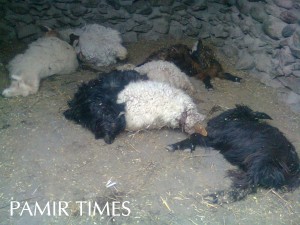
Livestock killed by snow leopard in Gigit, Pakistan. Often wolves also kill livestock and it can be difficult to know which animal is responsible if they are not caught in the act.Photo Pamir Times, Gilgit.
A snow leopard killed 68 domestic goats in six separate incidents, in a remote valley of Gilgit, Pakistan in one night last week. The cat got into the corrals at night in a village near the Pakistan-China border which is one of the country’s main snow leopard habitat regions.
Bodies of the animals were scattered all over the place after the incident,” said Rehman Posh, a conservationist working with the Khunjerab Village Organisation. He said the villagers were upset about the financial loss of so many dead animals.
“We have submitted our complaints. But they just come to tell us the importance of the snow leopards. They never recompense the poor herders who bear the losses,” a farmer said.
Unfortunately snow leopards attack and kill livestock when their natural wild prey is scarce and livestock numbers increase. Village numbers are growing in the mountain regions and humans now compete with snow leopards in their own habitat.
Community conservation programs can help with this type of human snow leopard conflict. Insurance schemes reimburse villagers for dead livestock and some programs help pay for better snow leopard proof livestock corrals that stop the cats from getting in. But the spread of these programs takes time and money; in the meantime it is hard on both villagers and snow leopards.
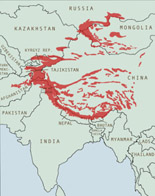
The BBC Wildlife Fund (BBCWF) today launched a program to protect snow leopards across Asia with a donation of $90,000. The BBCWF is teaming up with the Whitley Fund for Nature (WFN) and Nature Conservation Foundation (NCF) to empower local communities in conservation programs like environmental education, community‐based wildlife monitoring, anti‐poaching programs. Co-operation amongst snow leopard countries at the governmental level is also planned.
“This is the first large, multi‐country project of its kind for snow leopards,” says Dr. Charudutt Mishra, Trustee of NCF and Science and Conservation Director of the Snow Leopard Trust. It’s a huge leap forward for the species.” Snow leopard conservation lags behind big campaigns like those set up for tigers, but Dr. Mishra hopes this project will change that. “There is no doubt that across Central Asia’s mountains the endangered snow leopard faces immediate threats to its survival. The BBCWF’s funding makes it possible for us to address the threats as never before.”
Dr Charu Mishra. Photo SLT.
The BBC Wildlife Fund was founded by the famous BBC Natural History Unit (NHU) in May 2007. Millions of folks across the globe have watched their wonderful wildlife documentaries for many years, including the famous snow leopard hunt scene in the Mountains episode of Planet Earth. While producing outstanding films about wildlife the Unit witnessed alarming declines in the populations of many of the animals filmed. Their motto is – “After 50 years of watching the natural world on TV it’s time to give something back” and decided as well as filming, they wanted to address the plight of wildlife. The BBCWF first live appeal program, Saving Planet Earth, raised 2 million pounds in a year.
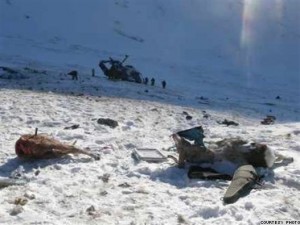
Allegations against seven who died and three survivors of illegal wildlife poaching in crashed helicopter.
A court in southern Siberia’s Altai Republic acquitted three high ranking Russian officials of hunting endangered animals when their helicopter crashed killing seven others in January 2009.
The case in the remote town of Koch Agash, has been over two years coming to court but Judge Nikolai Lubenitsky said yesterday the prosecution (which asked for one year jail terms) had failed to prove the defendants’ guilt.
The crash in Altai’s Chernaya mountain killed seven people, including the Russian president’s envoy to the State Duma, Alexander Kosopkin, and a federal environmental official, Viktor Kaymin, the chairman of the department of wildlife protection and management for the Altai Republic. [click to continue…]



 Late last year I was lucky to get to the
 The BBC Wildlife Fund (BBCWF) today launched a program to protect snow leopards across Asia with a donation of $90,000. The BBCWF is teaming up with the Whitley Fund for Nature (WFN) and Nature Conservation Foundation (NCF) to empower local communities in conservation programs like environmental education, community‐based wildlife monitoring, anti‐poaching programs. Co-operation amongst snow leopard countries at the governmental level is also planned.