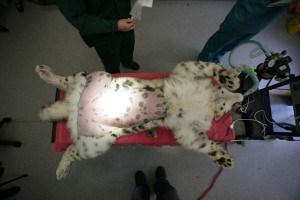
DNA sample
We all know snow leopards are very hard to study. They are shy and live in snow leopard habitat usually remote from easy access and often at high altitudes. Nepal, with its stunning Himalayan ecosystems has a significant snow leopard population. Until now researchers have relied on hard foot slogging into the remote areas to locate snow leopard signs (like pugmarks, scat and scrapes) as well as camera trapping and interviewing locals. This work is time consuming and expensive. For example each camera for camera trapping can cost up to $500. But now a local organisation, the Centre for Molecular Dynamics Nepal (CMDN) is hoping to change that.
The CMDN was established in 2007 by a group of scientists, medical teams, policy makers and academics to research diseases in the country. Today, in collaboration with the Snow Leopard Conservancy, it is using DNA identification for snow leopard research and conservation. Researchers can collect snow leopard scat (feces), which is still hard work for them walking in the mountains but doesn’t require them to spend months finding and following the cats. With the scat sample the DNA analysis is able to identify individual cats and provide a lot of data about them. Like fingerprinting, the DNA will identify individual cats. But more than that, DNA analysis will also provide information about the sex of the animal and its relationship to other cats in the area, providing a picture of how healthy the snow leopard population is.

Dibesh Karmacharya, the International Director of the Center for Molecular Dynamics Nepal
Dibesh Karmacharya, the International Director of the Center recently said “DNA techniques are particularly suited to snow leopard conservation because of the difficulty and risks involved in applying more conventional, invasive methods to such a low density, wide-ranging, and elusive species. We hope our policymakers, academics and conservation enthusiasts will be on board to review our efforts in the field of conservation, and support the use of new technologies to gather information for more effective strategies.”




 I’m not sure the drinking habitats of snow leopards in the wild have ever been studied but four engineers, lead by Dr Roman Stocker from MIT, studied cat drinking after he became enthralled with the drinking style of his companion cat, Cutta Cutta. Because cats lap water very quickly the human eye hasn’t been able to follow exactly what’s happening.
 Today’s Kathmandu Post reports good news that the number of snow leopards has increased in the Kanchenjunga Conservation Area (KCA) in eastern Nepal, where Mt Kanchenjunga, the world’s third largest mountain rises on the Indian border.


 I’ve met multimillionaires who are giving time and money to save snow leopards. I know you could be playing golf or sailing on yachts instead! (Seriously!) And I’ve met people who are spending every spare cent on this work and living in frugal happiness. My hat off to you all, and more power to you!