≡ Menu

Snow leopard?

Recently I received video of what appeared to be a snow leopard in Kamdesh District, Nuristan Province, Afghanistan taken by a young sergeant in the US Army. Several experts kindly commented their opinions through the Snow Leopard Network and my Blog, some thought it was a snow leopard and others raised the question as to whether it was another animal.

Today Tom McCarthy,  Ph.D. and Director of Snow Leopard Programs, PANTHERA, and George Schaller (world’s leading expert on snow leopards!) have established that it’s a yellow-throated marten and not a snow leopard.

Y a s h  V e e r  B h a t n a g a r,  P h. D. and Director, Snow Leopard Trust-India also suggested it wasn’t a snow leopard and he was right too.

Those of us with less experience but a lot of passion to conserve this beautiful animal were (and are) obviously hoping for evidence that snow leopards are surviving in this war zone.

We didn’t get the evidence this time but I couldn’t agree more with Ashiq Ahmad Khan (Chairman Steering Committee, SLN) and Safdar Ali Shah (NWFP Wildlife Department) that it’s important to work towards a “a trans border nation park to ensure protection of the snow leopard and other allied species before it is too late.”

Thanks also to Carl for looking out for snow leopards and wanting to be active in their conservation. We hope one day people in the field like him may see many snow leopards in this region if our conservation efforts can be successful.

Orjan, with cute animal -not snow leopard! -back on the Snow Leopard Trust's Mongolia project. Photo from SLT Blog.

Orjan is a Swedish PhD student working at the base camp of the Snow Leopard Trust’s long-term research project in Mongolia. Last year he blogged about his work capturing, collaring and collecting valuable data from five of the wild cats.

The last few months he’s been away from the project but is now back for another six months of work adventures. Follow him as he blogs about snow leopards, Mongolia, the people, the culture, the freezing climate …and Chinese police dogs….on the Snow Leopard Trust’s Blog .

World first for Snow Leopard Blog! A story about a soldier standing night guard at a small outpost who recognised one of the world’s most endangered and rare cats. Sergeant Carl Duke (US Army) sent me this amazing footage using advanced technology to film the snow leopard eight (!) kilometers in the distance. This was in the war zone on the border of Pakistan and Afghanistan. Carl told the intriguing story of how the footage was obtained.

“This video was made in the late fall of 2008 at Combat Outpost Lowell near Kamu, Kamdesh District, Nuristan Province, Afghanistan.  In the middle of the night SGT G was on guard scanning the surrounding hills when he spotted the animal with its give-away long thick tail. Fortunately, he had his personal camera on him and put it up to the screen of the LRAS3 (Long-Range Advance Scout Surveillance System) and pushed record.”

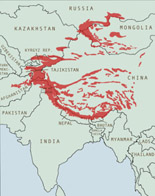
Location of night footage of snow leopard

Click image for close-up of the rugged mountains on the Afghanistan and Pakistan border where these videos were taken.

Carl said the snow leopard was most likely hunting for monkeys or livestock.

During his tour in Afghanistan Carl made a point of asking locals what they knew about snow leopards.  “Some people complained about them, one person said if you eat them you become more virile, another said someone had captured a cub and sold it a few years ago in Chawkay District, Konar Province.  One man claimed snow leopards shoot steel claws 15 meters!”

Long range advance scout surveillance system LRAS3. Photo Raytheon.

Naturally there’s little in the way of snow leopard research or conservation in this country, especially here in the dangerous border region, so it’s important any information be shared and Carl should be congratulated for his interest and concern about snow leopards. Carl said he hoped one day to go back to Afghanistan “I’ve heard a lot of great things about Afghanistan during the 60’s and 70’s. There’s so much I’d like to see and enjoy in Afghanistan – it’s just too dangerous now.”

Well done Carl, looking forward to hearing more about this story!

Exciting! We’ve been picked as Editor’s Choice on BestGreenBlog!

Timothy Latz, Editor of Best Green Blogs describes his mission – “This is the web’s largest directory of green and sustainable themed weblogs. Writers from all over the world are publishing articles and stories dealing with a wide variety of topics dealing with environmental issues and green living; and Best Green Blogs is an attempt to capture some of that independent publishing spirit.”

Blogs selected for “Editor’s Choice” are chosen for quality of content, design and information provided and stand out in the style of writing, topics presented or overall presentation.

It’s been a joy and a learning curve to do this blog over the last 14 months. I’ve met heaps of dedicated people working to save snow leopards in the wild. My blog shares some of their stories, stories that my stats program tells me  are read by people in over 50 countries.

Obviously a lot of people out there interested in the fate of these cool cats. Together I know we can make a difference for snow leopards and the people sharing their remote and difficult habitat.

Snow leopard camouflage. Photo by Kim Murray, Snow Leopard Trust.

We all know snow leopards have fabulous camouflage with their gray, white and yellowish fur and the spotty rosettes. But this really proves it. Kim Murray, the Snow Leopard Trust’s Assistant Director of Science took these photos and showed them to some school kids and asked where the snow leopard was hiding. They couldn’t find it, neither could I. (I squinted for over ten minutes at my computer screen).

Here it is!

Snow leopard revealed! Photo by Kim Murray, Snow Leopard Trust. Kim's working on the SLT's 10 year research project in the South Gobi, Mongolia.

Garry Weare

I’ve just finished a wonderful book about the Himalayas. Snow leopard country. It’s called “A long walk in the Himalayas – a trek from the Ganges to Kashmir” by Garry Weare.

Weare’s story of his five-month trek from the sacred source of the Ganges through the Kullu Valley, remote mountains of Zanskar and Ladakh (known as Little Tibet) to his beloved houseboat on a lake in Kashmir is an entertaining read. Throughout many years of travel in the Himalayas he has come to know the region, its peoples and cultures well and he writes about them with compassion, empathy and understanding.

“A long walk in the Himalayas”

Weare has serious Himalaya credentials. He’s a life member of the Himalayan Club, a fellow of the Royal Geographical Society, a noted mountain photographer and a founding director of the Australian Himalayan Foundation.

The book is a travel log, a meditation on walking, a memoir of places visted and loved and a tale of adventure. His journey, which is taken with a secret stash of rum and whisky, involved walking 2500 kilometres, most of it above 5000 metres and crossing at least 20 passes, a tough experience and he lost over 15 kilos.

During a trek in September 1995 Garry was lucky to actually see a snow leopard. “I had left camp early to cross the Konze La, a pass in western Ladakh. There had been an unseasonable snowfall and ….I stopped to watch a herd of yaks. At that point I sensed I was not the only one watching the yaks. Glancing around I caught a glimpse of a large cat. I had seen enough snow leopards in zoo enclosures to know what I was looking at. I just had a glimpse and no more but it was sufficient and for a while I did not move, hoping against hope that the elusive cat would reappear. It was not to be.”

Garry recently tod me, “The cat sighting was after a particular early but heavy snowfall in September. However as you appreciate the best opportunity to get a cat sighting is during the winter soon after the first winter snowfall when the bharal (Himalayan blue sheep, a favourite snow leopard prey) head to the valleys and the cats follow.” Lucky him!! Is all I can say.

Currently Garry is working on a Primary Health Care project in Zanskar and Ladakh, Northern India supported by the Australian Himalayan Foundation. The project trains the local Amchis, traditional faith healers in basic western medical advice.  Often these Amchi are the only medical help available to villagers in remote parts of the mountains. Last year the ABC’s ‘Foreign Correspondent’ did a segment on this project (see it here.) Absolutely fascinating.

You can support this and other Australian Himalayan Foundation projects by going to their website.

Annapurna ranges from my last trek in the region in 2004.

Over the years I’ve heard of many different threats to the survival of snow leopards in the wild. In Nepal it now turns out that forest fires are also a threat to the cats. Last week a fire in the Annapurna Conservation Area Project (ACAP) broke out after two hotel porters threw marijuana stubs onto a heavily wooded area.

“Though there have been no human casualties, forests of rhododendron and nigalo (arrow bamboo) worth millions of rupees have been destroyed in the fire. Many endangered species may have also died in the fire.” ACAP´s Ghandruk office chief Sudeep Adhikari said.

ACAP Project Director Lal Prasad Gurung said he has not seen fire on such scale in his 25-year conservation career and that the region is home to snow leopards and tahr (a large wild goat that is a prey species of the snow leopard) as well as numerous other animals. (Full story here.)

I live in Melbourne Victoria and know all too well the danger of bush or wildfire. Sadly we had horrendous fires here in February last year with the loss of 173 lives. Melbourne Zoo officials estimated millions of wild animals like kangaroos, koalas, wombats, possums and birds lost their lives in those fires too.

Photo WCS.

Photo by WCS.

“Researchers for the Wildlife Conservation Society (WCS) have discovered for the first time the breeding area of the large-billed reed warbler — dubbed in 2007 as “the world’s least known bird species” — in the remote and rugged Wakhan Corridor of the Pamir Mountains of north-eastern Afghanistan. Situated between the mountainous regions of the Pamirs in Tajikistan, Pakistan, and China, the Wakhan Corridor supports a surprisingly wide range of large mammal species, including Marco Polo sheep (or argali), ibex, lynx, wolf, and the elusive snow leopard.”

WCS camera trap photo of snow leopard 2009.

When I read this story this week I recalled that in August last year the WCS found evidence of snow leopards in the region too. (Read blog post here.)So what is this Wakhan corridor and why is it still home to rare birds and snow leopards at a time of such massive conflict in this country for the last 30 years?

Turns out (according to Wikipedia) the Wakhan Corridor is a long and slender land corridor along the easternmost section of Afghanistan in the Pamir Mountains. It’s approximately 210 kilometres (100 miles) long and between 20 kilometres (10 miles) and 60 kilometres (40 miles) wide.

It’s named after the Wakhan region of Afghanistan and connects the country to China in the east. It was once part of the Silk Road, the trade route that for hundreds of years connected central Asia with the Mediterranean countries. The Wakhan corridor region only has about 10,000 people and is one of the most peaceful regions in the country today. Both the low population and the fact that it isn’t an active war zone have made it possible for biologists to find this rare bird and snow leopards in the region in recent years. Let’s hope the objective of the WCS to establish a large wildlife protected area here can be pulled off.

"My grandma says" childrens book about snow leopards.A few years ago after I returned from a trek in the Mustang region of western Nepal with a wonderful guide, Binod Rana, he introduced me to his brother, Dipak. Dipak was doing community work and fundraising for a school in a village in the Langtang region and I wondered what I could do to help. One afternoon I went to that fabulous Kathmandu institution, Pilgrim’s Bookstore in Thamel…boy can I spend time and money there!

Anyway I found a beautiful book called “My grandmother says” about a young girl looking after wild snow leopards and helping to educate her friends about snow leopards in Nepal. This lovely little book was produced with the help of the Snow Leopard Conservancy and published in English and Nepali. I had a great idea. I bought a hundred copies and gave them to the village school. Dipak told me the kids loved them.

It turns out the Snow Leopard Conservancy has now produced another edition in English, Chinese and Tibetan. It would make a beautiful gift for any young child. The drawings are lovely and the story an inspiring one about young people and caring for their environment. If you have some young children in your life or are a teacher they would be an enjoyable read and a learninge experience. You can purchase the book from the Conservancy here.

Navin Singh Khadka, environmental journalist for the BBC. Photo by The Nepal Monitor.

Navin Singh Khadka is an environmental journalist from Nepal with a keen interest in how climate change is affecting the Himalayas. Currently based in London, he is an Environment Reporter for BBC News.

Navin has had some tough adventures doing his work. In today’s interview with The Nepal Monitor he not only talks about climate change coverage in Nepal’s media but also how he once battled altitude sickness to cover a story about risks faced by Everest porters and slept in a mountain cave doing a story on snow leopard poaching.

Asked what inspired him to become an environmental reporter and focus on climate change Navin says – “Environment has been one area I have been consistently and intensively covering since I began journalism more than one and a half decades ago. Wildlife used to be my favorite beat, and I have slept in caves in trans-Himalayan region to investigate, for instance, poaching of Snow leopard. But over the years I have witnessed how climate change is changing our natural environment, and that is how I was drawn into covering this phenomenal global issue. With so much of regional and global politics increasingly surrounding it, as a journalist, there is no looking back, I guess.”

Navin Singh Khadka at 4000m with Sherpa porters. Photo by BBC.


“Reporting climate issues for the BBC Nepali service is quite satisfying as I can reach millions of those very rural people who are already bearing the brunt of climate impacts but have no idea about climate change.”