≡ Menu
Shimbu, the grand dame of snow leopards at Melbourne Zoo enjoying peppermint scent. Photo by Mark Smith.

Shimbu, the grand dame of snow leopards at Melbourne Zoo enjoying peppermint scent. Photo by Mark Smith

Zoos have used scents for animal enrichment for many years but recently it’s been found that one particular scent, Calvin Klein’s Obsession for Men seems to be a big hit.

The technique of using scents to attract and interest cats in captivity was perfected by Pat Thomas, General Curator of the Wildlife Conservation Society’s Bronx Zoo. Pat trialled many perfumes on trees, rocks and grasses in the zoo’s tiger, snow leopard, and cheetah exhibits. He found the expensive Calvin Klein was really attractive to the cats which rubbed, sniffed, pawed and enjoyed the experience enormously.

“Calvin Klein Obsession for Men clearly passes the sniff test among the WCS Bronx Zoo’s big cat population,” said Thomas. “More importantly, this work is a great example of how The Wildlife Conservation Society’s Living Institutions and Global Conservation Programs work together to save wildlife and wild places.”

WCS research with jaguars in Guatemal using Calvin Klein's Obsession for Men scent. Photo WCS

WCS research with jaguars in Guatemal using Calvin Klein’s Obsession for Men scent. Photo WCS


The Wildlife Conservation Society (WCS) is doing more work with the perfume and has released a series of images from the jungles of Guatemala showing pumas and jaguars sniffing the scent.

WCS field conservationists have adopted the technique and have quickly learned that Obsession for Men is overwhelmingly the best way to attract jaguars in the wild to camera traps.


Nepal Himalayas at dusk. Photo by Dr Som Ale.

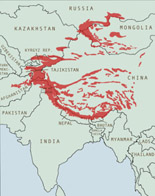
I was looking at some photos of the Himalayas the other day and thinking about how old that massive mountain range actually is. Himalayas, meaning in Sanskrit “the abode of snow”, are home to snow leopards across Nepal, Bhutan, Tibet, Pakistan, India and Afghanistan.

A quick look at Wikipedia had it sorted – the Himalayas were formed around 50 million years ago when the Indian landmass, which was a long way south of where it is today, shifted north and collided with Asia and forced a huge belt of mountains up into the air. Without this wonderful high and remote environment, we wouldn’t have snow leopards.

How the Himalayas were formed about 50 million years ago. Map by Wikipedia.

Surprisingly the Indian continent continues its northwards journey even today forcing the Himalayas to grow up even closer to the sky at a rate of around 5 cm per year. Not too sure what this Earth will be like in another 50 million years but the Himalayas will be even more huge. Hopefully snow leopards will still find a home there.

UN Environment Day 2010Today is World Environment Day 2010  – June 5th. This year’s UN theme  “Many Species – One Planet – One Future” made me reflect on just how important it is right now, this day, this month, this year, to focus our efforts on endangered wildlife before it’s too late.

This means a big effort to save the few remaining snow leopards in the wild.

In all range countries the news is not good. In some range countries the news is terrible. Poaching by the wealthy who enjoy hunting (Russia and some of the Central Asian states), decimation of prey species, herder retaliation killing of snow leopards in return for loss of livestock (India, Pakistan, Mongolia) and the continued demand for snow leopard parts for traditional medicines (Tibet, China).

Snow leopards, one particular species, an important part of our one planet, may not have a future for long unless we act quickly, consistently and with strong will.

Snow leopard at Melbourne Zoo. Photo Glenn McColl.

Snow leopard cub at Melbourne Zoo. Photo by Glenn McColl.

I know it’s hard for people living a long way away from snow leopard range countries to care about this animal. But we have to remember, we humans and all the planet’s wildlife are interconnected. I know it’s hard for people living a long way away from snow leopard range country to feel they can really help, but believe me, help you can. Spend a bit of time learning about this beautiful animal and its fragile environment. Encourage your kids to do a school project on them.

For your next holiday you can join a snow leopard ecotourism trip and lastly, but very importantly, give a gift of donation to the organisations that are working every day to save these magnificent cats. Donate for yourself, or as a gift to a loved one.

Celebrate Environment Day, help this big cat have a future. Let them live in the wild.

Mission to save snow leopard in Afghanistan. Photo Essay by Richard Fite in Time magazine.

Captured snow leopard in Afghanistan. Photo Essay by Richard Fite in Time magazine.

Readers may recall the story of the captured snow leopard in Afghanistan I wrote about in March. Richard Fite, the US veterinarian who advises for the U.S. Agricultural Department in northern Afghanistan, tried to save the cat, which had been captured for the illegal wildlife trade, but sadly she died.  Richard shared his hope with the world that at least many government officials and others in the country are now more aware of the need to help these rare animals and perhaps the remaining snow leopards will be treated better.

Time magazine recently released a photo essay of truly shocking photos taken by Richard of the poor cat. I hope, along with Richard and others in Afghanistan, that these photos will help in educating people of the need to actively protect these animals. I don’t believe it’s an over statement to say, that it will take a lot of effort, a real lot, to stop snow leopards becoming extinct in the wild in Afghanistan in our lifetime. May this poor snow leopard not have suffered and died in vain.

WWF Buy a goat, save a snow leopard.

WWF Buy a goat, save a snow leopard donation. Photo WWF website.

Sick of giving socks for presents? I know I’m sick of getting them. Well, not so much socks, not too many people give me those, but you know, those little gifts where people mean well, but you know that you’re never ever going to use the widget, gadget, thingumyjig.

If that’s you, then what about giving a goat? Why? Well, when you make a donation to the WWF, you can buy a goat, and get a personalized certificate to show your friend, family member, that you saved a snow leopard in their name.

How does it work? Snow leopards in Mongolia are going hungry because their natural prey, the natural food supply like wild argali goats, is being pushed out by domestic goats. So naturally they often hunt a domestic goat instead. When that happens the poor farmers and herders lose their only source of income and will often kill the snow leopard to stop it killing more livestock.

So WWF will give a herder in Mongolia a goat when he loses one and that stops him killing the cats and means they are protected and given a future. Great idea and everybody gets a wonderful present. Forget the socks – Buy a goat for some-one special today!

10th cat to be collared on amazing Snow Leopard Trust Mongolia project is female. Photo SLT.

The Snow Leopard Trust project in Mongolia has collared a tenth snow leopard and this time it’s a female which is great as the others have been male. Read about this amazing project, truly a world first in the number of cats collared and the huge amount of data being collected. Follow the cats on the Trust’s blog.

Yasmin the snow leopard showing off a beautiful tail. Photo by Jim Nicholson flickr.

Yasmin the snow leopard showing off a beautiful tail. Photo by Jim Nicholson on flickr.

I’ve been following the activities of the Snow Leopard Group on flickr for a few months and its worth bringing to readers’ attention. There are over 1200 members and thousands of photos of snow leopards taken in Zoos all around the world. Grab a good cup of tea or coffee and settle down for an enjoyable trip around the world with your favorite big cat. Here’s one pic from Jim Nicholson in the UK.

Snow leopard cubs from ex President of Kyrgyzstan's illegal private zoo die in Jalal-Abad Zoo.

Two snow leopard cubs confisctaed from ex President of Kyrgyzstan's illegal private zoo, died in Jalal-Abad Zoo this week. Map from Wikipedia.

Recently I posted a news story about the exPresident of Kyrgyzstan, Kurmanbek Bakiyev, having illegally kept a private zoo at his house. The zoo was discovered after he fled the country following weeks of violence and recent civil unrest. A number of endangered animals were found including two snow leopard cubs. Sadly the news has come through today that those two cubs died this week. A Russian news service said they were taken to a zoo in Jalal-Abad city, 240 km south of the capital, Bishkek. There have been no details about the deaths to date.


Video on the work of the Altai Foundation, which was founded in 2004 to protect Russia’s wilderness areas. It works with its US partner, the Altai Conservancy, to collect scientific data of wilderness areas and supports anti-poaching efforts to protect the last snow leopards.

Kids more interested in video games than nature

Only 9% of surveyed kids listed protecting the planet's animal life as a top priority. Photo AFP

This story fom AFP today. “Ten times more children around the world rank watching television and playing video games as more important to them than saving the environment, according to a survey released Wednesday.

Earth’s flora and fauna are disappearing 1,000 times faster than the natural extinction rate, but only nine percent of kids gave a top priority to protecting the planet’s animal life.

Many did not even know what is meant by “endangered species,” reported the survey, released by the UN Convention on Biodiversity.

“The survey confirms the alarming disconnect of our children with nature,” the Convention’s Executive Secretary, Ahmed Djoghlaf, said in a statement.

He called for “urgent action to close this growing gap between tomorrow’s citizens and their natural heritage.”

Sponsored by European aircraft giant Airbus, the survey was conducted among 10,000 five-to-18 year olds in 10 countries.

When asked which type of animal or plant they would most like to save, nine percent cited birds, 23 percent favoured reptiles, and 50 percent gave mammals top priority, with the snow leopard given as an example.”

While its good to see kids being aware of the snow leopard, the lack of interest and knowledge about nature in this generation could have big impacts for our natural environment in the future.

http://www.google.com/hostednews/afp/article/ALeqM5jS-uoaL5eHDSmqPG1Adkkm9MDjLw